Pavonine Quetzal

Pavonine Quetzal

Pharomachrus pavoninus

Silhouette: Jamie Whitehouse · PhyloPic

LCLeast ConcernNTVUENCR
Daily sighting probability <5% · Rare
at Manu National Park

In 3 days <5% in a week ~10%

55 Verified sightings at Manu National Park From 2019 to 2026
224 In all 4 parks
January Best month
☀️ Diurnal When it's spotted

About the Pavonine Quetzal

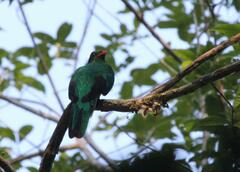
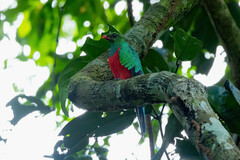
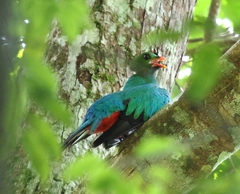
The pavonine quetzal (Pharomachrus pavoninus) is a species of bird in the family Trogonidae, the trogons. It is also known at the peacock trogon, red-billed train bearer, or viuda pico rojo in Spanish. The pavonine quetzal lives in the Neotropics, more specifically in the northern region of the Amazon basin, spreading from Colombia to Bolivia. The most notable characteristics helpful in identifying this bird are its plumage, red beak (male; females have grey bills), and its distribution - it is the only quetzal occupying the lowland rainforest east of the Andes.

The pavonine quetzal belongs to the Trogon family (Trogonidae) that falls in Trogoniformes, which differ from other birds primarily by the unique toe arrangement. As opposed to woodpeckers (family Picidae) who have the first and fourth toe facing backwards, trogons have the first and second toe positioned posteriorly, while the third and fourth remain anterior to the foot. Their toe arrangement makes them poorly suited for walking or hopping, and so trogons are most commonly seen flying or perched below canopy level. Some species, like the endangered resplendent quetzal have evolved some elaborate ornamental... Wikipedia →

Sounds

Call0:12

Brazil · 2026

© JAYRSON ARAUJO DE OLIVEIRA · XC1183692 · CC BY-NC-SA 4.0

Song0:13

Ecuador · 2025

© Manuel Sánchez-Nivicela · XC1163052 · CC BY-NC-ND 4.0

Song0:55

Colombia · 2022

© Frank Lambert · XC1141450 · CC BY-NC-ND 4.0

Global Distribution

Parks Where Found

# Park Country Daily sighting probability
1 Tambopata National Reserve 🇵🇪 Peru
<5%
2 Manu National Park 🇵🇪 Peru
<5%
3 Cuyabeno Wildlife Reserve 🇪🇨 Ecuador
<5%
4 Yasuní National Park 🇪🇨 Ecuador
<5%

Before you go

What are the chances of seeing a Pavonine Quetzal in Manu National Park?

Rare

Under 5% of wildlife watchers report a Pavonine Quetzal sighting in Manu National Park on a given day, based on 55 verified sightings from GBIF citizen-science data from 2019 to 2026. It is the 435th most-seen of the 641 birds we can rate there. Over three days the chance rises to under 5%, and over a week to about 10%, if each day is a fresh chance.

When is the best time to see a Pavonine Quetzal in Manu National Park?

January

In that month about 10% of wildlife watchers report a Pavonine Quetzal in Manu National Park on a given day, against under 5% in February to December, the lowest months.

What time of day is best to see a Pavonine Quetzal?

Between 10 am and 1 pm

Across all the parks we cover, that three-hour window holds the most Pavonine Quetzal sightings with a recorded time, and about 8 in 10 of them come between 6 am and 6 pm: it is a daytime animal.

Is Manu National Park the best place to see a Pavonine Quetzal?

Among the best

Of the 4 parks where we can rate Pavonine Quetzal sightings, Manu National Park ranks 2nd at under 5%, level with the leaders once rounded. The best odds are in Tambopata National Reserve (Peru, under 5%).

Which relatives of the Pavonine Quetzal live in Manu National Park?

Same family: Trogonidae

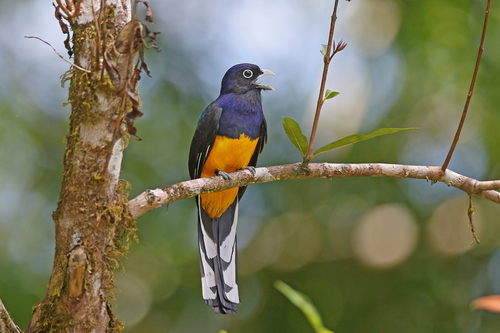
The closest relatives of the Pavonine Quetzal that you can see in Manu National Park (family Trogonidae, Trogons) are Black-tailed Trogon (about 30%), Blue-crowned Trogon (about 20%) and Collared Trogon (about 10%), with each one's daily chance of a sighting.

Where does the Pavonine Quetzal sighting chance come from?

GBIF citizen-science records

It is estimated from how often the Pavonine Quetzal is recorded against all the birds logged in Manu National Park (55 verified sightings from 2019 to 2026), calibrated against known sighting rates. Figures are rounded to the nearest 10% because citizen-science data supports honest approximations, not decimals, and months with records from fewer than five people show "—". How it works.

← Back to Manu National Park