Purús Jacamar

Purús Jacamar

Galbalcyrhynchus purusianus

Silhouette: FJDegrange · PhyloPic

LCLeast ConcernNTVUENCR
Daily sighting probability ~10% · With luck
at Manu National Park

In 3 days ~20% in a week ~30%

246 Verified sightings at Manu National Park From 2019 to 2026
277 In all 2 parks
October Best month
☀️ Diurnal When it's spotted

About the Purús Jacamar

The Purus jacamar (Galbalcyrhynchus purusianus) is a species of bird in the family Galbulidae. It is found in Bolivia, Brazil, and Peru. The Purus jacamar shares genus Galbalcyrhynchus with the white-eared jacamar (G. leucotis). They were originally treated a separate species, then as conspecific ("chestnut jacamar"), but are now understood to be separate species. The Purus jacamar is monotypic.

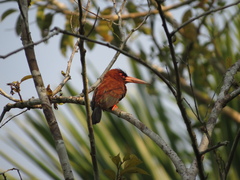
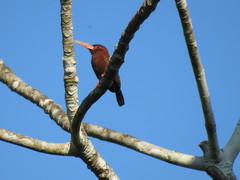
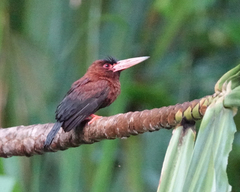
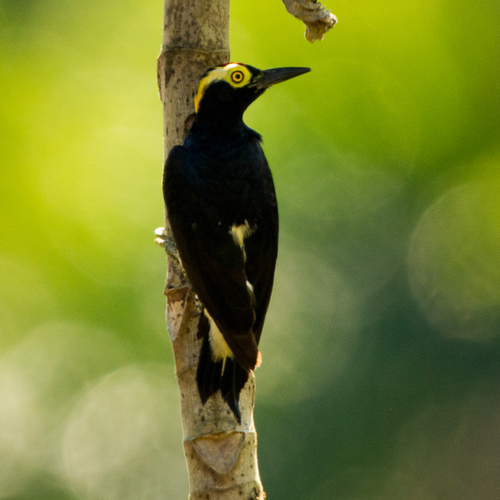
The Purus jacamar is 20 cm (7.9 in) long and weighs 50 g (1.8 oz). It is stouter than many jacamars, and has a more robust bill. It is almost entirely chestnut, with dark bronzy forehead, crown, wings, and tail. The juvenile is paler and its bill is shorter.

The Purus jacamar is found in the upper Amazon Basin of eastern Peru, western Brazil, and northern Bolivia. In this humid region, it inhabits terra firme and várzea forest, both primary and secondary. It prefers edges such as along waterways and oxbow lakes.

The Purus jacamar preys on insects, with Hymenoptera (bees and wasps) and Isoptera (termites) favored. It perches at mid- to upper canopy height singly or in small groups and... Wikipedia →

Sounds

Call0:31

Bolivia · 2021

© Jacob Wijpkema · XC685699 · CC BY-NC-SA 4.0

Song1:01

Brazil · 2019

© Felipe Arantes · XC475938 · CC BY-NC-SA 4.0

Song?0:27

Peru · 2009

© Andrew Spencer · XC41691 · CC BY-NC-ND 2.5

Global Distribution

Parks Where Found

# Park Country Daily sighting probability
1 Manu National Park 🇵🇪 Peru
~10%
2 Tambopata National Reserve 🇵🇪 Peru
<5%

Before you go

What are the chances of seeing a Purús Jacamar in Manu National Park?

With luck

About 10% of wildlife watchers report a Purús Jacamar sighting in Manu National Park on a given day, based on 246 verified sightings from GBIF citizen-science data from 2019 to 2026. It is the 266th most-seen of the 641 birds we can rate there. Over three days the chance rises to about 20%, and over a week to about 30%, if each day is a fresh chance.

When is the best time to see a Purús Jacamar in Manu National Park?

February, May, July and September–November

In those months about 10% of wildlife watchers report a Purús Jacamar in Manu National Park on a given day, against under 5% in March–April, June, August and December–January, the lowest months.

What time of day is best to see a Purús Jacamar?

Between 8 and 11 am

Across all the parks we cover, that three-hour window holds the most Purús Jacamar sightings with a recorded time, and about 9 in 10 of them come between 6 am and 6 pm: it is a daytime animal.

Is Manu National Park the best place to see a Purús Jacamar?

Yes

Of the 2 parks where we can rate Purús Jacamar sightings, Manu National Park has the highest daily chance: about 10%. Next come Tambopata National Reserve (Peru, under 5%).

Where does the Purús Jacamar sighting chance come from?

GBIF citizen-science records

It is estimated from how often the Purús Jacamar is recorded against all the birds logged in Manu National Park (246 verified sightings from 2019 to 2026), calibrated against known sighting rates. Figures are rounded to the nearest 10% because citizen-science data supports honest approximations, not decimals, and months with records from fewer than five people show "—". How it works.

← Back to Manu National Park