Scarlet-hooded Barbet

Scarlet-hooded Barbet

Eubucco tucinkae

Silhouette: Sheatherius · PhyloPic

LCLeast ConcernNTVUENCR
Daily sighting probability ~10% · With luck
at Manu National Park

In 3 days ~20% in a week ~40%

274 Verified sightings at Manu National Park From 2019 to 2026
358 In all 2 parks
March Best month
☀️ Diurnal When it's spotted

About the Scarlet-hooded Barbet

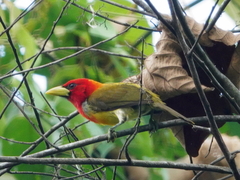
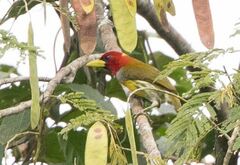
The scarlet-hooded barbet (Eubucco tucinkae) is a species of bird in the family Capitonidae, the New World barbets. It is found in Bolivia, Brazil, and Peru. The scarlet-hooded barbet is monotypic. At times it was thought to be closely related to the red-headed barbet (Eubucco bourceirii) and possibly conspecific, but it is treated now as a full species with no close relatives even within its genus.

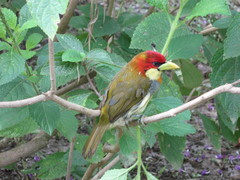
The scarlet-hooded barbet is approximately 17 cm (6.7 in) long and weighs 40 to 44 g (1.4 to 1.6 oz). The male's entire head, throat, and upper mantle are red but for a bit of black around the eye and bill. The rest of the upperparts are green. Its lower breast is orange and yellow; it has a gray patch on the side and the flanks are streaked with olive. Most of the female's head is also red, but the throat is yellow. It has an orange band on the upper breast and the rest of the underparts are like the male's.

The scarlet-hooded barbet is found in the upper Amazon Basin where eastern Peru, western Brazil, and a bit of western Bolivia meet. More than half of its range is in Peru. It inhabits bamboo and Heleconia... Wikipedia →

Sounds

Song0:22

Brazil · 2019

© Felipe Arantes · XC475699 · CC BY-NC-SA 4.0

Call0:45

Peru

© Paul Donahue · XC20925 · CC BY-NC-ND 2.5

Song0:23

Brazil · 2019

© GABRIEL LEITE · XC474839 · CC BY-NC-SA 4.0

Global Distribution

Parks Where Found

# Park Country Daily sighting probability
1 Manu National Park 🇵🇪 Peru
~10%
2 Tambopata National Reserve 🇵🇪 Peru
<5%

Before you go

What are the chances of seeing a Scarlet-hooded Barbet in Manu National Park?

With luck

About 10% of wildlife watchers report a Scarlet-hooded Barbet sighting in Manu National Park on a given day, based on 274 verified sightings from GBIF citizen-science data from 2019 to 2026. It is the 228th most-seen of the 641 birds we can rate there. Over three days the chance rises to about 20%, and over a week to about 40%, if each day is a fresh chance.

When is the best time to see a Scarlet-hooded Barbet in Manu National Park?

January, March and May–November

In those months about 10% of wildlife watchers report a Scarlet-hooded Barbet in Manu National Park on a given day, against under 5% in February, April and December, the lowest months.

What time of day is best to see a Scarlet-hooded Barbet?

Between 7 and 10 am

Across all the parks we cover, that three-hour window holds the most Scarlet-hooded Barbet sightings with a recorded time, and about 9 in 10 of them come between 6 am and 6 pm: it is a daytime animal.

Is Manu National Park the best place to see a Scarlet-hooded Barbet?

Yes

Of the 2 parks where we can rate Scarlet-hooded Barbet sightings, Manu National Park has the highest daily chance: about 10%. Next come Tambopata National Reserve (Peru, under 5%).

Where does the Scarlet-hooded Barbet sighting chance come from?

GBIF citizen-science records

It is estimated from how often the Scarlet-hooded Barbet is recorded against all the birds logged in Manu National Park (274 verified sightings from 2019 to 2026), calibrated against known sighting rates. Figures are rounded to the nearest 10% because citizen-science data supports honest approximations, not decimals, and months with records from fewer than five people show "—". How it works.

← Back to Manu National Park