
Twist-neck Turtle

Twist-neck Turtle

Platemys platycephala

Silhouette: SeismicShrimp · PhyloPic

Daily sighting probability ~20% · Possible
at Manu National Park

In 3 days ~50% in a week ~80%

26 Verified sightings at Manu National Park From 2019 to 2026
31 In all 2 parks
February Best month
☀️🌙 Day & Night When it's spotted

About the Twist-neck Turtle

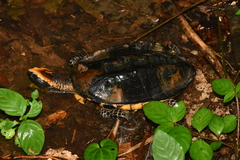
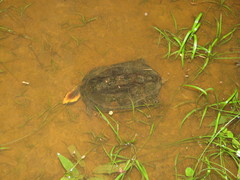
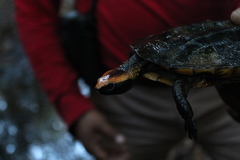
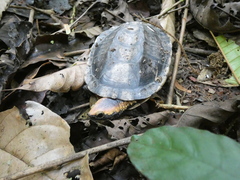
The twist-necked turtle (Platemys platycephala), also known as the flat-headed turtle, is distributed widely across northern South America. Twist-necked turtles have extremely flat shells that help them hide from predators under rocks and debris. When threatened, this turtle withdraws by twisting its head into its shell. P. platycephala is the only species of the genus Platemys and occurs in northern and central South America. Platemys platycephala means "flat turtle, flat-head" and accurately describes the structure of the head and shell. This species inhabits shallow creek beds and frequently forages on the floor of the Amazon rainforest for insects, amphibians, and mollusks. Camouflage, head and body shape, and advanced sexual anatomy allow this species of turtle to effectively populate much of South America. Mating occurs during rainy months (March–December) and egg deposit occurs during dry months (January–March). Males have been known to behave aggressively towards females during copulation by squirting water from nostrils and biting. A few genomic studies show mosaicism exists among populations of the twist-necked turtle in Suriname. In other words, diploid and triploid levels exist among individuals at this particular location. No threats have been reported for this species and the International Union for Conservation of Nature does not have a current listing. Lack of human consumption due to the species' small size and its wide range explain why scientists are not concerned about this turtle species. Wikipedia →

Global Distribution

Parks Where Found

# Park Country Daily sighting probability
1 Manu National Park 🇵🇪 Peru
~20%
2 Tambopata National Reserve 🇵🇪 Peru
~10%

Zoos & Centres Where Found

# Zoo / Centre Country
1 Shedd Aquarium 🇺🇸 United States In captivity
2 Zlín-Lešná Zoo 🇨🇿 Czechia In captivity
3 Zoo Miami 🇺🇸 United States In captivity
4 Wrocław Zoological Garden 🇵🇱 Poland In captivity
5 The Living Planet Aquarium 🇺🇸 United States In captivity
6 Africarium 🇵🇱 Poland In captivity
7 Downtown Aquarium, Houston 🇺🇸 United States In captivity
8 Reptielenzoo Iguana 🇳🇱 Netherlands In captivity
9 terrarium ogrodu zoologicznego we Wrocławiu 🇵🇱 Poland In captivity

Before you go

What are the chances of seeing a Twist-neck Turtle in Manu National Park?

Possible

About 20% of wildlife watchers report a Twist-neck Turtle sighting in Manu National Park on a given day, based on 26 verified sightings from GBIF citizen-science data from 2019 to 2026. It is the 15th most-seen of the 56 reptiles we can rate there. Over three days the chance rises to about 50%, and over a week to about 80%, if each day is a fresh chance.

When is the best time to see a Twist-neck Turtle in Manu National Park?

February

In that month about 30% of wildlife watchers report a Twist-neck Turtle in Manu National Park on a given day, against under 5% in March–April and July–September, the lowest months. That is one of Manu National Park's wettest months, with about 290 mm of rain against 60 mm in August.

What time of day is best to see a Twist-neck Turtle?

Between 8 and 11 am

Across all the parks we cover, that three-hour window holds the most Twist-neck Turtle sightings with a recorded time, and about 7 in 10 of them come between 6 am and 6 pm: it is seen both by day and at night.

Is Manu National Park the best place to see a Twist-neck Turtle?

Yes

Of the 2 parks where we can rate Twist-neck Turtle sightings, Manu National Park has the highest daily chance: about 20%. Next come Tambopata National Reserve (Peru, about 10%).

Where does the Twist-neck Turtle sighting chance come from?

GBIF citizen-science records

It is estimated from how often the Twist-neck Turtle is recorded against all the reptiles logged in Manu National Park (26 verified sightings from 2019 to 2026), calibrated against known sighting rates. Figures are rounded to the nearest 10% because citizen-science data supports honest approximations, not decimals, and months with records from fewer than five people show "—". How it works.

← Back to Manu National Park