Charles Myers Anole

Charles Myers Anole

Anolis charlesmyersi

Silhouette: Sarah Werning · PhyloPic

LCLeast ConcernNTVUENCR
Daily sighting probability ~10% · With luck
at Marino Ballena National Park

In 3 days ~40% in a week ~70%

7 Verified sightings at Marino Ballena National Park From 2019 to 2026
19 In all 3 parks
March Best month
☀️ Diurnal When it's spotted

About the Charles Myers Anole

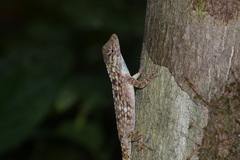
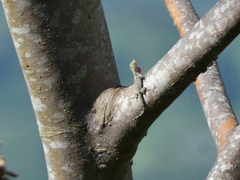
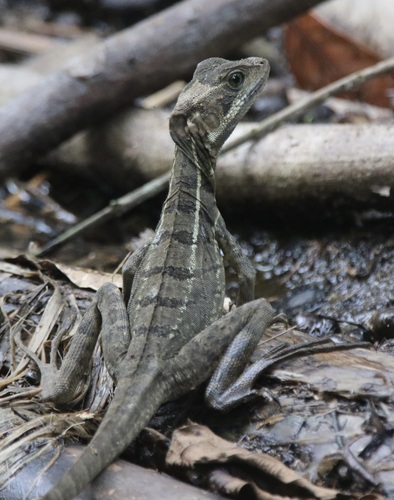
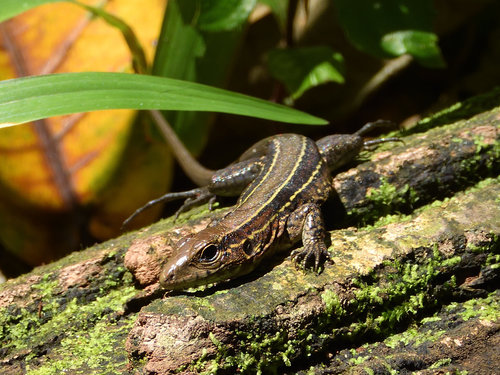
Anolis charlesmyersi is a species of lizard in the family Dactyloidae. The species is native to Central America. The specific name, charlesmyersi, is in honor of American herpetologist Charles William Myers. A. charlesmyersi is found in Costa Rica and Panama.

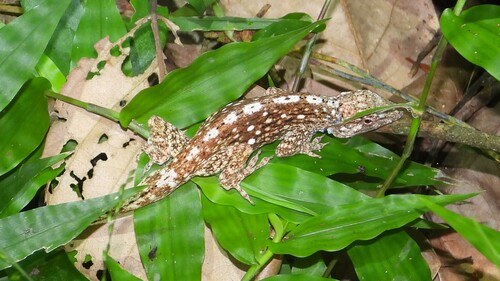
The preferred natural habitat of A. charlesmyersi is forest. A. charlesmyersi is medium-sized for its genus. Adults may attain a snout-to-vent length (SVL) of about 7.5 cm (3.0 in). The tail is relatively short, 1 – 1.5 times SVL. The hind legs are very short for the genus. The dewlap is brick red, with rows of white spots.

A. charlesmyersi is oviparous. Köhler G (2010). "A revision of the Central American species related to Anolis pentaprion with the resurrection of A. beckeri and the description of a new species (Squamata: Polychrotidae)". Zootaxa (in English and Spanish). 2354: 1–18. doi:10.11646/zootaxa.2354.1.1. (Anolis charlesmyersi, new species)

Nicholson KE; Crother BI; Guyer C; Savage JM (2012). "It is time for a new classification of anoles (Squamata: Dactyloidae)". Zootaxa. 3477: 1–108. Bibcode... Wikipedia →
Global Distribution

Parks Where Found

# Park Country Daily sighting probability
1 Marino Ballena National Park 🇨🇷 Costa Rica
~10%
2 Manuel Antonio National Park 🇨🇷 Costa Rica
~10%
3 Corcovado National Park 🇨🇷 Costa Rica
~10%

Before you go

What are the chances of seeing a Charles Myers Anole in Marino Ballena National Park?

With luck

About 10% of wildlife watchers report a Charles Myers Anole sighting in Marino Ballena National Park on a given day, based on 7 verified sightings from GBIF citizen-science data from 2019 to 2026. It is the 14th most-seen of the 17 reptiles we can rate there. Over three days the chance rises to about 40%, and over a week to about 70%, if each day is a fresh chance.

When is the best time to see a Charles Myers Anole in Marino Ballena National Park?

March

In that month about 30% of wildlife watchers report a Charles Myers Anole in Marino Ballena National Park on a given day, against under 5% in February, April, July–September and November–December, the lowest months. That is one of Marino Ballena National Park's driest months, with about 110 mm of rain against 920 mm in October.

What time of day is best to see a Charles Myers Anole?

Between 9 am and noon

Across all the parks we cover, that three-hour window holds the most Charles Myers Anole sightings with a recorded time, and about 8 in 10 of them come between 6 am and 6 pm: it is a daytime animal.

Is Marino Ballena National Park the best place to see a Charles Myers Anole?

Yes

Of the 3 parks where we can rate Charles Myers Anole sightings, Marino Ballena National Park has the highest daily chance: about 10%. Next come Manuel Antonio National Park (Costa Rica, about 10%) and Corcovado National Park (Costa Rica, about 10%).

Which relatives of the Charles Myers Anole live in Marino Ballena National Park?

Same genus: Anolis

The closest relatives of the Charles Myers Anole that you can see in Marino Ballena National Park (genus Anolis, Anoles) are Border Anole (about 40%) and Many-scaled Anole (about 20%), with each one's daily chance of a sighting.

Where does the Charles Myers Anole sighting chance come from?

GBIF citizen-science records

It is estimated from how often the Charles Myers Anole is recorded against all the reptiles logged in Marino Ballena National Park (7 verified sightings from 2019 to 2026), calibrated against known sighting rates. Figures are rounded to the nearest 10% because citizen-science data supports honest approximations, not decimals, and months with records from fewer than five people show "—". How it works.

← Back to Marino Ballena National Park