
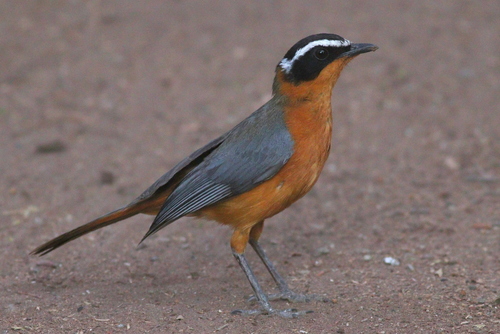
African Blue Flycatcher

African Blue Flycatcher

Elminia longicauda

Silhouette: Sheatherius · PhyloPic

LCLeast ConcernNTVUENCR
Daily sighting probability <5% · Rare
at Masai Mara National Reserve

In 3 days ~10% in a week ~30%

130 Verified sightings at Masai Mara National Reserve From 2019 to 2026
1,385 In all 8 parks
December Best month
☀️ Diurnal When it's spotted

About the African Blue Flycatcher

The African blue flycatcher or blue-crested flycatcher (Elminia longicauda) is a species of bird in the family Stenostiridae from western and central Sub-Saharan Africa. The African blue flycatcher is a dainty, pale, bright blue flycatcher with a short crest and long tail. The entire upper parts and tail are bright blue, shading between blue and cyan, with black lores and black flight feathers edged with blue, the underparts are greyish blue fading to whitish on the belly. The bill and legs are black. Juveniles are duller with faint greyish spotting on the head and wing coverts. It measures 15–18 cm (5.9–7.1 in) in length and weighs 7–12 g (0.25–0.42 oz).

The song of the African blue flycatcher is a series of slow, rather random and tuneless sibilant notes strung together in no particular order. Call is a quiet "tsip". The African blue flycatcher occurs from Mauritania, Senegal and Gambia east discontinuously to Kenya and south through the eastern Democratic Republic of Congo to northern Angola.

Its natural habitats are moist lowland forests, mangrove forests, gallery forest, montane forests, gardens, wooded farmland and... Wikipedia →

Sounds

Song0:56

Senegal · 2024

© Frank Lambert · XC1041364 · CC BY-NC-ND 4.0

Call0:53

Senegal · 2018

© Bram Piot · XC405127 · CC BY-NC-SA 4.0

Recording0:21

Ghana · 2022

© Phil Gregory · XC718068 · CC BY-NC-SA 4.0

Global Distribution

Parks Where Found

# Park Country Daily sighting probability
1 Kibale National Park 🇺🇬 Uganda
~40%
2 Bwindi Impenetrable National Park 🇺🇬 Uganda
~20%
3 Niokolo-Koba National Park 🇸🇳 Senegal
~10%
4 Queen Elizabeth National Park 🇺🇬 Uganda
~10%
5 Masai Mara National Reserve 🇰🇪 Kenya
<5%
6 Semuliki National Park 🇺🇬 Uganda
<5%
7 Virunga National Park 🇨🇩 Democratic Republic of the Congo
<5%
8 Murchison Falls National Park 🇺🇬 Uganda
<5%

Cities Where Found

# City Country Daily sighting probability
1 Yaoundé 🇨🇲 Cameroon
~40%
2 Abuja 🇳🇬 Nigeria
~10%
3 Kampala 🇺🇬 Uganda
<5%

Before you go

What are the chances of seeing an African Blue Flycatcher in Masai Mara National Reserve?

Rare

Under 5% of wildlife watchers report an African Blue Flycatcher sighting in Masai Mara National Reserve on a given day, based on 130 verified sightings from GBIF citizen-science data from 2019 to 2026. It is the 215th most-seen of the 398 birds we can rate there. Over three days the chance rises to about 10%, and over a week to about 30%, if each day is a fresh chance.

When is the best time to see an African Blue Flycatcher in Masai Mara National Reserve?

February, April, October and December

In those months about 10% of wildlife watchers report an African Blue Flycatcher in Masai Mara National Reserve on a given day, against under 5% in January, March, May–September and November, the lowest months.

What time of day is best to see an African Blue Flycatcher?

Between 2 and 5 pm

Across all the parks we cover, that three-hour window holds the most African Blue Flycatcher sightings with a recorded time, and about 8 in 10 of them come between 6 am and 6 pm: it is a daytime animal.

Which relatives of the African Blue Flycatcher live in Masai Mara National Reserve?

Same order: Passeriformes

The closest relatives of the African Blue Flycatcher that you can see in Masai Mara National Reserve (order Passeriformes, Perching Birds) are Superb Starling (about 60%), Common Bulbul (about 60%) and Rüppell's Glossy-starling (about 50%), with each one's daily chance of a sighting.

Where does the African Blue Flycatcher sighting chance come from?

GBIF citizen-science records

It is estimated from how often the African Blue Flycatcher is recorded against all the birds logged in Masai Mara National Reserve (130 verified sightings from 2019 to 2026), calibrated against known sighting rates. Figures are rounded to the nearest 10% because citizen-science data supports honest approximations, not decimals, and months with records from fewer than five people show "—". How it works.

← Back to Masai Mara National Reserve