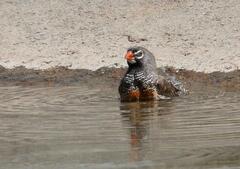

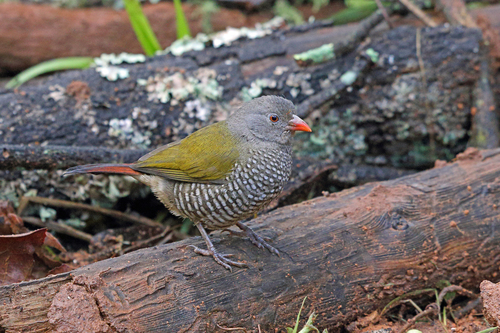
Black-faced Quailfinch

Black-faced Quailfinch

Ortygospiza atricollis

Silhouette: Sheatherius · PhyloPic

LCLeast ConcernNTVUENCR
Daily sighting probability ~10% · With luck
at Masai Mara National Reserve

In 3 days ~30% in a week ~50%

353 Verified sightings at Masai Mara National Reserve From 2019 to 2026
1,359 In all 16 parks
April Best month
☀️ Diurnal When it's spotted

About the Black-faced Quailfinch

The black-faced quailfinch (Ortygospiza atricollis atricollis), is a common subspecies of estrildid finch found in western and central of Africa. Some taxonomists consider it to be conspecific with the African quailfinch, others consider all three species to be conspecific.

BirdLife Species Factsheet Quail Finch/Black-faced quailfinch - Species text in The Atlas of Southern African Birds. African Quailfinch (Ortygospiza atricollis) - Species page in Handbook of the Birds of the World Alive Wikipedia →

Sounds

Call0:17

Zambia · 2022

© Dries Van de Loock · XC758508 · CC BY-NC-ND 4.0

Flight call0:12

South Africa · 2021

© Lynette Rudman · XC648492 · CC BY-NC-SA 4.0

Song0:49

Mozambique · 2016

© Jude Allport · XC316699 · CC BY-NC-SA 4.0

Global Distribution

Parks Where Found

# Park Country Daily sighting probability
1 Nairobi National Park 🇰🇪 Kenya
~20%
2 Masai Mara National Reserve 🇰🇪 Kenya
~10%
3 Kafue National Park 🇿🇲 Zambia
~10%
4 Kidepo Valley National Park 🇺🇬 Uganda
~10%
5 Queen Elizabeth National Park 🇺🇬 Uganda
~10%
6 Serengeti National Park 🇹🇿 Tanzania
~10%
7 Ngorongoro Conservation Area 🇹🇿 Tanzania
<5%
8 Murchison Falls National Park 🇺🇬 Uganda
<5%
9 Hwange National Park 🇿🇼 Zimbabwe
<5%
10 Amboseli National Park 🇰🇪 Kenya
<5%
11 Samburu National Reserve 🇰🇪 Kenya
<5%
12 Moremi Game Reserve 🇧🇼 Botswana
<5%
13 Kruger National Park 🇿🇦 South Africa
<5%
14 Lake Nakuru National Park 🇰🇪 Kenya
<5%
15 Etosha National Park 🇳🇦 Namibia
<5%
16 Chobe National Park 🇧🇼 Botswana
<5%

Zoos & Centres Where Found

# Zoo / Centre Country
1 Zoo Pilsen 🇨🇿 Czechia In captivity

Before you go

What are the chances of seeing a Black-faced Quailfinch in Masai Mara National Reserve?

With luck

About 10% of wildlife watchers report a Black-faced Quailfinch sighting in Masai Mara National Reserve on a given day, based on 353 verified sightings from GBIF citizen-science data from 2019 to 2026. It is the 132nd most-seen of the 398 birds we can rate there. Over three days the chance rises to about 30%, and over a week to about 50%, if each day is a fresh chance.

When is the best time to see a Black-faced Quailfinch in Masai Mara National Reserve?

April

In that month about 30% of wildlife watchers report a Black-faced Quailfinch in Masai Mara National Reserve on a given day, against under 5% in August and September, the lowest months. That is one of Masai Mara National Reserve's wettest months, with about 140 mm of rain against 15 mm in July.

What time of day is best to see a Black-faced Quailfinch?

Between 10 am and 1 pm

Across all the parks we cover, that three-hour window holds the most Black-faced Quailfinch sightings with a recorded time, and about 9 in 10 of them come between 6 am and 6 pm: it is a daytime animal.

Is Masai Mara National Reserve the best place to see a Black-faced Quailfinch?

2nd of 16

Of the 16 parks where we can rate Black-faced Quailfinch sightings, Masai Mara National Reserve ranks 2nd at about 10%. The best odds are in Nairobi National Park (Kenya, about 20%).

Which relatives of the Black-faced Quailfinch live in Masai Mara National Reserve?

Same family: Estrildidae

The closest relatives of the Black-faced Quailfinch that you can see in Masai Mara National Reserve (family Estrildidae, Waxbills and Allies) are Purple Grenadier (about 40%), Red-cheeked Cordon-bleu (about 20%) and Red-billed Firefinch (about 10%), with each one's daily chance of a sighting.

Where does the Black-faced Quailfinch sighting chance come from?

GBIF citizen-science records

It is estimated from how often the Black-faced Quailfinch is recorded against all the birds logged in Masai Mara National Reserve (353 verified sightings from 2019 to 2026), calibrated against known sighting rates. Figures are rounded to the nearest 10% because citizen-science data supports honest approximations, not decimals, and months with records from fewer than five people show "—". How it works.

← Back to Masai Mara National Reserve