
Grey Kestrel

Grey Kestrel

Falco ardosiaceus

Silhouette: Shyamal · PhyloPic

LCLeast ConcernNTVUENCR
Daily sighting probability ~20% · Possible
at Masai Mara National Reserve

In 3 days ~50% in a week ~80%

559 Verified sightings at Masai Mara National Reserve From 2019 to 2026
2,949 In all 18 parks
March Best month
☀️ Diurnal When it's spotted

About the Grey Kestrel

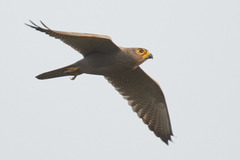
The grey kestrel (Falco ardosiaceus) is an African bird of prey belonging to the falcon family Falconidae. Its closest relatives are the banded kestrel and Dickinson's kestrel and the three are sometimes placed in the subgenus Dissodectes.

It is a fairly small, stocky kestrel with a large, flat-topped head and fairly short wings that don't reach past the tip of the tail when at rest. It is 28–33 cm long with a wingspan of 58–72 cm and a weight of up to 300 grams. The female is 4-11% larger and 5-11% heavier than the male. The plumage of the adult is uniformly dark grey apart from darker wingtips, faint dark streaking on the body and slightly barred flight feathers. The feet and cere are yellow and there is bare yellow skin around the eye. The most similar species is the sooty falcon which has a more rounded head, long wings extending past the tail and less yellow around the eye.

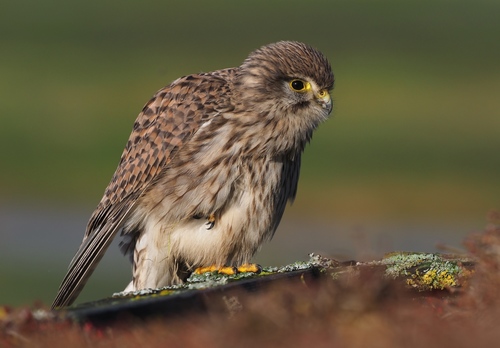
Juvenile grey kestrels are browner than the adults with a greenish cere and greenish around the eye. Juvenile Dickinson's kestrels are similar but have a barred tail and a more strongly barred underwing. The grey kestrel is generally silent outside the breeding season but has a shrill, chattering... Wikipedia →

Sounds

Call0:30

Senegal · 2019

© Bram Piot · XC476002 · CC BY-NC-SA 4.0

Global Distribution

Parks Where Found

# Park Country Daily sighting probability
1 Murchison Falls National Park 🇺🇬 Uganda
~50%
2 Niokolo-Koba National Park 🇸🇳 Senegal
~40%
3 Ruaha National Park 🇹🇿 Tanzania
~40%
4 Queen Elizabeth National Park 🇺🇬 Uganda
~30%
5 Kidepo Valley National Park 🇺🇬 Uganda
~20%
6 Masai Mara National Reserve 🇰🇪 Kenya
~20%
7 Lake Mburo National Park 🇺🇬 Uganda
~10%
8 Akagera National Park 🇷🇼 Rwanda
~10%
9 Tarangire National Park 🇹🇿 Tanzania
~10%
10 Serengeti National Park 🇹🇿 Tanzania
~10%
11 Mikumi National Park 🇹🇿 Tanzania
~10%
12 Lake Manyara National Park 🇹🇿 Tanzania
<5%
13 Virunga National Park 🇨🇩 Democratic Republic of the Congo
<5%
14 Kibale National Park 🇺🇬 Uganda
<5%
15 Semuliki National Park 🇺🇬 Uganda
<5%
16 Ngorongoro Conservation Area 🇹🇿 Tanzania
<5%
17 Bwindi Impenetrable National Park 🇺🇬 Uganda
<5%
18 Lake Nakuru National Park 🇰🇪 Kenya
<5%

Cities Where Found

# City Country Daily sighting probability
1 Ouagadougou 🇧🇫 Burkina Faso
~20%
2 Abuja 🇳🇬 Nigeria
~10%
3 Accra 🇬🇭 Ghana
<5%
4 Kampala 🇺🇬 Uganda
<5%
5 Serrekunda 🇬🇲 Gambia
<5%
6 Kigali 🇷🇼 Rwanda
<5%

Before you go

What are the chances of seeing a Grey Kestrel in Masai Mara National Reserve?

Possible

About 20% of wildlife watchers report a Grey Kestrel sighting in Masai Mara National Reserve on a given day, based on 559 verified sightings from GBIF citizen-science data from 2019 to 2026. It is the 73rd most-seen of the 398 birds we can rate there. Over three days the chance rises to about 50%, and over a week to about 80%, if each day is a fresh chance.

When is the best time to see a Grey Kestrel in Masai Mara National Reserve?

December to March

In those months about 30% of wildlife watchers report a Grey Kestrel in Masai Mara National Reserve on a given day, against about 10% in May–June and August, the lowest months.

What time of day is best to see a Grey Kestrel?

Between 8 and 11 am

Across all the parks we cover, that three-hour window holds the most Grey Kestrel sightings with a recorded time, and about 9 in 10 of them come between 6 am and 6 pm: it is a daytime animal.

Which relatives of the Grey Kestrel live in Masai Mara National Reserve?

Same genus: Falco

The closest relatives of the Grey Kestrel that you can see in Masai Mara National Reserve (genus Falco, Typical Falcons) are Lesser Kestrel (about 10%) and Common Kestrel (about 10%), with each one's daily chance of a sighting.

Where does the Grey Kestrel sighting chance come from?

GBIF citizen-science records

It is estimated from how often the Grey Kestrel is recorded against all the birds logged in Masai Mara National Reserve (559 verified sightings from 2019 to 2026), calibrated against known sighting rates. Figures are rounded to the nearest 10% because citizen-science data supports honest approximations, not decimals, and months with records from fewer than five people show "—". How it works.

← Back to Masai Mara National Reserve