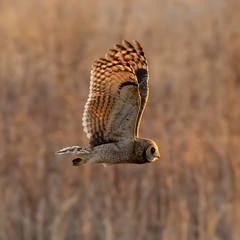
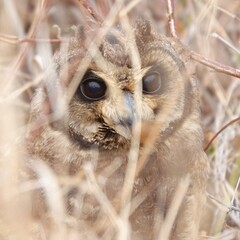
Marsh Owl

Marsh Owl

Asio capensis

Silhouette: Ferran Sayol · PhyloPic

LCLeast ConcernNTVUENCR
Daily sighting probability <5% · Rare
at Masai Mara National Reserve

In 3 days <5%

22 Verified sightings at Masai Mara National Reserve From 2019 to 2026
187 In all 9 parks
April Best month
🌅 Crepuscular When it's spotted

About the Marsh Owl

The marsh owl (Asio capensis) is a medium to large species of owl in the family Strigidae. Medium-sized, dark brown with a pumpkin-shaped head with small 'ear' tufts. The facial disc is pale buff, with a distinct dark brown rim with buff speckles. There is a dark brown area around the eyes, which are also dark brown. Its ear-tufts are earth-brown and quite small, often not visible, and set near the centre of the forehead. The tail is dark brown, barred pale buff with a whitish tip. Tarsi are feathered pale tawny-buff and toes are covered with pale buffish plumes, leaving the dark brown tips bare. Claws are blackish.

Males are generally paler than females, and there is some individual variation in tone. Length is 31–38 cm, wing length is 284–380mm, tail length is 132–186mm, and weight is 225–485g. The marsh owl's habitat preference is open grassland, marshlands and short scrub, typically near marshy grounds, vleis or dams. Marsh owls prefer to nest on the ground and they have also been observed leaving certain areas during drought-stricken times. Their preferred habitat tends to be vulnerable to destruction due to agriculture or overgrazing. Wikipedia →

Sounds

Call0:32

South Africa · 2022

© Tony Archer · XC713851 · CC BY-NC-SA 4.0

Song0:55

Morocco · 2014

© Thijs Fijen · XC181902 · CC BY-NC-SA 4.0

Call0:22

Morocco · 2016

© Jacob Lotz · XC315989 · CC BY-NC-SA 4.0

Global Distribution

Parks Where Found

# Park Country Daily sighting probability
1 West Coast National Park 🇿🇦 South Africa
<5%
2 Nairobi National Park 🇰🇪 Kenya
<5%
3 Moremi Game Reserve 🇧🇼 Botswana
<5%
4 Hwange National Park 🇿🇼 Zimbabwe
<5%
5 Amboseli National Park 🇰🇪 Kenya
<5%
6 Masai Mara National Reserve 🇰🇪 Kenya
<5%
7 Serengeti National Park 🇹🇿 Tanzania
<5%
8 Chobe National Park 🇧🇼 Botswana
<5%
9 Kruger National Park 🇿🇦 South Africa
<5%

Cities Where Found

# City Country Daily sighting probability
1 Harare 🇿🇼 Zimbabwe
<5%
2 Johannesburg 🇿🇦 South Africa
<5%

Zoos & Centres Where Found

# Zoo / Centre Country
1 Dullstroom Bird Of Prey & Rehabilitation Centre 🇿🇦 South Africa In captivity

Before you go

What are the chances of seeing a Marsh Owl in Masai Mara National Reserve?

Rare

Under 5% of wildlife watchers report a Marsh Owl sighting in Masai Mara National Reserve on a given day, based on 22 verified sightings from GBIF citizen-science data from 2019 to 2026. It is the 355th most-seen of the 398 birds we can rate there. Over three days the chance rises to under 5%, if each day is a fresh chance.

When is the best time to see a Marsh Owl in Masai Mara National Reserve?

Any time of year

In every month with enough records, under 5% of wildlife watchers report a Marsh Owl in Masai Mara National Reserve on a given day, so our monthly data shows no clear season.

What time of day is best to see a Marsh Owl?

Between 5 and 8 pm

Across all the parks we cover, that three-hour window holds the most Marsh Owl sightings with a recorded time, and about 6 in 10 of them come between 6 am and 6 pm: it is most active around dawn and dusk.

Is Masai Mara National Reserve the best place to see a Marsh Owl?

Among the best

Of the 9 parks where we can rate Marsh Owl sightings, Masai Mara National Reserve ranks 6th at under 5%, level with the leaders once rounded. The best odds are in West Coast National Park (South Africa, under 5%), Nairobi National Park (Kenya, under 5%) and Moremi Game Reserve (Botswana, under 5%).

Where does the Marsh Owl sighting chance come from?

GBIF citizen-science records

It is estimated from how often the Marsh Owl is recorded against all the birds logged in Masai Mara National Reserve (22 verified sightings from 2019 to 2026), calibrated against known sighting rates. Figures are rounded to the nearest 10% because citizen-science data supports honest approximations, not decimals, and months with records from fewer than five people show "—". How it works.

← Back to Masai Mara National Reserve