Pearly Green Lacewing

Pearly Green Lacewing

Chrysopa perla

Daily sighting probability ~10% · With luck
at Mercantour National Park

In 3 days ~30% in a week ~50%

7 Verified sightings at Mercantour National Park From 2019 to 2026
19 In all 3 parks
June Best month
☀️🌙 Day & Night When it's spotted

About the Pearly Green Lacewing

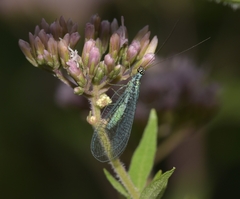
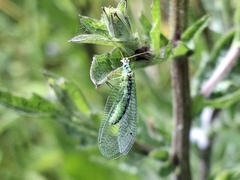
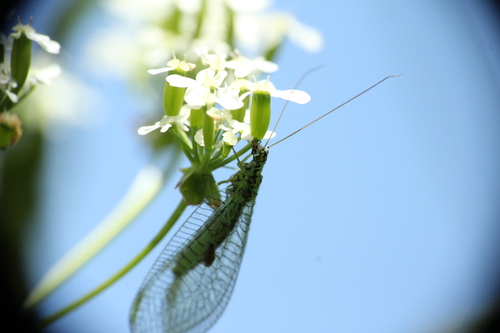
Chrysopa perla, the Pearly Green Lacewing, is an insect species belonging to the green lacewing family, Chrysopidae (subfamily Chrysopinae). This widespread species is present in most of Europe and in temperate zones of Asia.

These insects prefer cool and shady areas, mainly in deciduous woods, wet forests, woodland edges, hedge rows, scrubby grassland and shrubs. The adults reach 10–12 millimetres (0.39–0.47 in) of length, with a wingspan of 25–30 millimetres (0.98–1.18 in). The basic coloration of the body is green. Wings are blue-green with black veins. They turn pale yellow during the winter. Several black markings are present on the head, the thorax and below the abdomen. The second antennal segment is black. This species is rather similar to Chrysopa dorsalis, showing an oval pale spot between the eyes, which is roundish in C. perla.

Adults can be encountered from May through August. They are fearsome predators, primarily feeding on aphids, occasionally on flower nectar. The females usually lay eggs near aphid colonies. Larvae are predators, mainly feeding on Aphididae, Coccidae species and caterpillars (Pieris... Wikipedia →
Global Distribution

Parks Where Found

# Park Country Daily sighting probability
1 Mercantour National Park 🇫🇷 France
~10%
2 Bavarian Forest National Park 🇩🇪 Germany
~10%
3 Pyrénées National Park 🇫🇷 France
<5%

Cities Where Found

# City Country Daily sighting probability
1 Manchester 🇬🇧 United Kingdom
~10%
2 Nizhny Novgorod 🇷🇺 Russia
~10%
3 Helsinki 🇫🇮 Finland
<5%
4 Birmingham 🇬🇧 United Kingdom
<5%
5 Bucharest 🇷🇴 Romania
<5%
6 Kazan 🇷🇺 Russia
<5%
7 Moscow 🇷🇺 Russia
<5%
8 Kyiv 🇺🇦 Ukraine
<5%
9 Saint Petersburg 🇷🇺 Russia
<5%
10 London 🇬🇧 United Kingdom
<5%

Before you go

What are the chances of seeing a Pearly Green Lacewing in Mercantour National Park?

With luck

About 10% of wildlife watchers report a Pearly Green Lacewing sighting in Mercantour National Park on a given day, based on 7 verified sightings from GBIF citizen-science data from 2019 to 2026. It is the 307th most-seen of the 412 insects we can rate there. Over three days the chance rises to about 30%, and over a week to about 50%, if each day is a fresh chance.

When is the best time to see a Pearly Green Lacewing in Mercantour National Park?

June

In that month about 20% of wildlife watchers report a Pearly Green Lacewing in Mercantour National Park on a given day, against under 5% in August to May, the lowest months.

What time of day is best to see a Pearly Green Lacewing?

Between 11 am and 2 pm

Across all the parks we cover, that three-hour window holds the most Pearly Green Lacewing sightings with a recorded time, and about 6 in 10 of them come between 6 am and 6 pm: it is seen both by day and at night.

Is Mercantour National Park the best place to see a Pearly Green Lacewing?

Yes

Of the 3 parks where we can rate Pearly Green Lacewing sightings, Mercantour National Park has the highest daily chance: about 10%. Next come Bavarian Forest National Park (Germany, about 10%) and Pyrénées National Park (France, under 5%).

Which relatives of the Pearly Green Lacewing live in Mercantour National Park?

Same order: Neuroptera

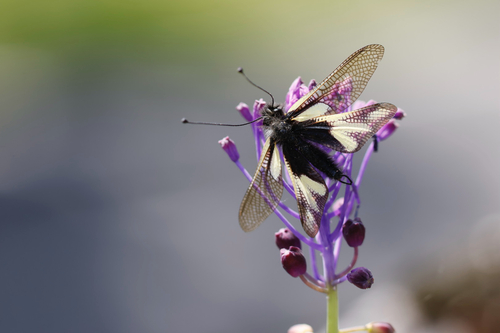
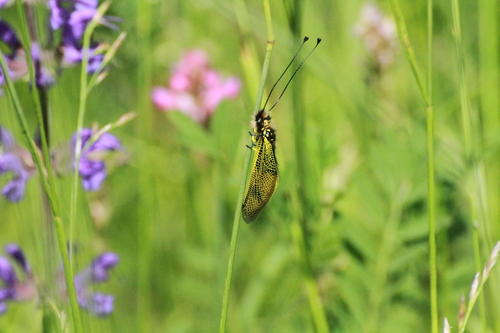
The closest relatives of the Pearly Green Lacewing that you can see in Mercantour National Park (order Neuroptera, Antlions, Lacewings, and Allies) are Owly Sulphur (about 20%) and Libelloides longicornis (about 10%), with each one's daily chance of a sighting.

Where does the Pearly Green Lacewing sighting chance come from?

GBIF citizen-science records

It is estimated from how often the Pearly Green Lacewing is recorded against all the insects logged in Mercantour National Park (7 verified sightings from 2019 to 2026), calibrated against known sighting rates. Figures are rounded to the nearest 10% because citizen-science data supports honest approximations, not decimals, and months with records from fewer than five people show "—". How it works.

← Back to Mercantour National Park