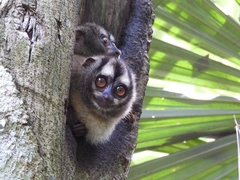
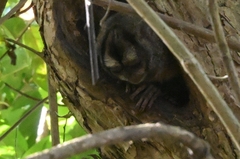
Panamanian Night Monkey

Panamanian Night Monkey

Aotus zonalis

Silhouette: E. Lear, 1819 (vectorization by Yan Wong) · PhyloPic

LCNTNear ThreatenedVUENCR
Daily sighting probability ~10% · With luck
at Parque Natural Metropolitano

In 3 days ~20% in a week ~30%

7 Verified sightings at Parque Natural Metropolitano From 2019 to 2026
151 In all 4 parks
February Best month
🌅 Crepuscular When it's spotted

About the Panamanian Night Monkey

The Panamanian night monkey or Chocoan night monkey (Aotus zonalis) is a species of night monkey formerly considered a subspecies of the gray-bellied night monkey of the family Aotidae. Its range consists of Panama and the Chocó region of Colombia. There are also unconfirmed reports of its occurrence in Costa Rica, especially on the Caribbean coast of Costa Rica. The species definitely occurs in the Atlantic lowlands of Panama close to the Costa Rica border.

The exact classification of the Panamanian Night Monkey is uncertain. While some authors consider it a subspecies of the gray-bellied night monkey, A. lemurinus, other authors follow a study by Thomas Defler from 2001, which concluded that it is a separate species, A. zonalis.

The Panamanian night monkey is a relatively small monkey, with males weighing approximately 889 grams (31.4 oz) and females weighing about 916 grams (32.3 oz). The fur on the back ranges from grayish brown to reddish brown. The belly is yellow. The hair on the back of the hands and feet is black or dark brown, which is a key distinguishing feature from other northern "gray-necked" Aotus species; also, its hair is shorter. Other distinguishing features relate to its skull, which has a broad braincase, a depressed interorbital region, and large molariform teeth.

Like other night monkeys, the Panamanian night monkey has large eyes, befitting its nocturnal lifestyle. But unlike many nocturnal animal species, its eyes do not have a tapetum lucidum. Also like other night monkeys, it has a short tail relative to the body size.

The Panamanian night monkey is arboreal and nocturnal. It and the other members of the genus Aotus are the only nocturnal monkeys. It is found in several types of forest, including secondary forest and coffee plantations. It lives in small groups of between two and six monkeys, consisting of an adult pair and one infant and several juveniles and/or subadults. Groups are territorial, and groups occupy ranges that overlap only slightly.

Vocal, olfactory and behavioral forms of communication have all been recorded. At least nine vocal calls have been reported, including various types of grunts, screams, squeals, moans and trills. Males develop a scent gland near their tail at the age of about one year that is used for scent marking. Urine washing, in which urine is rubbed on the hands and feet, is also used. Wikipedia →

Global Distribution

Parks Where Found

# Park Country Daily sighting probability
1 Soberanía National Park 🇵🇦 Panama
~30%
2 Bastimentos Island National Marine Park 🇵🇦 Panama
~20%
3 La Amistad International Park (Panama) 🇵🇦 Panama
~10%
4 Parque Natural Metropolitano 🇵🇦 Panama
~10%

Zoos & Centres Where Found

# Zoo / Centre Country
1 Parque Municipal Summit 🇵🇦 Panama In captivity
2 El Nispero Zoo 🇵🇦 Panama In captivity

Before you go

What are the chances of seeing a Panamanian Night Monkey in Parque Natural Metropolitano?

With luck

About 10% of wildlife watchers report a Panamanian Night Monkey sighting in Parque Natural Metropolitano on a given day, based on 7 verified sightings from GBIF citizen-science data from 2019 to 2026. It is the 13th most-seen of the 15 mammals we can rate there. Over three days the chance rises to about 20%, and over a week to about 30%, if each day is a fresh chance.

When is the best time to see a Panamanian Night Monkey in Parque Natural Metropolitano?

May–June and December–March

In those months about 10% of wildlife watchers report a Panamanian Night Monkey in Parque Natural Metropolitano on a given day, against under 5% in April and July–November, the lowest months.

What time of day is best to see a Panamanian Night Monkey?

Between 6 and 9 pm

Across all the parks we cover, that three-hour window holds the most Panamanian Night Monkey sightings with a recorded time, and about 6 in 10 of them come between 6 am and 6 pm: it is most active around dawn and dusk.

Which relatives of the Panamanian Night Monkey live in Parque Natural Metropolitano?

Same order: Primates

The closest relatives of the Panamanian Night Monkey that you can see in Parque Natural Metropolitano (order Primates) are Geoffroy’s Tamarin (about 30%) and Mantled Howler Monkey (about 20%), with each one's daily chance of a sighting.

Where does the Panamanian Night Monkey sighting chance come from?

GBIF citizen-science records

It is estimated from how often the Panamanian Night Monkey is recorded against all the mammals logged in Parque Natural Metropolitano (7 verified sightings from 2019 to 2026), calibrated against known sighting rates. Figures are rounded to the nearest 10% because citizen-science data supports honest approximations, not decimals, and months with records from fewer than five people show "—". How it works.

← Back to Parque Natural Metropolitano