


Completed

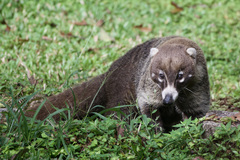


White-nosed Coati
Nasua narica
Silhouette: Margot Michaud · PhyloPic
- KingdomAnimalia (Animals)
- PhylumChordata (Chordates)
- ClassMammalia (Mammals)
- OrderCarnivora (Carnivorans)
- FamilyProcyonidae (Raccoons, Coatis, and Allies)
- GenusNasua (Coatis)
- SpeciesNasua narica (White-nosed Coati)
In 3 days ~80% in a week >90%
372 Verified sightings at Parque Natural Metropolitano From 2019 to 2026
5,829 In all 37 parks
November Best month
☀️ Diurnal When it's spotted
About the White-nosed Coati
The white-nosed coati (Nasua narica), also known as the coatimundi, is a species of coati and a member of the family Procyonidae (raccoons and their relatives). Local Spanish names for the species include antoon, gato solo, pizote, and tejón, depending upon the region. It weighs about 4–6 kg (8.8–13.2 lb), and the nose-to-tail length of the species is about 110 cm (3.6 ft) with about half of that being the tail length. However, small females can weigh as little as 3.1 kg (6.8 lb), while large males can weigh as much as 9 kg (20 lb).
The white-nosed coati is distributed from as far north as Flagstaff, Arizona, New Mexico, through Mexico, Central America, and the far northwestern region of Colombia near the border with Panama. It inhabits wooded areas in tropical and subtropical dry broadleaf forests and in tropical and subtropical moist broadleaf forests at elevations from sea level to 3,000 m (9,800 ft).
Coatis from Cozumel Island have been treated as a separate species, the Cozumel Island coati, but the vast majority of recent authorities treat it as a subspecies, N. narica nelsoni, of the white-nosed coati. They are smaller than white-nosed coatis... Wikipedia →
Sounds
Call0:21
Honduras · 2024
© Enrique Mejía · XC992861 · CC BY-NC-SA 4.0
Recording0:06
Mexico · 2017
d99 · iNaturalist · CC0
Recording0:18
Mexico · 2022
© Marco Alfonso Alpuche Pech · iNaturalist · CC BY-NC 4.0
Recent sightings of White-nosed Coati in Parque Natural Metropolitano
LIVEiNaturalistGlobal Distribution
Parks Where Found
Cities Where Found
| # | City | Country | Daily sighting probability |
|---|---|---|---|
| 1 | Panama City | 🇵🇦 Panama | |
| 2 | Monterrey | 🇲🇽 México | |
| 3 | San José | 🇨🇷 Costa Rica | |
| 4 | Guadalajara | 🇲🇽 México |
Zoos & Centres Where Found
| # | Zoo / Centre | Country | |
|---|---|---|---|
| 1 | Prague Zoo | 🇨🇿 Czechia | |
| 2 | National Zoological Park | 🇺🇸 United States | |
| 3 | Leipzig Zoological Garden | 🇩🇪 Germany | |
| 4 | Zürich Zoo | 🇨🇭 Switzerland | |
| 5 | North Carolina Zoo | 🇺🇸 United States | |
| 6 | Greensboro Science Center | 🇺🇸 United States | |
| 7 | Bioparque Estrella | 🇲🇽 Mexico | |
| 8 | San Diego Zoo Safari Park | 🇺🇸 United States | |
| 9 | Living Desert Zoo and Gardens | 🇺🇸 United States | |
| 10 | Bronx Zoo | 🇺🇸 United States | |
| 11 | Auto Safari Chapin | 🇬🇹 Guatemala | |
| 12 | Ecological Center of Sonora | 🇲🇽 Mexico | |
| 13 | Sedgwick County Zoo | 🇺🇸 United States | |
| 14 | Omaha’s Henry Doorly Zoo and Aquarium | 🇺🇸 United States | |
| 15 | Phoenix Zoo | 🇺🇸 United States | |
| 16 | Parque Municipal Summit | 🇵🇦 Panama | |
| 17 | Parco Natura Viva | 🇮🇹 Italy | |
| 18 | Xcaret | 🇲🇽 Mexico | |
| 19 | Guadalajara Zoo | 🇲🇽 Mexico | |
| 20 | Joya Grande | 🇭🇳 Honduras | |
| 21 | Berlin Zoological Garden | 🇩🇪 Germany | |
| 22 | Brevard Zoo | 🇺🇸 United States | |
| 23 | Night Safari | 🇸🇬 Singapore | |
| 24 | Zacango Zoo | 🇲🇽 Mexico | |
| 25 | Zoologischer Garten Leipzig | 🇩🇪 Germany | |
| 26 | Fort Worth Zoo | 🇺🇸 United States | |
| 27 | Singapore Zoo | 🇸🇬 Singapore | |
| 28 | Houston Zoo | 🇺🇸 United States | |
| 29 | Zoológico la pastroa | 🇲🇽 Mexico | |
| 30 | Bioparque Municipal Vesty Pakos | 🇧🇴 Bolivia | |
| 31 | ABQ BioPark Zoo | 🇺🇸 United States | |
| 32 | Jijamata Udyaan | 🇮🇳 India | |
| 33 | Opel-Zoo | 🇩🇪 Germany | |
| 34 | Philadelphia Zoo | 🇺🇸 United States | |
| 35 | Zoologischer Garten Magdeburg | 🇩🇪 Germany | |
| 36 | Chapultepec Zoo | 🇲🇽 Mexico | |
| 37 | Fresno Chaffee Zoo | 🇺🇸 United States | |
| 38 | London Zoo | 🇬🇧 United Kingdom | |
| 39 | John Ball Zoo | 🇺🇸 United States | |
| 40 | Monterey Zoo | 🇺🇸 United States | |
| 41 | River Wonders | 🇸🇬 Singapore | |
| 42 | Zoologico de Chihuahua | 🇲🇽 Mexico | |
| 43 | Safari Masai Mara | 🇲🇽 Mexico | |
| 44 | Stone Zoo | 🇺🇸 United States | |
| 45 | UMA "El Palapo" | 🇲🇽 Mexico | |
| 46 | Dierenpark Zie-ZOO | 🇳🇱 Netherlands | |
| 47 | Zoológico Tamatán | 🇲🇽 Mexico | |
| 48 | ZooAmerica | 🇺🇸 United States | |
| 49 | Alameda Park Zoo | 🇺🇸 United States | |
| 50 | Greenville Zoo | 🇺🇸 United States |
Closest Relatives at Parque Natural Metropolitano


Before you go
What are the chances of seeing a White-nosed Coati in Parque Natural Metropolitano?
Likely
About 40% of wildlife watchers report a White-nosed Coati sighting in Parque Natural Metropolitano on a given day, based on 372 verified sightings from GBIF citizen-science data from 2019 to 2026. It is the 2nd most-seen of the 15 mammals we can rate there. Over three days the chance rises to about 80%, and over a week to over 90%, if each day is a fresh chance.
When is the best time to see a White-nosed Coati in Parque Natural Metropolitano?
April, September and November–January
In those months about 50% of wildlife watchers report a White-nosed Coati in Parque Natural Metropolitano on a given day, against about 20% in July, the lowest month.
What time of day is best to see a White-nosed Coati?
Between 10 am and 1 pm
Across all the parks we cover, that three-hour window holds the most White-nosed Coati sightings with a recorded time, and about 9 in 10 of them come between 6 am and 6 pm: it is a daytime animal.
Is Parque Natural Metropolitano the best place to see a White-nosed Coati?
15th of 37
Of the 37 parks where we can rate White-nosed Coati sightings, Parque Natural Metropolitano ranks 15th at about 40%. The best odds are in Tikal National Park (Guatemala, about 90%), Arenal Volcano National Park (Costa Rica, about 80%) and Palo Verde National Park (Costa Rica, about 80%). All parks ranked.
Where does the White-nosed Coati sighting chance come from?
GBIF citizen-science records
It is estimated from how often the White-nosed Coati is recorded against all the mammals logged in Parque Natural Metropolitano (372 verified sightings from 2019 to 2026), calibrated against known sighting rates. Figures are rounded to the nearest 10% because citizen-science data supports honest approximations, not decimals, and months with records from fewer than five people show "—". How it works.
