Purple-faced Lutung

Purple-faced Lutung

Semnopithecus vetulus

Silhouette: Kai R. Caspar · PhyloPic

LCNTVUENEndangeredCR Endemic
Daily sighting probability ~30% · Possible
at Minneriya National Park

In 3 days ~60% in a week ~90%

36 Verified sightings at Minneriya National Park From 2019 to 2026
286 In all 3 parks
September Best month
☀️ Diurnal When it's spotted

About the Purple-faced Lutung

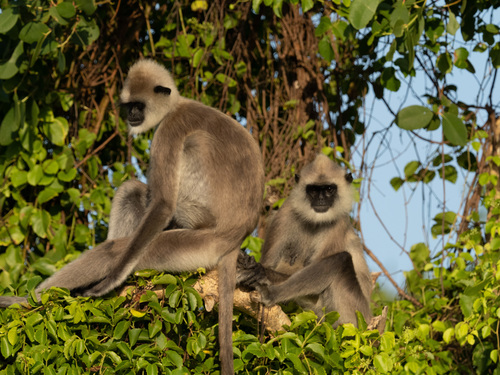
The purple-faced langur (Semnopithecus vetulus), also known as the purple-faced leaf monkey, is a species of Old World monkey that is endemic to Sri Lanka. The animal is a long-tailed arboreal species, identified by a mostly brown appearance, dark face (with paler lower face) and a very shy nature. The species was once highly prevalent, found in suburban Colombo and the "wet zone" villages (areas with high temperatures and high humidity throughout the year, whilst rain deluges occur during the monsoon seasons), but rapid urbanization has led to a significant decrease in the population level of the monkeys. It had traditionally been classified within the genus Trachypithecus but was moved to the genus Semnopithecus based on DNA evidence indicating that is it more closely related to the gray langurs.

In Sinhala, it is known as ශ්‍රී ලංකා කළු වඳුරා [kalu ʋaⁿd̪uraː] (Sri Lanka black monkey). In the purple-faced langur, males are usually larger than females. Males measure 50 to 67.1 cm (19.7 to 26.4 in) in head-body length with a tail of 67 to 85.1 cm (26.4 to 33.5 in). Females possess a head-body length 44.7 to 60 cm (17.6 to 23.6 in) and tail length of 58.9 to 82 cm... Wikipedia →

Sounds

Alarm call0:11

Sri Lanka · 2007

© Jelle Scharringa · XC1025063 · CC BY-NC-SA 4.0

Global Distribution

Parks Where Found

# Park Country Daily sighting probability
1 Sinharaja Forest Reserve 🇱🇰 Sri Lanka
~50%
2 Minneriya National Park 🇱🇰 Sri Lanka
~30%
3 Wilpattu National Park 🇱🇰 Sri Lanka
~20%

Zoos & Centres Where Found

# Zoo / Centre Country
1 National Zoological Gardens of Sri Lanka 🇱🇰 Sri Lanka In captivity

Before you go

What are the chances of seeing a Purple-faced Lutung in Minneriya National Park?

Possible

About 30% of wildlife watchers report a Purple-faced Lutung sighting in Minneriya National Park on a given day, based on 36 verified sightings from GBIF citizen-science data from 2019 to 2026. It is the 7th most-seen of the 18 mammals we can rate there. Over three days the chance rises to about 60%, and over a week to about 90%, if each day is a fresh chance.

When is the best time to see a Purple-faced Lutung in Minneriya National Park?

February, July and September

In those months about 40% of wildlife watchers report a Purple-faced Lutung in Minneriya National Park on a given day, against under 5% in June and October, the lowest months. Those are among Minneriya National Park's driest months, with about 60 mm of rain a month against 340 mm in November.

What time of day is best to see a Purple-faced Lutung?

Between 6 and 9 am

Across all the parks we cover, that three-hour window holds the most Purple-faced Lutung sightings with a recorded time, and about 7 in 10 of them come between 6 am and 6 pm: it is a daytime animal.

Is Minneriya National Park the best place to see a Purple-faced Lutung?

2nd of 3

Of the 3 parks where we can rate Purple-faced Lutung sightings, Minneriya National Park ranks 2nd at about 30%. The best odds are in Sinharaja Forest Reserve (Sri Lanka, about 50%).

Where does the Purple-faced Lutung sighting chance come from?

GBIF citizen-science records

It is estimated from how often the Purple-faced Lutung is recorded against all the mammals logged in Minneriya National Park (36 verified sightings from 2019 to 2026), calibrated against known sighting rates. Figures are rounded to the nearest 10% because citizen-science data supports honest approximations, not decimals, and months with records from fewer than five people show "—". How it works.

← Back to Minneriya National Park