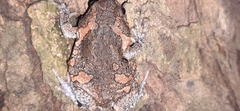
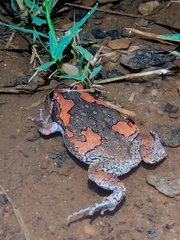
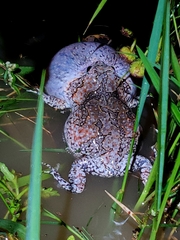
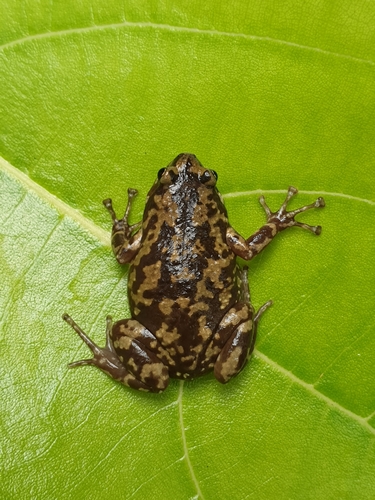
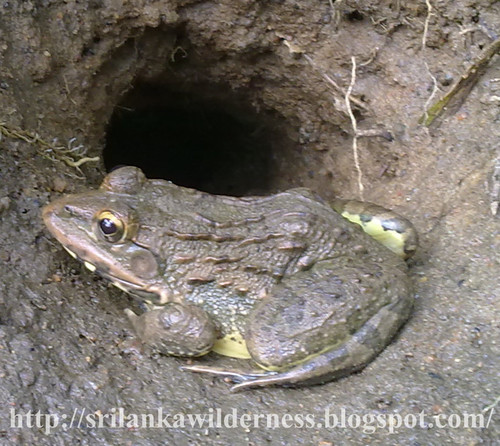
Sri Lankan Bullfrog

Sri Lankan Bullfrog

Uperodon taprobanicus

Silhouette: PhyloPic

LCLeast ConcernNTVUENCR
Daily sighting probability ~30% · Possible
at Minneriya National Park

In 3 days ~60% in a week ~90%

23 Verified sightings at Minneriya National Park From 2019 to 2026
23 In 1 park
February Best month
🌅 Crepuscular When it's spotted

About the Sri Lankan Bullfrog

Uperodon taprobanicus, also known as the Sri Lankan bullfrog, Sri Lankan painted frog, Sri Lankan kaloula, Ceylon kaloula, Indian painted frog, or painted globular frog, is a species of narrow-mouthed frog found in Nepal, Bangladesh, southern and eastern India, and Sri Lanka up to an altitude of about 1300 metres. It can grow to an adult length of up to 75 millimetres(7.5 cm) long from snout to vent. It was originally described as a subspecies of Kaloula pulchra, ssp. taprobanica. The IUCN lists it as being of "Least Concern".

Blackburn and colleagues (2013) suggested that Uperodon taprobanicus, then recognized as K. taprobanica, might not form a clade with the other Kaloula species, although it did clearly form a clade with Metaphrynella, Ramanella, and the rest of Kaloula. De Sá and colleagues (2012) grouped Uperodon taprobanicus (as K. taprobanica) as a sister clade to Ramanella and Uperodon rather than with the rest of Kaloula, which De Sá et al. (2012) listed as a sister clade to Metaphrynella and Phrynella. In 2016, Peloso and colleagues synonymized Ramanella with Uperodon and transferred this species to the genus Uperodon.

This plump species... Wikipedia →

Sounds

Recording1:01

India · 2023

© aritranature · iNaturalist · CC BY-NC 4.0

Global Distribution

Parks Where Found

# Park Country Daily sighting probability
1 Minneriya National Park 🇱🇰 Sri Lanka
~30%

More parks will be added in future updates.

Cities Where Found

# City Country Daily sighting probability
1 Thrissur 🇮🇳 India
~40%
2 Kollam 🇮🇳 India
~30%
3 Chennai 🇮🇳 India
~30%
4 Ponnani 🇮🇳 India
~30%
5 Kozhikode 🇮🇳 India
~30%
6 Bengaluru 🇮🇳 India
~20%
7 Colombo [Sri Jayawardenepura Kotte] 🇱🇰 Sri Lanka
~20%
8 Salem 🇮🇳 India
~20%
9 Mysuru 🇮🇳 India
~10%
10 Kochi 🇮🇳 India
~10%

Before you go

What are the chances of seeing a Sri Lankan Bullfrog in Minneriya National Park?

Possible

About 30% of wildlife watchers report a Sri Lankan Bullfrog sighting in Minneriya National Park on a given day, based on 23 verified sightings from GBIF citizen-science data from 2019 to 2026. It is the 4th most-seen of the 10 amphibians we can rate there. Over three days the chance rises to about 60%, and over a week to about 90%, if each day is a fresh chance.

When is the best time to see a Sri Lankan Bullfrog in Minneriya National Park?

February, April and October–November

In those months about 40% of wildlife watchers report a Sri Lankan Bullfrog in Minneriya National Park on a given day, against under 5% in January, May–July and September, the lowest months. Those are among Minneriya National Park's wettest months, with about 180 mm of rain a month against 20 mm in June.

What time of day is best to see a Sri Lankan Bullfrog?

Between 3 and 6 pm

Across all the parks we cover, that three-hour window holds the most Sri Lankan Bullfrog sightings with a recorded time, and about 6 in 10 of them come between 6 am and 6 pm: it is most active around dawn and dusk.

Where else can you see a Sri Lankan Bullfrog?

Only Minneriya National Park, in our data

Minneriya National Park is the only park on Wallace's Line with enough records to rate Sri Lankan Bullfrog sightings: about 30% of wildlife watchers there report one on a given day.

Where does the Sri Lankan Bullfrog sighting chance come from?

GBIF citizen-science records

It is estimated from how often the Sri Lankan Bullfrog is recorded against all the amphibians logged in Minneriya National Park (23 verified sightings from 2019 to 2026), calibrated against known sighting rates. Figures are rounded to the nearest 10% because citizen-science data supports honest approximations, not decimals, and months with records from fewer than five people show "—". How it works.

← Back to Minneriya National Park