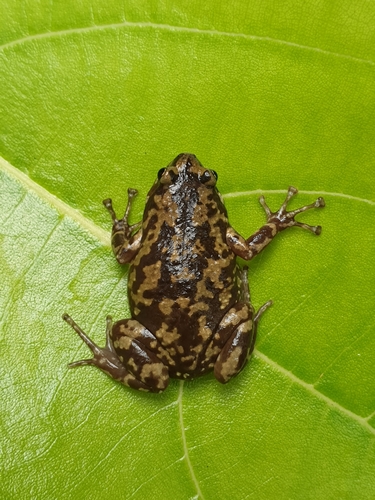
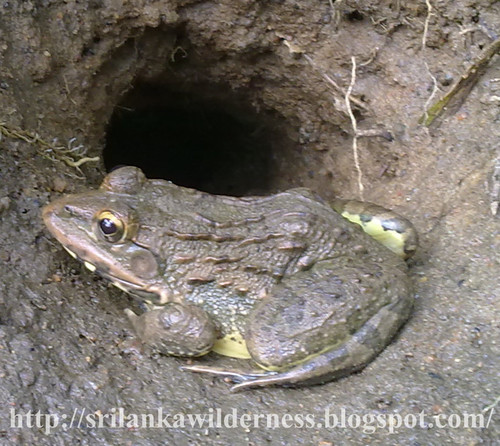
Common Hourglass Tree Frog

Common Hourglass Tree Frog

Polypedates cruciger

Silhouette: Jose Carlos Arenas-Monroy · PhyloPic

LCLeast ConcernNTVUENCR Endemic
Daily sighting probability ~30% · Possible
at Minneriya National Park

In 3 days ~70% in a week ~90%

27 Verified sightings at Minneriya National Park From 2019 to 2026
85 In all 4 parks
August Best month
☀️ Diurnal When it's spotted

About the Common Hourglass Tree Frog

Polypedates cruciger (commonly known as the Sri Lanka whipping frog or common hour-glass tree-frog) is a species of frog in the family Rhacophoridae endemic to Sri Lanka. It has been osbserved as high as 1600 meters above sea level.

This frog can tolerate different habitats, including secondary forest, banana farms, gardens, and buildings. Scientists have not seen this frog in primary forest. Scientists say this frog is not in danger of dying out because of its large range and tolerance to altered habitat.

Scientists used to think frog was conspecific with Polypedates pseudocruciger, which lives in India's Western Ghat mountains. Wikipedia →

Global Distribution

Parks Where Found

# Park Country Daily sighting probability
1 Sinharaja Forest Reserve 🇱🇰 Sri Lanka
~40%
2 Minneriya National Park 🇱🇰 Sri Lanka
~30%
3 Wilpattu National Park 🇱🇰 Sri Lanka
~30%
4 Udawalawe National Park 🇱🇰 Sri Lanka
~20%

Cities Where Found

# City Country Daily sighting probability
1 Colombo [Sri Jayawardenepura Kotte] 🇱🇰 Sri Lanka
~30%

Before you go

What are the chances of seeing a Common Hourglass Tree Frog in Minneriya National Park?

Possible

About 30% of wildlife watchers report a Common Hourglass Tree Frog sighting in Minneriya National Park on a given day, based on 27 verified sightings from GBIF citizen-science data from 2019 to 2026. It is the 3rd most-seen of the 10 amphibians we can rate there. Over three days the chance rises to about 70%, and over a week to about 90%, if each day is a fresh chance.

When is the best time to see a Common Hourglass Tree Frog in Minneriya National Park?

August

In that month about 50% of wildlife watchers report a Common Hourglass Tree Frog in Minneriya National Park on a given day, against under 5% in February and September, the lowest months. That is one of Minneriya National Park's driest months, with about 45 mm of rain against 340 mm in November.

What time of day is best to see a Common Hourglass Tree Frog?

Between 3 and 6 pm

Across all the parks we cover, that three-hour window holds the most Common Hourglass Tree Frog sightings with a recorded time, and about 8 in 10 of them come between 6 am and 6 pm: it is a daytime animal.

Is Minneriya National Park the best place to see a Common Hourglass Tree Frog?

2nd of 4

Of the 4 parks where we can rate Common Hourglass Tree Frog sightings, Minneriya National Park ranks 2nd at about 30%. The best odds are in Sinharaja Forest Reserve (Sri Lanka, about 40%). All parks ranked.

Where does the Common Hourglass Tree Frog sighting chance come from?

GBIF citizen-science records

It is estimated from how often the Common Hourglass Tree Frog is recorded against all the amphibians logged in Minneriya National Park (27 verified sightings from 2019 to 2026), calibrated against known sighting rates. Figures are rounded to the nearest 10% because citizen-science data supports honest approximations, not decimals, and months with records from fewer than five people show "—". How it works.

← Back to Minneriya National Park