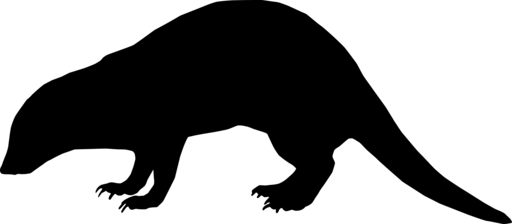
Gambian Mongoose silhouette

Silhouette: Margot Michaud · PhyloPic

Gambian Mongoose

Mungos gambianus

LCLeast ConcernNTVUENCR
Daily sighting probability ~30% · Possible
at Mole National Park

In 3 days ~70% in a week ~90%

6 Verified sightings at Mole National Park From 2019 to 2026
6 In 1 park
January Best month
☀️ Diurnal When it's spotted

About the Gambian Mongoose

The Gambian mongoose (Mungos gambianus) is a mongoose species native to the Guinean forest-savanna mosaic from Gambia to Nigeria. It is listed as Least Concern on the IUCN Red List since 2008. Herpestes gambianus was the scientific name proposed by William Ogilby in 1835 for a mongoose specimen from Gambia.

The Gambian mongoose has a grizzled grey and brown fur, which is mixed with red on the back, hips and thighs. Its throat and the sides of the neck are pale silvery brown, and the neck is marked with a dark brown stripe running from the ear to the shoulder. The breast, belly and inner sides of the legs are red. Its feet are black, and its tail is mixed with black and has a black tuft at the end.

It has five toes on each foot, which is bare from the sole to the wrist and heel. Their faces are short, and have only two molars on each jaw. Females have six mammae. The Gambian mongoose is endemic to West Africa where it can be found in the mesic savannas and woodlands from Senegal and Gambia in the west east to Nigeria. The Gambian mongoose is diurnal, gregarious and terrestrial. They live in...
Wikipedia →

Global Distribution

Parks Where Found

# Park Country Daily sighting probability
1 Mole National Park 🇬🇭 Ghana
~30%

More parks will be added in future updates.

Before you go

What are the chances of seeing a Gambian Mongoose in Mole National Park?

Possible

About 30% of wildlife watchers report a Gambian Mongoose sighting in Mole National Park on a given day, based on 6 verified sightings from GBIF citizen-science data from 2019 to 2026. It is the 15th most-seen of the 15 mammals we can rate there. Over three days the chance rises to about 70%, and over a week to about 90%, if each day is a fresh chance.

When is the best time to see a Gambian Mongoose in Mole National Park?

January

In that month about 60% of wildlife watchers report a Gambian Mongoose in Mole National Park on a given day, against under 5% in February and October, the lowest months. That is one of Mole National Park's driest months, with almost no rain against 220 mm in August. May and August have too few records to rate.

What time of day is best to see a Gambian Mongoose?

Between 6 and 9 am

Across all the parks we cover, that three-hour window holds the most Gambian Mongoose sightings with a recorded time, and about 8 in 10 of them come between 6 am and 6 pm: it is a daytime animal.

Where else can you see a Gambian Mongoose?

Only Mole National Park, in our data

Mole National Park is the only park on Wallace's Line with enough records to rate Gambian Mongoose sightings: about 30% of wildlife watchers there report one on a given day.

Where does the Gambian Mongoose sighting chance come from?

GBIF citizen-science records

It is estimated from how often the Gambian Mongoose is recorded against all the mammals logged in Mole National Park (6 verified sightings from 2019 to 2026), calibrated against known sighting rates. Figures are rounded to the nearest 10% because citizen-science data supports honest approximations, not decimals, and months with records from fewer than five people show "—". How it works.

← Back to Mole National Park