


Completed


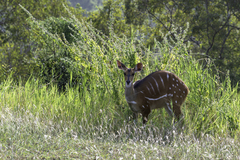
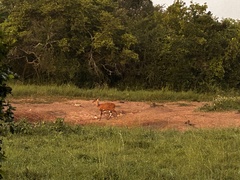
Northern Bushbuck
Tragelaphus scriptus
Silhouette: Robert Hering · PhyloPic
- KingdomAnimalia (Animals)
- PhylumChordata (Chordates)
- ClassMammalia (Mammals)
- OrderArtiodactyla (Even-toed Ungulates and Cetaceans)
- FamilyBovidae (Bovids)
- GenusTragelaphus (Spiral-horned Antelopes)
- SpeciesTragelaphus scriptus (Northern Bushbuck)
In 3 days >90%
64 Verified sightings at Mole National Park From 2019 to 2026
2,223 In all 39 parks
October Best month
☀️ Diurnal When it's spotted
About the Northern Bushbuck
The harnessed bushbuck (Tragelaphus scriptus) or northern bushbuck, is a medium-sized antelope, widespread in sub-Saharan-Africa. The harnessed bushbuck species has been separated from the Cape bushbuck, a southern and eastern species.
In a 2007 study, 19 genetically-based groupings were found, some of which do not correspond to previously described subspecies; eight of these were grouped under the nominate taxon. Former subspecies included as synonyms to the nominate taxon are phaleratus, bor and dodingae.
Hassanin et al. (2018) found an mtDNA/nuclear DNA discordance between scriptus and sylvaticus clades. Their phylogenetic analyses showed that the scriptus (northern) lineage is a sister-group of sylvaticus (southern) lineage in the nuclear tree, whereas it has nyala (Tragelaphus angasii) haplotypes in the mitochondrial tree. They also found different karyotypes (chromosome numbers and arrangements), with those of scriptus deriving from the nyala. They concluded that scriptus (but not sylvaticus) had hybridized with an "extinct species closely related to T. angasii" in ancient times; and that "the division into two bushbuck species is supported by the analyses of...
Recent sightings of Northern Bushbuck in Mole National Park
LIVEiNaturalistGlobal Distribution
Parks Where Found
Zoos & Centres Where Found
| # | Zoo / Centre | Country | |
|---|---|---|---|
| 1 | Ragunan Zoo | 🇮🇩 Indonesia | |
| 2 | California Academy of Sciences | 🇺🇸 United States | |
| 3 | Kano Zoo | 🇳🇬 Nigeria | |
| 4 | Valencia Bioparc | 🇪🇸 Spain | |
| 5 | Gladys Porter Zoo | 🇺🇸 United States | |
| 6 | World of Birds Wildlife Sanctuary and Monkey Park | 🇿🇦 South Africa | |
| 7 | Audu Bako Zoo | 🇳🇬 Nigeria | |
| 8 | Moholoholo Wildlife Rehabilitation Centre | 🇿🇦 South Africa |
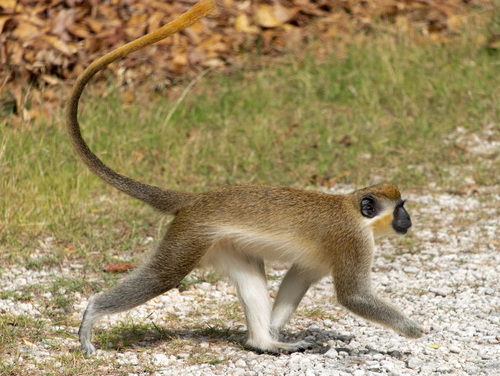
Closest Relatives at Mole National Park






Before you go
What are the chances of seeing a Northern Bushbuck in Mole National Park?
Very likely
About 80% of wildlife watchers report a Northern Bushbuck sighting in Mole National Park on a given day, based on 64 verified sightings from GBIF citizen-science data from 2019 to 2026. It is the 4th most-seen of the 15 mammals we can rate there. Over three days the chance rises to over 90%, if each day is a fresh chance.
When is the best time to see a Northern Bushbuck in Mole National Park?
October
In that month about 90% of wildlife watchers report a Northern Bushbuck in Mole National Park on a given day, against about 30% in July, the lowest month. May and August have too few records to rate.
What time of day is best to see a Northern Bushbuck?
Between 9 am and noon
Across all the parks we cover, that three-hour window holds the most Northern Bushbuck sightings with a recorded time, and about 8 in 10 of them come between 6 am and 6 pm: it is a daytime animal.
Is Mole National Park the best place to see a Northern Bushbuck?
Among the best
Of the 39 parks where we can rate Northern Bushbuck sightings, Mole National Park ranks 2nd at about 80%, level with the leaders once rounded. The best odds are in Aberdare National Park (Kenya, about 80%). All parks ranked.
Which relatives of the Northern Bushbuck live in Mole National Park?
Same family: Bovidae
The closest relatives of the Northern Bushbuck that you can see in Mole National Park (family Bovidae, Bovids) are Kob (about 80%), Waterbuck (about 50%) and Hartebeest (about 40%), with each one's daily chance of a sighting.
Where does the Northern Bushbuck sighting chance come from?
GBIF citizen-science records
It is estimated from how often the Northern Bushbuck is recorded against all the mammals logged in Mole National Park (64 verified sightings from 2019 to 2026), calibrated against known sighting rates. Figures are rounded to the nearest 10% because citizen-science data supports honest approximations, not decimals, and months with records from fewer than five people show "—". How it works.
