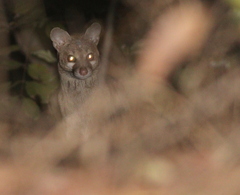
West African Large-spotted Genet

West African Large-spotted Genet

Genetta pardina

Silhouette: Margot Michaud · PhyloPic

LCLeast ConcernNTVUENCR
Daily sighting probability ~50% · Likely
at Mole National Park

In 3 days ~80% in a week >90%

14 Verified sightings at Mole National Park From 2019 to 2026
20 In all 2 parks
January Best month
☀️🌙 Day & Night When it's spotted

About the West African Large-spotted Genet

The pardine genet (Genetta pardina), also known as the West African large spotted genet, is a genet species living in West Africa. As it is widely distributed and common, it is listed as Least Concern on the IUCN Red List.

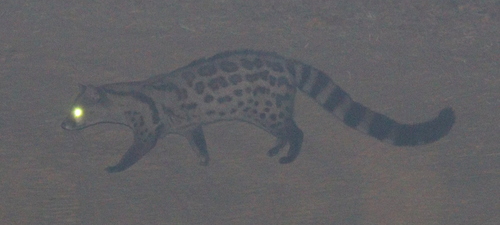
The pardine genet's fur is yellowish grey with round black spots, which are bigger on the hind legs than on the shoulders. Its head is more reddish, and the muzzle brownish. It has white spots under each eye and below the chin. Its ears are grey. Its tail has six to seven narrow white and six to seven broader black rings. The tip of the tail is black.

Measurements of adult males range from 410 to 553 mm (16.1 to 21.8 in) in head and body with a 390 to 490 mm (15 to 19 in) long tail. Adult females range from 410 to 530 mm (16 to 21 in) in head and body with a 420 to 450 mm (17 to 18 in) long tail.

Pardine genets are distributed from Senegal eastwards to Ghana, where the Volta River is possibly a barrier to dispersal. They live in rainforests, gallery forests, moist woodlands, but also in plantations. They also venture into suburbs.

Pardine genets are solitary, and active at night. They...
Wikipedia →

Global Distribution

Parks Where Found

# Park Country Daily sighting probability
1 Mole National Park 🇬🇭 Ghana
~50%
2 Niokolo-Koba National Park 🇸🇳 Senegal
~30%

Before you go

What are the chances of seeing a West African Large-spotted Genet in Mole National Park?

Likely

About 50% of wildlife watchers report a West African Large-spotted Genet sighting in Mole National Park on a given day, based on 14 verified sightings from GBIF citizen-science data from 2019 to 2026. It is the 11th most-seen of the 15 mammals we can rate there. Over three days the chance rises to about 80%, and over a week to over 90%, if each day is a fresh chance.

When is the best time to see a West African Large-spotted Genet in Mole National Park?

January

In that month about 70% of wildlife watchers report a West African Large-spotted Genet in Mole National Park on a given day, against under 5% in November, the lowest month. That is one of Mole National Park's driest months, with almost no rain against 220 mm in August. May and August have too few records to rate.

What time of day is best to see a West African Large-spotted Genet?

Between 7 and 10 pm

Across all the parks we cover, that three-hour window holds the most West African Large-spotted Genet sightings with a recorded time, and about 6 in 10 of them come between 6 pm and 6 am: it is seen both by day and at night.

Is Mole National Park the best place to see a West African Large-spotted Genet?

Yes

Of the 2 parks where we can rate West African Large-spotted Genet sightings, Mole National Park has the highest daily chance: about 50%. Next come Niokolo-Koba National Park (Senegal, about 30%).

Which relatives of the West African Large-spotted Genet live in Mole National Park?

Same order: Carnivora

The closest relatives of the West African Large-spotted Genet that you can see in Mole National Park (order Carnivora, Carnivorans) are White-tailed Mongoose (about 40%) and Gambian Mongoose (about 30%), with each one's daily chance of a sighting.

Where does the West African Large-spotted Genet sighting chance come from?

GBIF citizen-science records

It is estimated from how often the West African Large-spotted Genet is recorded against all the mammals logged in Mole National Park (14 verified sightings from 2019 to 2026), calibrated against known sighting rates. Figures are rounded to the nearest 10% because citizen-science data supports honest approximations, not decimals, and months with records from fewer than five people show "—". How it works.

← Back to Mole National Park