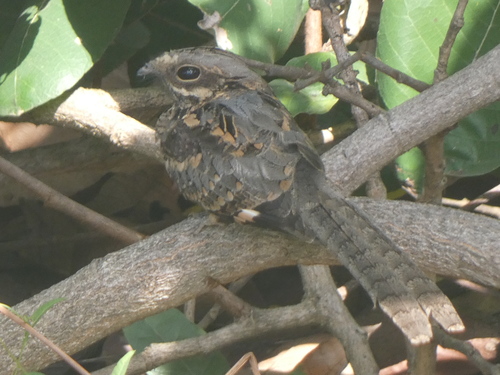
Plain Nightjar

Plain Nightjar

Caprimulgus inornatus

Silhouette: Ferran Sayol · PhyloPic

LCLeast ConcernNTVUENCR
Daily sighting probability <5% · Rare
at Mole National Park

In 3 days ~10%

10 Verified sightings at Mole National Park From 2019 to 2026
67 In all 4 parks
April Best month
🌙 Nocturnal When it's spotted

About the Plain Nightjar

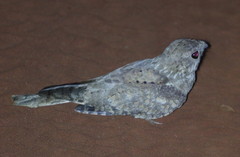
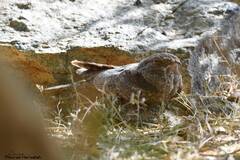
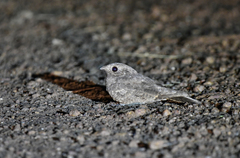
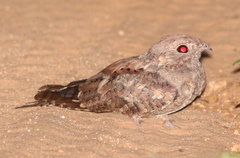
The plain nightjar (Caprimulgus inornatus) is a species of nightjar in the family Caprimulgidae. It breeds in the southern Sahel, Southern Sudan, the Horn of Africa and the southwestern Arabian Peninsula. It migrates to lower latitudes - including central Congo and northern Tanzania. A rather plain looking nightjar with grey-brown, brown, and rufous morphs. Males have white spots on primaries (4 feathers), large white corners to tail, and no white on the throat (may show black spots on the crown and scapulars like Star-spotted Nightjar). Females have buffy-brown wing spots, and no white on the tail.

This species has an extremely large range, and hence does not approach the thresholds for Vulnerable under the range size criterion (Extent of Occurrence <20,000 km2 combined with a declining or fluctuating range size, habitat extent/quality, or population size and a small number of locations or severe fragmentation). The population trend appears to be stable, and hence the species does not approach the thresholds for Vulnerable under the population trend criterion (>30% decline over ten years or three generations). The population size has not been quantified, but...

Wikipedia →

Sounds

Song0:22

Saudi Arabia · 2022

© David Darrell-Lambert · XC746376 · CC BY-NC-SA 4.0

Alarm call0:23

Benin · 2014

© Richard Hoyer · XC170217 · CC BY-NC-SA 3.0

Global Distribution

Parks Where Found

# Park Country Daily sighting probability
1 Tsavo West National Park 🇰🇪 Kenya
<5%
2 Mole National Park 🇬🇭 Ghana
<5%
3 Murchison Falls National Park 🇺🇬 Uganda
<5%
4 Queen Elizabeth National Park 🇺🇬 Uganda
<5%

Before you go

What are the chances of seeing a Plain Nightjar in Mole National Park?

Rare

Under 5% of wildlife watchers report a Plain Nightjar sighting in Mole National Park on a given day, based on 10 verified sightings from GBIF citizen-science data from 2019 to 2026. It is the 245th most-seen of the 266 birds we can rate there. Over three days the chance rises to about 10%, if each day is a fresh chance.

When is the best time to see a Plain Nightjar in Mole National Park?

April and November

In those months about 10% of wildlife watchers report a Plain Nightjar in Mole National Park on a given day, against under 5% in May–June, August–October and December–March, the lowest months. Those are among Mole National Park's driest months, with about 30 mm of rain a month against 220 mm in August. July has too few records to rate.

What time of day is best to see a Plain Nightjar?

Between 6 and 9 pm

Across all the parks we cover, that three-hour window holds the most Plain Nightjar sightings with a recorded time, and about 7 in 10 of them come between 6 pm and 6 am: it is mostly seen at night.

Is Mole National Park the best place to see a Plain Nightjar?

Among the best

Of the 4 parks where we can rate Plain Nightjar sightings, Mole National Park ranks 2nd at under 5%, level with the leaders once rounded. The best odds are in Tsavo West National Park (Kenya, under 5%).

Which relatives of the Plain Nightjar live in Mole National Park?

Same genus: Caprimulgus

The closest relatives of the Plain Nightjar that you can see in Mole National Park (genus Caprimulgus, Old World Nightjars) are Long-tailed Nightjar (about 30%) and Standard-winged Nightjar (about 20%), with each one's daily chance of a sighting.

Where does the Plain Nightjar sighting chance come from?

GBIF citizen-science records

It is estimated from how often the Plain Nightjar is recorded against all the birds logged in Mole National Park (10 verified sightings from 2019 to 2026), calibrated against known sighting rates. Figures are rounded to the nearest 10% because citizen-science data supports honest approximations, not decimals, and months with records from fewer than five people show "—". How it works.

← Back to Mole National Park