Whitethroated Bee-eater

Whitethroated Bee-eater

Merops albicollis

Silhouette: Sheatherius · PhyloPic

LCLeast ConcernNTVUENCR
Daily sighting probability <5% · Rare
at Mole National Park

In 3 days ~10% in a week ~20%

18 Verified sightings at Mole National Park From 2019 to 2026
2,058 In all 19 parks
October Best month
☀️ Diurnal When it's spotted

About the Whitethroated Bee-eater

The white-throated bee-eater (Merops albicollis) is a species of bee-eater that breeds in semi-desert along the southern edge of the Sahara. The white-throated bee-eater is migratory, wintering in a completely different habitat in the equatorial rain forests of Africa from southern Senegal to Uganda.

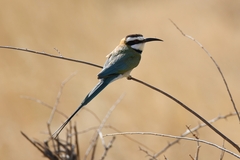
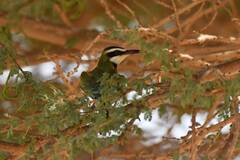
This species, like other bee-eaters, is a richly coloured, slender bird. It is predominantly green, but its face and throat are white with a black crown, eye stripe, and neckband. The underparts are pale green shading to blue on the breast. The eye is red and the beak is black.

The white-throated bee-eater can reach a length of 19–21 cm, excluding the two very elongated central tail feathers, which can exceed an additional length of 12 cm. They weigh between 20 and 28 grams. Sexes are alike, except that the male has longer tail feathers. The call is similar to European bee-eater.

White-throated bee-eaters also feed and roost communally. As the name suggests, bee-eaters predominantly eat insects, especially bees, wasps and hornets, which are caught in the air by sorties from an open perch. However, this species probably takes mainly flying ants and beetles...

Wikipedia →

Sounds

Call0:19

Saudi Arabia · 2026

© Mischa Keijmel · XC1141832 · CC BY-NC-SA 4.0

Flight call0:20

Saudi Arabia · 2022

© David Darrell-Lambert · XC746340 · CC BY-NC-SA 4.0

Song0:15

Guinea-Bissau · 2020

© Joost van Bruggen · XC523062 · CC BY-NC-ND 4.0

Global Distribution

Parks Where Found

# Park Country Daily sighting probability
1 Meru National Park 🇰🇪 Kenya
~60%
2 Samburu National Reserve 🇰🇪 Kenya
~50%
3 Kakum National Park 🇬🇭 Ghana
~40%
4 Awash National Park 🇪🇹 Ethiopia
~20%
5 Semuliki National Park 🇺🇬 Uganda
~20%
6 Queen Elizabeth National Park 🇺🇬 Uganda
~20%
7 Kibale National Park 🇺🇬 Uganda
~10%
8 Chinko Conservation Area 🇨🇫 Central African Republic
~10%
9 Tsavo East National Park 🇰🇪 Kenya
~10%
10 Virunga National Park 🇨🇩 Democratic Republic of the Congo
~10%
11 Mole National Park 🇬🇭 Ghana
<5%
12 Bwindi Impenetrable National Park 🇺🇬 Uganda
<5%
13 Tsavo West National Park 🇰🇪 Kenya
<5%
14 Murchison Falls National Park 🇺🇬 Uganda
<5%
15 Arusha National Park 🇹🇿 Tanzania
<5%
16 Masai Mara National Reserve 🇰🇪 Kenya
<5%
17 Ngorongoro Conservation Area 🇹🇿 Tanzania
<5%
18 Lake Mburo National Park 🇺🇬 Uganda
<5%
19 Kruger National Park 🇿🇦 South Africa
<5%

Cities Where Found

# City Country Daily sighting probability
1 Kampala 🇺🇬 Uganda
~30%
2 Lagos 🇳🇬 Nigeria
~20%
3 Abidjan 🇨🇮 Côte d'Ivoire
~20%
4 Accra 🇬🇭 Ghana
~10%
5 Freetown 🇸🇱 Sierra Leone
~10%
6 Cotonou 🇧🇯 Benin
~10%
7 Lomé 🇹🇬 Togo
~10%
8 Mombasa 🇰🇪 Kenya
~10%
9 Abuja 🇳🇬 Nigeria
<5%
10 Serrekunda 🇬🇲 Gambia
<5%

Zoos & Centres Where Found

# Zoo / Centre Country
1 San Diego Zoo 🇺🇸 United States In captivity
2 Bronx Zoo 🇺🇸 United States In captivity
3 National Aviary 🇺🇸 United States In captivity

Before you go

What are the chances of seeing a Whitethroated Bee-eater in Mole National Park?

Rare

Under 5% of wildlife watchers report a Whitethroated Bee-eater sighting in Mole National Park on a given day, based on 18 verified sightings from GBIF citizen-science data from 2019 to 2026. It is the 216th most-seen of the 266 birds we can rate there. Over three days the chance rises to about 10%, and over a week to about 20%, if each day is a fresh chance.

When is the best time to see a Whitethroated Bee-eater in Mole National Park?

October

In that month about 20% of wildlife watchers report a Whitethroated Bee-eater in Mole National Park on a given day, against under 5% in June, August–September and December–April, the lowest months. July has too few records to rate.

What time of day is best to see a Whitethroated Bee-eater?

Between 9 am and noon

Across all the parks we cover, that three-hour window holds the most Whitethroated Bee-eater sightings with a recorded time, and about 8 in 10 of them come between 6 am and 6 pm: it is a daytime animal.

Where does the Whitethroated Bee-eater sighting chance come from?

GBIF citizen-science records

It is estimated from how often the Whitethroated Bee-eater is recorded against all the birds logged in Mole National Park (18 verified sightings from 2019 to 2026), calibrated against known sighting rates. Figures are rounded to the nearest 10% because citizen-science data supports honest approximations, not decimals, and months with records from fewer than five people show "—". How it works.

← Back to Mole National Park