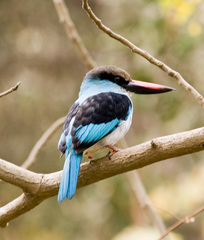
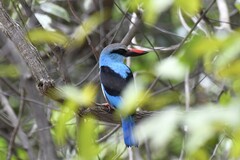
Blue-breasted Kingfisher

Blue-breasted Kingfisher

Halcyon malimbica

Silhouette: Andy Wilson · PhyloPic

LCLeast ConcernNTVUENCR
Daily sighting probability ~40% · Likely
at Mole National Park

In 3 days ~70% in a week >90%

168 Verified sightings at Mole National Park From 2019 to 2026
1,139 In all 12 parks
April Best month
☀️ Diurnal When it's spotted

About the Blue-breasted Kingfisher

The blue-breasted kingfisher (Halcyon malimbica) is a tree kingfisher widely distributed across Equatorial Africa. This kingfisher is essentially resident, but retreats from drier savanna areas to wetter habitats in the dry season.

This is a large kingfisher, 25 cm in length. The adult has a bright blue head, back, wing panel and tail. Its underparts are white, but it has a blue breast band. The shoulders are black. The flight of the blue-breasted kingfisher is rapid and direct. The large bill has a red upper mandible and black lower mandible. The legs are bright red.

Sexes are similar, but juveniles are duller than adults. The call of this noisy kingfisher is a whistled pu-pu-pu-pu-ku-ku-ku-ku. The blue-breasted kingfisher is a species of a variety of well-wooded habitats. It perches quietly in deep shade whilst seeking food. It is territorial but wary. This species mainly hunts large insects, arthropods, fish and frogs, but will also eat the fruit of the Oil Palm.

It has a striking display in which the wings are spread to show the white linings. The nest is a hole in a tree termite nest. A single clutch of two round white eggs is typical.

Wikipedia →

Sounds

Recording0:29

Gabon · 2021

© BurBenj · XC1120072 · CC BY-NC-SA 4.0

Song0:27

Gambia · 2025

© Sven Kransel · XC1063333 · CC BY-NC-SA 4.0

Call0:32

Congo (Democratic Republic) · 2022

© Deville Tanguy · XC822884 · CC BY-NC-SA 4.0

Global Distribution

Parks Where Found

# Park Country Daily sighting probability
1 Niokolo-Koba National Park 🇸🇳 Senegal
~60%
2 Mole National Park 🇬🇭 Ghana
~40%
3 Semuliki National Park 🇺🇬 Uganda
~40%
4 Odzala-Kokoua National Park 🇨🇬 Republic of the Congo
~40%
5 Kibale National Park 🇺🇬 Uganda
~20%
6 Chinko Conservation Area 🇨🇫 Central African Republic
~20%
7 Taï National Park 🇨🇮 Ivory Coast
~10%
8 Kakum National Park 🇬🇭 Ghana
~10%
9 Virunga National Park 🇨🇩 Democratic Republic of the Congo
~10%
10 Queen Elizabeth National Park 🇺🇬 Uganda
~10%
11 Murchison Falls National Park 🇺🇬 Uganda
<5%
12 Lake Mburo National Park 🇺🇬 Uganda
<5%

Cities Where Found

# City Country Daily sighting probability
1 Serrekunda 🇬🇲 Gambia
~30%
2 Lagos 🇳🇬 Nigeria
~20%
3 Abuja 🇳🇬 Nigeria
~10%
4 Accra 🇬🇭 Ghana
<5%
5 Kampala 🇺🇬 Uganda
<5%

Zoos & Centres Where Found

# Zoo / Centre Country
1 Denver Zoo 🇺🇸 United States In captivity
2 Barcelona Zoo 🇪🇸 Spain In captivity
3 ZooTampa 🇺🇸 United States In captivity
4 Philadelphia Zoo 🇺🇸 United States In captivity
5 Bird Paradise 🇸🇬 Singapore In captivity
6 Aquarama Barcelona 🇪🇸 Spain In captivity
7 Rainforest Wild Asia 🇸🇬 Singapore In captivity
8 Valencia Bioparc 🇪🇸 Spain In captivity
9 Bird Kingdom 🇨🇦 Canada In captivity

Before you go

What are the chances of seeing a Blue-breasted Kingfisher in Mole National Park?

Likely

About 40% of wildlife watchers report a Blue-breasted Kingfisher sighting in Mole National Park on a given day, based on 168 verified sightings from GBIF citizen-science data from 2019 to 2026. It is the 52nd most-seen of the 266 birds we can rate there. Over three days the chance rises to about 70%, and over a week to over 90%, if each day is a fresh chance.

When is the best time to see a Blue-breasted Kingfisher in Mole National Park?

February and April

In those months about 50% of wildlife watchers report a Blue-breasted Kingfisher in Mole National Park on a given day, against about 20% in May and August, the lowest months. Those are among Mole National Park's driest months, with about 30 mm of rain a month against 220 mm in August. July has too few records to rate.

What time of day is best to see a Blue-breasted Kingfisher?

Between 8 and 11 am

Across all the parks we cover, that three-hour window holds the most Blue-breasted Kingfisher sightings with a recorded time, and about 8 in 10 of them come between 6 am and 6 pm: it is a daytime animal.

Is Mole National Park the best place to see a Blue-breasted Kingfisher?

2nd of 12

Of the 12 parks where we can rate Blue-breasted Kingfisher sightings, Mole National Park ranks 2nd at about 40%. The best odds are in Niokolo-Koba National Park (Senegal, about 60%). All parks ranked.

Which relatives of the Blue-breasted Kingfisher live in Mole National Park?

Same genus: Halcyon

The closest relatives of the Blue-breasted Kingfisher that you can see in Mole National Park (genus Halcyon, Typical Woodland Kingfishers) are Gray-headed Kingfisher (about 50%) and Striped Kingfisher (about 20%), with each one's daily chance of a sighting.

Where does the Blue-breasted Kingfisher sighting chance come from?

GBIF citizen-science records

It is estimated from how often the Blue-breasted Kingfisher is recorded against all the birds logged in Mole National Park (168 verified sightings from 2019 to 2026), calibrated against known sighting rates. Figures are rounded to the nearest 10% because citizen-science data supports honest approximations, not decimals, and months with records from fewer than five people show "—". How it works.

← Back to Mole National Park