Malagasy Brush Warbler

Malagasy Brush Warbler

Nesillas typica

Silhouette: Sheatherius · PhyloPic

LCLeast ConcernNTVUENCR
Daily sighting probability ~40% · Likely
at Montagne d'Ambre National Park

In 3 days ~80% in a week >90%

17 Verified sightings at Montagne d'Ambre National Park From 2019 to 2026
942 In all 5 parks
October Best month
☀️ Diurnal When it's spotted

About the Malagasy Brush Warbler

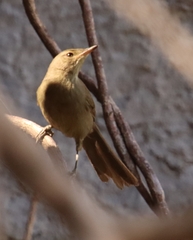
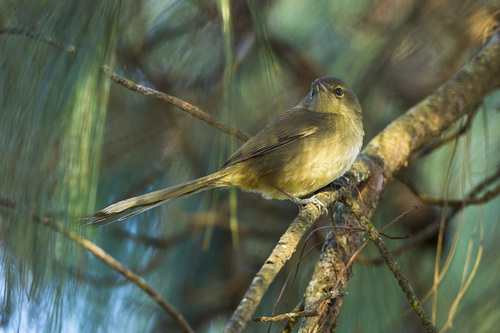
The Malagasy brush warbler (Nesillas typica), also known as the Madagascar brush warbler, is a species of Old World warbler in the family Acrocephalidae.. The Malagasy brush warbler is a widespread species of forest undergrowth and is found primarily in both Madagascar and the Comoro Islands. The bird is typically found alone or in pairs of 2 and flies short distances due to a small wingspan. Its natural habitats are subtropical or tropical dry forests, subtropical or tropical moist lowland forests, and subtropical or tropical moist shrubland.

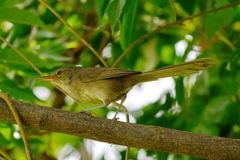
The Malagasy brush warbler is brown with contrastingly white eyebrows. Nesillas typica is an example of the genus, which is a category that ranks above species and below family. The bird has a sleek and slim body, low forehead and crown (raised to form a slight crest), and shorter sized bird. The Malagasy brush warbler's wings are short and rounded. Males' wing spans range from 62-70mm while females range from 58-67mm. The tails are long and graduated: males range from 72-93mm while females are 67-83mm. In relation to the rest of its body, its bill is long and brown with the forehead and crown being relatively low.
Wikipedia →

Sounds

Call0:33

Madagascar · 2025

© Joost van Bruggen · XC1079464 · CC BY-NC-ND 4.0

Alarm call0:12

Madagascar · 2024

© Francesco Barberini · XC937168 · CC BY-NC-SA 4.0

Song0:54

Madagascar · 2020

© Ken Behrens · XC624019 · CC BY-NC-SA 4.0

Global Distribution

Parks Where Found

# Park Country Daily sighting probability
1 Mantadia National Park 🇲🇬 Madagascar
~60%
2 Ranomafana National Park 🇲🇬 Madagascar
~60%
3 Montagne d'Ambre National Park 🇲🇬 Madagascar
~40%
4 Ankarana National Park 🇲🇬 Madagascar
~30%
5 Ankarafantsika National Park 🇲🇬 Madagascar
<5%

Cities Where Found

# City Country Daily sighting probability
1 Antananarivo 🇲🇬 Madagascar
~50%

Before you go

What are the chances of seeing a Malagasy Brush Warbler in Montagne d'Ambre National Park?

Likely

About 40% of wildlife watchers report a Malagasy Brush Warbler sighting in Montagne d'Ambre National Park on a given day, based on 17 verified sightings from GBIF citizen-science data from 2019 to 2026. It is the 7th most-seen of the 30 birds we can rate there. Over three days the chance rises to about 80%, and over a week to over 90%, if each day is a fresh chance.

What time of day is best to see a Malagasy Brush Warbler?

Between 9 am and noon

Across all the parks we cover, that three-hour window holds the most Malagasy Brush Warbler sightings with a recorded time, and about 8 in 10 of them come between 6 am and 6 pm: it is a daytime animal.

Is Montagne d'Ambre National Park the best place to see a Malagasy Brush Warbler?

3rd of 5

Of the 5 parks where we can rate Malagasy Brush Warbler sightings, Montagne d'Ambre National Park ranks 3rd at about 40%. The best odds are in Mantadia National Park (Madagascar, about 60%) and Ranomafana National Park (Madagascar, about 60%). All parks ranked.

Which relatives of the Malagasy Brush Warbler live in Montagne d'Ambre National Park?

Same order: Passeriformes

The closest relatives of the Malagasy Brush Warbler that you can see in Montagne d'Ambre National Park (order Passeriformes, Perching Birds) are Madagascar Bulbul (about 60%), Souimanga Sunbird (about 60%) and Amber Mountain Rock-Thrush (about 50%), with each one's daily chance of a sighting.

Where does the Malagasy Brush Warbler sighting chance come from?

GBIF citizen-science records

It is estimated from how often the Malagasy Brush Warbler is recorded against all the birds logged in Montagne d'Ambre National Park (17 verified sightings from 2019 to 2026), calibrated against known sighting rates. Figures are rounded to the nearest 10% because citizen-science data supports honest approximations, not decimals, and months with records from fewer than five people show "—". How it works.

← Back to Montagne d'Ambre National Park