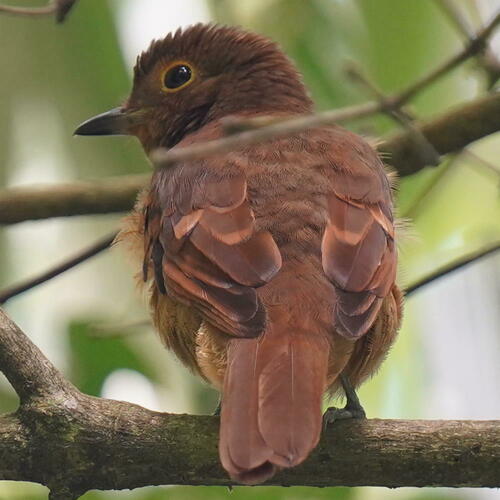
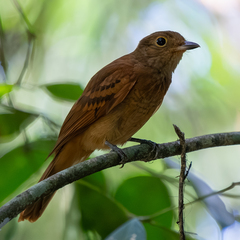

Speckled Mourner

Speckled Mourner

Laniocera rufescens

Silhouette: Sheatherius · PhyloPic

LCLeast ConcernNTVUENCR
Daily sighting probability <5% · Rare
at Montes Azules Biosphere Reserve

In 3 days ~10% in a week ~20%

12 Verified sightings at Montes Azules Biosphere Reserve From 2019 to 2026
454 In all 4 parks
May Best month
☀️ Diurnal When it's spotted

About the Speckled Mourner

The speckled mourner (Laniocera rufescens) is a species of bird in the family Tityridae. It is found in Mexico, in every Central American country except El Salvador, and in Colombia and Ecuador. The speckled mourner was originally described in 1858 as Lipaugus rufescens, placing it in the family Cotingidae. It was later reassigned to genus Laniocera that Lesson had erected in 1841. Well into the twentieth century authors variously placed that genus in Cotingidae, the manakin family Pipridae, or the tyrant flycatcher family Tyrannidae. Several early twenty-first century studies confirmed the placement of Laniocera in Tityridae and taxonomic systems made the reassignment. In 1998 the American Ornithological Society was unsure where to place the genus and listed its members as incertae sedis but in 2011 moved them to Tityridae.

The speckled mourner shares genus Laniocera with the cinereous mourner (L. hypopyrra) and the two form a superspecies. The speckled mourner is 19 to 21.5... Wikipedia →

Sounds

Song0:32

Panama · 2021

© Daniel Errichetti · XC645537 · CC BY-NC-SA 4.0

Call0:07

Honduras · 2017

© Roland Rumm · XC371504 · CC BY-NC-SA 4.0

Song0:16

Ecuador · 1998

© Patricio Mena Valenzuela · XC275490 · CC BY-NC-SA 4.0

Global Distribution

Parks Where Found

# Park Country Daily sighting probability
1 Darién National Park 🇵🇦 Panama
~10%
2 Montes Azules Biosphere Reserve 🇲🇽 Mexico
<5%
3 Soberanía National Park 🇵🇦 Panama
<5%
4 Pico Bonito National Park 🇭🇳 Honduras
<5%

Before you go

What are the chances of seeing a Speckled Mourner in Montes Azules Biosphere Reserve?

Rare

Under 5% of wildlife watchers report a Speckled Mourner sighting in Montes Azules Biosphere Reserve on a given day, based on 12 verified sightings from GBIF citizen-science data from 2019 to 2026. It is the 202nd most-seen of the 240 birds we can rate there. Over three days the chance rises to about 10%, and over a week to about 20%, if each day is a fresh chance.

When is the best time to see a Speckled Mourner in Montes Azules Biosphere Reserve?

May

In that month about 20% of wildlife watchers report a Speckled Mourner in Montes Azules Biosphere Reserve on a given day, against under 5% in July to April, the lowest months.

What time of day is best to see a Speckled Mourner?

Between 8 and 11 am

Across all the parks we cover, that three-hour window holds the most Speckled Mourner sightings with a recorded time, and about 8 in 10 of them come between 6 am and 6 pm: it is a daytime animal.

Is Montes Azules Biosphere Reserve the best place to see a Speckled Mourner?

2nd of 4

Of the 4 parks where we can rate Speckled Mourner sightings, Montes Azules Biosphere Reserve ranks 2nd at under 5%. The best odds are in Darién National Park (Panama, about 10%).

Which relatives of the Speckled Mourner live in Montes Azules Biosphere Reserve?

Same family: Cotingidae

The closest relatives of the Speckled Mourner that you can see in Montes Azules Biosphere Reserve (family Cotingidae, Cotingas) are Masked Tityra (about 30%), Russet-winged Schiffornis (about 20%) and Rufous Piha (about 10%), with each one's daily chance of a sighting.

Where does the Speckled Mourner sighting chance come from?

GBIF citizen-science records

It is estimated from how often the Speckled Mourner is recorded against all the birds logged in Montes Azules Biosphere Reserve (12 verified sightings from 2019 to 2026), calibrated against known sighting rates. Figures are rounded to the nearest 10% because citizen-science data supports honest approximations, not decimals, and months with records from fewer than five people show "—". How it works.

← Back to Montes Azules Biosphere Reserve