Common Mussurana

Common Mussurana

Clelia clelia

Silhouette: Alex Slavenko · PhyloPic

LCLeast ConcernNTVUENCR
Daily sighting probability ~10% · With luck
at Monteverde Cloud Forest Reserve

In 3 days ~20% in a week ~30%

6 Verified sightings at Monteverde Cloud Forest Reserve From 2019 to 2026
58 In all 5 parks
November Best month
☀️🌙 Day & Night When it's spotted

About the Common Mussurana

Clelia clelia, commonly known as the mussurana, black mussurana or windward cribo, is a species of snake in the subfamily Dipsadinae of the family Colubridae. The species is native to the New World. The subspecific name, groomei, is in honor of Grenadian zoologist John R. Groome.

Clelia clelia is called doi or duma in the Kwaza language of Rondônia, Brazil. Clelia clelia is found in Central America, South America, and the Lesser Antilles (including the island of Trinidad). The preferred natural habitat of Clelia clelia is forest at altitudes from sea level to 1,500 m (4,900 ft).

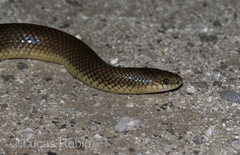
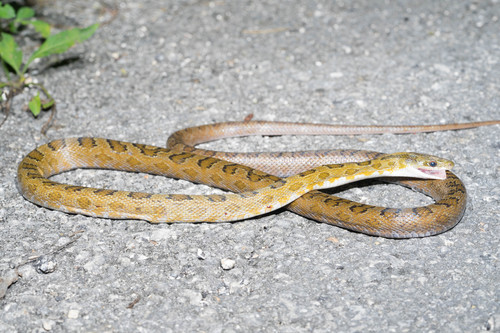
Clelia clelia is a large snake. Adults may attain a snout-to-vent length (SVL) of 2.1 m (6.9 ft). Dorsally, adults are uniform black, gray, or olive-gray. Ventrally, adults are yellowish white. Juveniles are pale brown or red, with a black head and a yellow collar.

Clelia clelia is terrestrial. It is primarily nocturnal, but it is also sometimes diurnal. Clelia clelia is a generalized noctural predator with a strong degree of ophiophagy, including venomous snakes of the genera Bothriechis, Bothrops... Wikipedia →

Global Distribution

Parks Where Found

# Park Country Daily sighting probability
1 Tambopata National Reserve 🇵🇪 Peru
~10%
2 Manu National Park 🇵🇪 Peru
~10%
3 Arenal Volcano National Park 🇨🇷 Costa Rica
~10%
4 La Amistad International Park (Panama) 🇵🇦 Panama
~10%
5 Monteverde Cloud Forest Reserve 🇨🇷 Costa Rica
~10%

Zoos & Centres Where Found

# Zoo / Centre Country
1 VigoNature 🇪🇸 Spain In captivity

Before you go

What are the chances of seeing a Common Mussurana in Monteverde Cloud Forest Reserve?

With luck

About 10% of wildlife watchers report a Common Mussurana sighting in Monteverde Cloud Forest Reserve on a given day, based on 6 verified sightings from GBIF citizen-science data from 2019 to 2026. It is the 37th most-seen of the 43 reptiles we can rate there. Over three days the chance rises to about 20%, and over a week to about 30%, if each day is a fresh chance.

When is the best time to see a Common Mussurana in Monteverde Cloud Forest Reserve?

February, April, June, August and November–December

In those months about 10% of wildlife watchers report a Common Mussurana in Monteverde Cloud Forest Reserve on a given day, against under 5% in January, March, May, July and September–October, the lowest months.

What time of day is best to see a Common Mussurana?

Between 7 and 10 pm

Across all the parks we cover, that three-hour window holds the most Common Mussurana sightings with a recorded time, and about half of them come between 6 pm and 6 am: it is seen both by day and at night.

Is Monteverde Cloud Forest Reserve the best place to see a Common Mussurana?

Among the best

Of the 5 parks where we can rate Common Mussurana sightings, Monteverde Cloud Forest Reserve ranks 5th at about 10%, level with the leaders once rounded. The best odds are in Tambopata National Reserve (Peru, about 10%), Manu National Park (Peru, about 10%) and Arenal Volcano National Park (Costa Rica, about 10%).

Which relatives of the Common Mussurana live in Monteverde Cloud Forest Reserve?

Same family: Colubridae

The closest relatives of the Common Mussurana that you can see in Monteverde Cloud Forest Reserve (family Colubridae, Colubrid Snakes) are Chicken Snake (about 10%), Green Rat Snake (about 10%) and Puffing Snake (about 10%), with each one's daily chance of a sighting.

Where does the Common Mussurana sighting chance come from?

GBIF citizen-science records

It is estimated from how often the Common Mussurana is recorded against all the reptiles logged in Monteverde Cloud Forest Reserve (6 verified sightings from 2019 to 2026), calibrated against known sighting rates. Figures are rounded to the nearest 10% because citizen-science data supports honest approximations, not decimals, and months with records from fewer than five people show "—". How it works.

← Back to Monteverde Cloud Forest Reserve