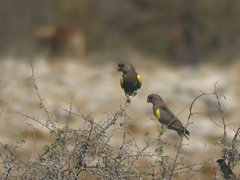

Meyer's Parrot

Meyer's Parrot

Poicephalus meyeri

Silhouette: Sheatherius · PhyloPic

LCLeast ConcernNTVUENCR
Daily sighting probability ~50% · Likely
at Moremi Game Reserve

In 3 days ~80% in a week >90%

658 Verified sightings at Moremi Game Reserve From 2019 to 2026
4,978 In all 24 parks
August Best month
☀️ Diurnal When it's spotted

About the Meyer's Parrot

Meyer's parrot (Poicephalus meyeri), also known as the brown parrot, is a species of parrot native to Africa. A Meyer's parrot has black feathers, turquoise belly, blue rump, and bright yellow markings on the carpal joint of the wings. Most subspecies have some yellow on the top of the head as well. Forshaw (1989) recognizes six subspecies of P. meyeri which vary in home range, size and in markings, including the extent of yellow markings to the head and wings, and the intensity of turquoise markings on the belly and rump.

German physician and ornithologist Philipp Jakob Cretzschmar described Meyer's parrot in 1827. The name commemorates the German ornithologist Bernhard Meyer. Wikipedia →

Sounds

Flight call0:21

Zambia · 2023

© Marc Anderson · XC892520 · CC BY-NC-ND 4.0

Song0:46

Zambia · 2024

© Dries Van de Loock · XC872301 · CC BY-NC-ND 4.0

Call0:12

Tanzania · 2022

© isaac kilusu · XC767573 · CC BY-NC-SA 4.0

Global Distribution

Parks Where Found

# Park Country Daily sighting probability
1 Ruaha National Park 🇹🇿 Tanzania
~60%
2 Kidepo Valley National Park 🇺🇬 Uganda
~60%
3 Lake Mburo National Park 🇺🇬 Uganda
~50%
4 Moremi Game Reserve 🇧🇼 Botswana
~50%
5 Kafue National Park 🇿🇲 Zambia
~50%
6 Akagera National Park 🇷🇼 Rwanda
~40%
7 Mana Pools National Park 🇿🇼 Zimbabwe
~40%
8 Lower Zambezi National Park 🇿🇲 Zambia
~30%
9 Hwange National Park 🇿🇼 Zimbabwe
~20%
10 Tarangire National Park 🇹🇿 Tanzania
~20%
11 Lake Nakuru National Park 🇰🇪 Kenya
~20%
12 South Luangwa National Park 🇿🇲 Zambia
~20%
13 Serengeti National Park 🇹🇿 Tanzania
~20%
14 Masai Mara National Reserve 🇰🇪 Kenya
~20%
15 Chobe National Park 🇧🇼 Botswana
~10%
16 Gonarezhou National Park 🇿🇼 Zimbabwe
~10%
17 Kibale National Park 🇺🇬 Uganda
~10%
18 Mikumi National Park 🇹🇿 Tanzania
~10%
19 Murchison Falls National Park 🇺🇬 Uganda
~10%
20 Etosha National Park 🇳🇦 Namibia
<5%
21 Queen Elizabeth National Park 🇺🇬 Uganda
<5%
22 Samburu National Reserve 🇰🇪 Kenya
<5%
23 Ngorongoro Conservation Area 🇹🇿 Tanzania
<5%
24 Kruger National Park 🇿🇦 South Africa
<5%

Cities Where Found

# City Country Daily sighting probability
1 Lusaka 🇿🇲 Zambia
~20%
2 Kampala 🇺🇬 Uganda
~10%
3 Harare 🇿🇼 Zimbabwe
<5%
4 Kigali 🇷🇼 Rwanda
<5%

Zoos & Centres Where Found

# Zoo / Centre Country
1 Loro Parque 🇪🇸 Spain In captivity
2 World of Birds Wildlife Sanctuary and Monkey Park 🇿🇦 South Africa In captivity
3 Bird Park 🇷🇺 Russia In captivity
4 Kuusamon Suurpetokeskus 🇫🇮 Finland In captivity

Before you go

What are the chances of seeing a Meyer's Parrot in Moremi Game Reserve?

Likely

About 50% of wildlife watchers report a Meyer's Parrot sighting in Moremi Game Reserve on a given day, based on 658 verified sightings from GBIF citizen-science data from 2019 to 2026. It is the 20th most-seen of the 334 birds we can rate there. Over three days the chance rises to about 80%, and over a week to over 90%, if each day is a fresh chance.

When is the best time to see a Meyer's Parrot in Moremi Game Reserve?

August

In that month about 60% of wildlife watchers report a Meyer's Parrot in Moremi Game Reserve on a given day, against about 30% in February, July and December, the lowest months. That is one of Moremi Game Reserve's driest months, with almost no rain against 150 mm in January.

What time of day is best to see a Meyer's Parrot?

Between 7 and 10 am

Across all the parks we cover, that three-hour window holds the most Meyer's Parrot sightings with a recorded time, and about 8 in 10 of them come between 6 am and 6 pm: it is a daytime animal.

Where does the Meyer's Parrot sighting chance come from?

GBIF citizen-science records

It is estimated from how often the Meyer's Parrot is recorded against all the birds logged in Moremi Game Reserve (658 verified sightings from 2019 to 2026), calibrated against known sighting rates. Figures are rounded to the nearest 10% because citizen-science data supports honest approximations, not decimals, and months with records from fewer than five people show "—". How it works.

← Back to Moremi Game Reserve