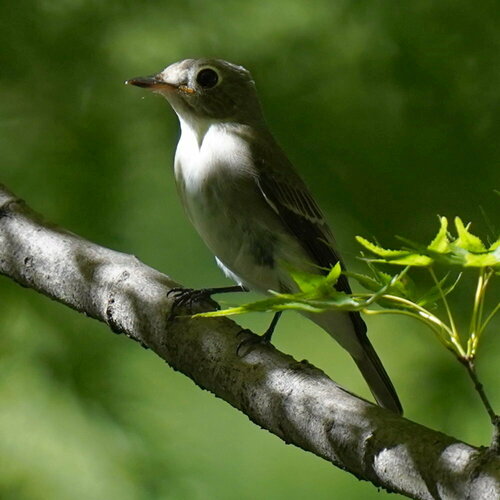
Nilgiri Flycatcher

Nilgiri Flycatcher

Eumyias albicaudatus

Silhouette: Martin Bulla, based on François Desbordes' illustration · PhyloPic

LCLeast ConcernNTVUENCR Endemic
Daily sighting probability <5% · Rare
at Mudumalai National Park

In 3 days <5% in a week ~10%

14 Verified sightings at Mudumalai National Park From 2019 to 2026
327 In all 3 parks
April Best month
🌅 Crepuscular When it's spotted

About the Nilgiri Flycatcher

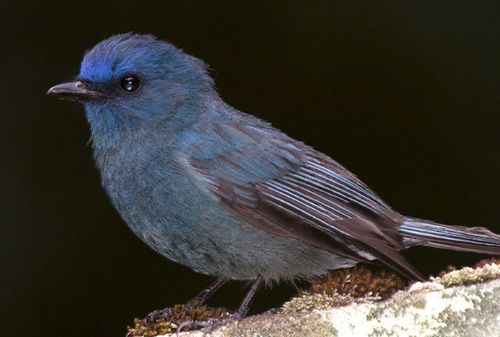
The Nilgiri flycatcher (Eumyias albicaudatus) is an Old World flycatcher with a very restricted range in the hills of southern India. It was formerly referred to as the Nilgiri verditer flycatcher because of its similarity to the verditer flycatcher, a winter migrant to the Nilgiris, which, however, has distinct dark lores and a lighter shade of blue. There are two small white patches at the base of the tail. It is found mainly in the higher altitude shola forests of the Western Ghats and the Nilgiris.

This small and somewhat long-tailed flycatcher is about 13 cm (5.1 in). It is dark steely indigo blue with some violet-blue on the forehead and darker lores. It is much darker than the verditer flycatcher and does not have as strong a contrast in the pale face and black lores. The female is duller with dark brown on the upperparts and dark grey below. The two central tail feathers are blue and the lateral feathers are dark brown and edged with indigo. The bases of the outer tail feathers are white but this is not easily visible when the bird is sitting. The wing feathers are dark brown with a narrow outer fringe of blue. The juvenile is dark brown with creamy spots... Wikipedia →

Sounds

Song0:10

India · 2016

© Frank Lambert · XC474084 · CC BY-NC-ND 4.0

Call0:09

India · 2015

© Richard Thomas · XC239738 · CC BY-NC-SA 4.0

Song0:31

India · 2018

© Viral joshi · XC400011 · CC BY-NC-SA 4.0

Global Distribution

Parks Where Found

# Park Country Daily sighting probability
1 Eravikulam National Park 🇮🇳 India
~60%
2 Mudumalai National Park 🇮🇳 India
<5%
3 Periyar National Park 🇮🇳 India
<5%

Before you go

What are the chances of seeing a Nilgiri Flycatcher in Mudumalai National Park?

Rare

Under 5% of wildlife watchers report a Nilgiri Flycatcher sighting in Mudumalai National Park on a given day, based on 14 verified sightings from GBIF citizen-science data from 2019 to 2026. It is the 215th most-seen of the 233 birds we can rate there. Over three days the chance rises to under 5%, and over a week to about 10%, if each day is a fresh chance.

When is the best time to see a Nilgiri Flycatcher in Mudumalai National Park?

Any time of year

In every month with enough records, under 5% of wildlife watchers report a Nilgiri Flycatcher in Mudumalai National Park on a given day, so our monthly data shows no clear season.

What time of day is best to see a Nilgiri Flycatcher?

Between 4 and 7 am

Across all the parks we cover, that three-hour window holds the most Nilgiri Flycatcher sightings with a recorded time, and about 6 in 10 of them come between 6 am and 6 pm: it is most active around dawn and dusk.

Is Mudumalai National Park the best place to see a Nilgiri Flycatcher?

2nd of 3

Of the 3 parks where we can rate Nilgiri Flycatcher sightings, Mudumalai National Park ranks 2nd at under 5%. The best odds are in Eravikulam National Park (India, about 60%).

Where does the Nilgiri Flycatcher sighting chance come from?

GBIF citizen-science records

It is estimated from how often the Nilgiri Flycatcher is recorded against all the birds logged in Mudumalai National Park (14 verified sightings from 2019 to 2026), calibrated against known sighting rates. Figures are rounded to the nearest 10% because citizen-science data supports honest approximations, not decimals, and months with records from fewer than five people show "—". How it works.
← Back to Mudumalai National Park