Side-striped Jackal

Side-striped Jackal

Canis adustus

Daily sighting probability ~40% · Likely
at Murchison Falls National Park

In 3 days ~80% in a week >90%

26 Verified sightings at Murchison Falls National Park From 2019 to 2026
175 In all 11 parks
August Best month
🌅 Crepuscular When it's spotted

About the Side-striped Jackal

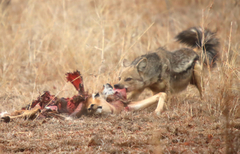
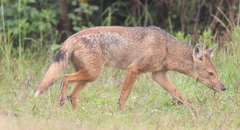
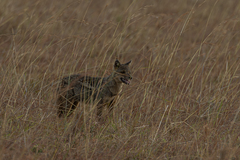
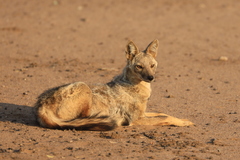
The side-striped jackal (Lupulella adusta or Schaeffia adusta) is a canine native to Central and Southern Africa. The side-striped jackal has a much wider distribution than the better-known black-backed Jackal, but there are large parts of their range with no information on their population status.

The Swedish zoologist Carl Jakob Sundevall named the species Canis adustus in 1847. The German zoologist Max Hilzheimer proposed a different genus as Schaeffia adusta in 1906. Fossil remains of the side-striped jackal date to the Pliocene era. A mitochondrial DNA sequence alignment for the wolf-like canids gave a phylogenetic tree with the side-striped jackal and the black-backed jackal being the most basal members of this clade, which means that this tree is indicating an African origin for the clade.

Wikipedia →

Global Distribution

Parks Where Found

# Park Country Daily sighting probability
1 Kidepo Valley National Park 🇺🇬 Uganda
~70%
2 Liwonde National Park 🇲🇼 Malawi
~60%
3 Murchison Falls National Park 🇺🇬 Uganda
~40%
4 Kafue National Park 🇿🇲 Zambia
~30%
5 Mana Pools National Park 🇿🇼 Zimbabwe
~30%
6 Moremi Game Reserve 🇧🇼 Botswana
~30%
7 uMkhuze Game Reserve 🇿🇦 South Africa
~20%
8 Kruger National Park 🇿🇦 South Africa
~10%
9 Serengeti National Park 🇹🇿 Tanzania
~10%
10 Masai Mara National Reserve 🇰🇪 Kenya
~10%
11 iSimangaliso Wetland Park 🇿🇦 South Africa
~10%

Cities Where Found

# City Country Daily sighting probability
1 Nairobi 🇰🇪 Kenya
~10%

Zoos & Centres Where Found

# Zoo / Centre Country
1 Kano Zoo 🇳🇬 Nigeria In captivity
2 Nairobi Safari Walk 🇰🇪 Kenya In captivity
3 Animal Orphanage 🇰🇪 Kenya In captivity
4 Audu Bako Zoo 🇳🇬 Nigeria In captivity

Before you go

What are the chances of seeing a Side-striped Jackal in Murchison Falls National Park?

Likely

About 40% of wildlife watchers report a Side-striped Jackal sighting in Murchison Falls National Park on a given day, based on 26 verified sightings from GBIF citizen-science data from 2019 to 2026. It is the 15th most-seen of the 25 mammals we can rate there. Over three days the chance rises to about 80%, and over a week to over 90%, if each day is a fresh chance.

When is the best time to see a Side-striped Jackal in Murchison Falls National Park?

August

In that month about 50% of wildlife watchers report a Side-striped Jackal in Murchison Falls National Park on a given day, against under 5% in June and December, the lowest months.

What time of day is best to see a Side-striped Jackal?

Between 6 and 9 am

Across all the parks we cover, that three-hour window holds the most Side-striped Jackal sightings with a recorded time, and about 7 in 10 of them come between 6 am and 6 pm: it is most active around dawn and dusk.

Is Murchison Falls National Park the best place to see a Side-striped Jackal?

3rd of 11

Of the 11 parks where we can rate Side-striped Jackal sightings, Murchison Falls National Park ranks 3rd at about 40%. The best odds are in Kidepo Valley National Park (Uganda, about 70%) and Liwonde National Park (Malawi, about 60%). All parks ranked.

Which relatives of the Side-striped Jackal live in Murchison Falls National Park?

Same order: Carnivora

The closest relatives of the Side-striped Jackal that you can see in Murchison Falls National Park (order Carnivora, Carnivorans) are Lion (about 60%), Leopard (about 50%) and Spotted Hyena (about 40%), with each one's daily chance of a sighting.

Where does the Side-striped Jackal sighting chance come from?

GBIF citizen-science records

It is estimated from how often the Side-striped Jackal is recorded against all the mammals logged in Murchison Falls National Park (26 verified sightings from 2019 to 2026), calibrated against known sighting rates. Figures are rounded to the nearest 10% because citizen-science data supports honest approximations, not decimals, and months with records from fewer than five people show "—". How it works.

← Back to Murchison Falls National Park