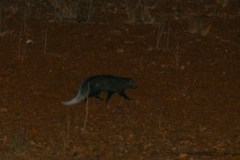
White-tailed Mongoose

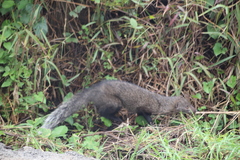
White-tailed Mongoose

Ichneumia albicauda

Silhouette: Margot Michaud · PhyloPic

LCLeast ConcernNTVUENCR
Daily sighting probability ~20% · Possible
at Murchison Falls National Park

In 3 days ~40% in a week ~70%

6 Verified sightings at Murchison Falls National Park From 2019 to 2026
52 In all 6 parks
May Best month
☀️🌙 Day & Night When it's spotted

About the White-tailed Mongoose

The white-tailed mongoose (Ichneumia albicauda) is a species in the mongoose family Herpestidae. It is the only member of the genus Ichneumia. Herpestes albicaudus was the scientific name proposed by Georges Cuvier in 1829 for a mongoose specimen with a white tail from Senegal. The genus name Ichneumia was coined by Isidore Geoffroy Saint-Hilaire in 1837.

The white-tailed mongoose attains a weight range of 1.8 to 5.2 kg (4.0 to 11.5 lb), with an average of approximately 3.38 kg (7.5 lb), has a head-and-body length of 53 to 71 cm (21 to 28 in) and a tail length of 40 to 47 cm (16 to 19 in). On average it appears to be the longest and heaviest extant species of mongoose, although its linear and body mass parameters broadly overlap with other larger mongoose species, in particular, the marsh mongoose seems to most closely rival (and possibly match) in range of body masses reported if not average weight. Its legs are relatively long for a mongoose. The head is long and narrow. Its large, rounded ears are set low on the sides of the head. It has a yellow to tan coloration on its body, with long black guard hairs, giving it an overall grizzled grey appearance... Wikipedia →

Sounds

Recording0:10

South Sudan · 2026

© Inge van den Meiracker · iNaturalist · CC BY-NC 4.0

Recording0:05

Congo - Kinshasa · 2017

© Mathias D'haen · iNaturalist · CC BY-NC 4.0

Recording0:34

Kenya · 2025

© Simon Musila · iNaturalist · CC BY-NC 4.0

Global Distribution

Parks Where Found

# Park Country Daily sighting probability
1 South Luangwa National Park 🇿🇲 Zambia
~30%
2 Liwonde National Park 🇲🇼 Malawi
~30%
3 Murchison Falls National Park 🇺🇬 Uganda
~20%
4 Tarangire National Park 🇹🇿 Tanzania
~10%
5 Masai Mara National Reserve 🇰🇪 Kenya
~10%
6 Kruger National Park 🇿🇦 South Africa
~10%

Cities Where Found

# City Country Daily sighting probability
1 Nairobi 🇰🇪 Kenya
~10%
2 Durban 🇿🇦 South Africa
~10%

Before you go

What are the chances of seeing a White-tailed Mongoose in Murchison Falls National Park?

Possible

About 20% of wildlife watchers report a White-tailed Mongoose sighting in Murchison Falls National Park on a given day, based on 6 verified sightings from GBIF citizen-science data from 2019 to 2026. It is the 22nd most-seen of the 23 mammals we can rate there. Over three days the chance rises to about 40%, and over a week to about 70%, if each day is a fresh chance.

When is the best time to see a White-tailed Mongoose in Murchison Falls National Park?

January, March and May

In those months about 30% of wildlife watchers report a White-tailed Mongoose in Murchison Falls National Park on a given day, against under 5% in February, April, June–July and September–December, the lowest months.

What time of day is best to see a White-tailed Mongoose?

Between 6 and 9 pm

Across all the parks we cover, that three-hour window holds the most White-tailed Mongoose sightings with a recorded time, and about 7 in 10 of them come between 6 pm and 6 am: it is seen both by day and at night.

Is Murchison Falls National Park the best place to see a White-tailed Mongoose?

3rd of 6

Of the 6 parks where we can rate White-tailed Mongoose sightings, Murchison Falls National Park ranks 3rd at about 20%. The best odds are in South Luangwa National Park (Zambia, about 30%) and Liwonde National Park (Malawi, about 30%).

Which relatives of the White-tailed Mongoose live in Murchison Falls National Park?

Same order: Carnivora

The closest relatives of the White-tailed Mongoose that you can see in Murchison Falls National Park (order Carnivora, Carnivorans) are Lion (about 60%), Leopard (about 50%) and Spotted Hyena (about 40%), with each one's daily chance of a sighting.

Where does the White-tailed Mongoose sighting chance come from?

GBIF citizen-science records

It is estimated from how often the White-tailed Mongoose is recorded against all the mammals logged in Murchison Falls National Park (6 verified sightings from 2019 to 2026), calibrated against known sighting rates. Figures are rounded to the nearest 10% because citizen-science data supports honest approximations, not decimals, and months with records from fewer than five people show "—". How it works.

← Back to Murchison Falls National Park