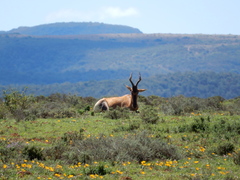
Hartebeest

Hartebeest

Alcelaphus buselaphus

Silhouette: TeaandBiology · PhyloPic

LCLeast ConcernNTVUENCR
Daily sighting probability ~70% · Very likely
at Murchison Falls National Park

In 3 days >90%

152 Verified sightings at Murchison Falls National Park From 2019 to 2026
1,020 In all 15 parks
August Best month
☀️ Diurnal When it's spotted

About the Hartebeest

The hartebeest (Alcelaphus buselaphus), also known as kongoni or kaama, is an African antelope. It is the only member of the genus Alcelaphus. Eight subspecies have been described, including two sometimes considered to be independent species. A large antelope, the hartebeest stands just over 1 m (3 ft 3 in) at the shoulder, and has a typical head-and-body length of 2 to 2.50 m (6 ft 7 in to 8 ft 2 in). The weight ranges from 100 to 200 kg (220 to 440 lb). It has a particularly elongated forehead and oddly-shaped horns, a short neck, and pointed ears. Its legs, which often have black markings, are unusually long. The coat is generally short and shiny. Coat colour varies by the subspecies, from the sandy brown of the western hartebeest to the chocolate brown of the Swayne's hartebeest. Both sexes of all subspecies have horns, with those of females being slenderer. Horns can reach lengths of 45–70 cm (18–28 in). Apart from its long face, the large chest and the sharply sloping back differentiate the hartebeest from other antelopes. A conspicuous hump over the shoulders is due to the long dorsal processes of the vertebrae in this region.

Gregarious animals, hartebeest form herds of 20 to 300 individuals. They are very alert and non-aggressive. They are primarily grazers, with their diets consisting mainly of grasses. Mating in hartebeest takes place throughout the year with one or two peaks, and depends upon the subspecies and local factors. Both males and females reach sexual maturity at one to two years of age. Gestation is eight to nine months long, after which a single calf is born. Births usually peak in the dry season. The lifespan is 12 to 15 years.

Inhabiting dry savannas and wooded grasslands, hartebeest often move to more arid places after rainfall. They have been reported from altitudes on Mount Kenya up to 4,000 m (13,000 ft). The hartebeest was formerly widespread in Africa, but populations have undergone a drastic decline due to habitat destruction, hunting, human settlement, and competition with livestock for food. Each of the eight subspecies of the hartebeest has a different conservation status. The Bubal hartebeest was declared extinct by the International Union for Conservation of Nature (IUCN) in 1994. While the populations of the red hartebeest are on the rise, those of the Tora hartebeest, already Critically Endangered, are falling. The hartebeest is extinct in Algeria, Egypt, Lesotho, Libya, Morocco, Somalia, and Tunisia; but has been introduced into Eswatini and Zimbabwe. It is a popular game animal due to its highly regarded meat. Wikipedia →

Sounds

Recording0:22

Ghana · 2026

© Valentin Moser · iNaturalist · CC BY 4.0

Global Distribution

Parks Where Found

# Park Country Daily sighting probability
1 Kidepo Valley National Park 🇺🇬 Uganda
~80%
2 Nairobi National Park 🇰🇪 Kenya
~80%
3 Murchison Falls National Park 🇺🇬 Uganda
~70%
4 Tsavo East National Park 🇰🇪 Kenya
~70%
5 Mkomazi National Park 🇹🇿 Tanzania
~50%
6 Tsavo West National Park 🇰🇪 Kenya
~50%
7 Serengeti National Park 🇹🇿 Tanzania
~50%
8 Kafue National Park 🇿🇲 Zambia
~40%
9 Masai Mara National Reserve 🇰🇪 Kenya
~40%
10 Gorongosa National Park 🇲🇿 Mozambique
~30%
11 Ngorongoro Conservation Area 🇹🇿 Tanzania
~30%
12 Liwonde National Park 🇲🇼 Malawi
~30%
13 Tarangire National Park 🇹🇿 Tanzania
~20%
14 Addo Elephant National Park 🇿🇦 South Africa
~10%
15 Etosha National Park 🇳🇦 Namibia
~10%

Cities Where Found

# City Country Daily sighting probability
1 Nairobi 🇰🇪 Kenya
~10%

Before you go

What are the chances of seeing a Hartebeest in Murchison Falls National Park?

Very likely

About 70% of wildlife watchers report a Hartebeest sighting in Murchison Falls National Park on a given day, based on 152 verified sightings from GBIF citizen-science data from 2019 to 2026. It is the 4th most-seen of the 23 mammals we can rate there. Over three days the chance rises to over 90%, if each day is a fresh chance.

When is the best time to see a Hartebeest in Murchison Falls National Park?

January, August–September and November

In those months about 80% of wildlife watchers report a Hartebeest in Murchison Falls National Park on a given day, against about 50% in April, the lowest month.

What time of day is best to see a Hartebeest?

Between 7 and 10 am

Across all the parks we cover, that three-hour window holds the most Hartebeest sightings with a recorded time, and about 9 in 10 of them come between 6 am and 6 pm: it is a daytime animal.

Which relatives of the Hartebeest live in Murchison Falls National Park?

Same family: Bovidae

The closest relatives of the Hartebeest that you can see in Murchison Falls National Park (family Bovidae, Bovids) are Kob (about 80%), Oribi (about 70%) and African Buffalo (about 70%), with each one's daily chance of a sighting.

Where does the Hartebeest sighting chance come from?

GBIF citizen-science records

It is estimated from how often the Hartebeest is recorded against all the mammals logged in Murchison Falls National Park (152 verified sightings from 2019 to 2026), calibrated against known sighting rates. Figures are rounded to the nearest 10% because citizen-science data supports honest approximations, not decimals, and months with records from fewer than five people show "—". How it works.

← Back to Murchison Falls National Park