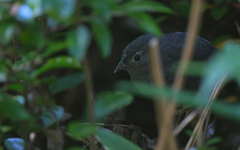
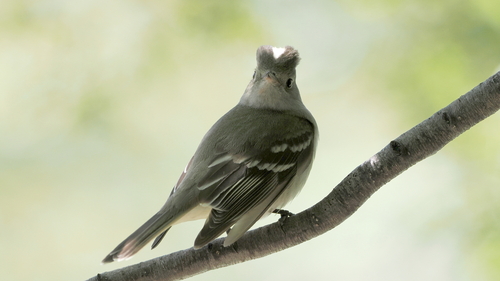
Ochre-flanked Tapaculo

Ochre-flanked Tapaculo

Eugralla paradoxa

Silhouette: Ferran Sayol · PhyloPic

LCLeast ConcernNTVUENCR
Daily sighting probability <5% · Rare
at Nahuel Huapi National Park

In 3 days <5% in a week ~10%

13 Verified sightings at Nahuel Huapi National Park From 2019 to 2026
41 In all 2 parks
December Best month
☀️ Diurnal When it's spotted

About the Ochre-flanked Tapaculo

The ochre-flanked tapaculo (Eugralla paradoxa) is a species of bird in the family Rhinocryptidae. It is found in south-central Chile and adjacent western Argentina. The ochre-flanked tapaculo is the only member of the genus Eugralla and has no subspecies. It had at one time been assigned to genus Triptohinus but Eugralla has priority.

The ochre-flanked tapaculo is 14.5 cm (5.7 in) long. Two males weighed 28.6 and 30.5 g (1.01 and 1.08 oz) and other specimens of unknown sex weighed 25.5 to 29 g (0.90 to 1.02 oz). The adults' upper parts are dark gray, the underparts as far as the abdomen paler gray, and the abdomen and vent are clay brown. The flanks are tawny brown The juvenile is barred throughout with cinnamon to rufous over dusky gray. Unusual for a tapaculo, it has a "Roman nose" facial profile.

The ochre-flanked tapaculo is a year round resident of south-central Chile (Maule Region to Los Lagos Region) and the western parts of the adjoining Argentinian provinces of Neuquén, Río Negro, and Chubut. It is found from sea level to 900 m (3,000 ft) and perhaps higher, where it inhabits dense undergrowth and... Wikipedia →

Sounds

Call0:23

Chile · 2025

© Marc Anderson · XC1015503 · CC BY-NC-ND 4.0

Song0:51

Chile · 2023

© Barry Edmonston · XC856364 · CC BY-NC-SA 4.0

Alarm call0:52

Chile · 2020

© Ignacio Escobar · XC614576 · CC BY-NC-SA 4.0

Global Distribution

Parks Where Found

# Park Country Daily sighting probability
1 Vicente Pérez Rosales National Park 🇨🇱 Chile
~10%
2 Nahuel Huapi National Park 🇦🇷 Argentina
<5%

Before you go

What are the chances of seeing an Ochre-flanked Tapaculo in Nahuel Huapi National Park?

Rare

Under 5% of wildlife watchers report an Ochre-flanked Tapaculo sighting in Nahuel Huapi National Park on a given day, based on 13 verified sightings from GBIF citizen-science data from 2019 to 2026. It is the 96th most-seen of the 111 birds we can rate there. Over three days the chance rises to under 5%, and over a week to about 10%, if each day is a fresh chance.

When is the best time to see an Ochre-flanked Tapaculo in Nahuel Huapi National Park?

Any time of year

In every month with enough records, under 5% of wildlife watchers report an Ochre-flanked Tapaculo in Nahuel Huapi National Park on a given day, so our monthly data shows no clear season.

What time of day is best to see an Ochre-flanked Tapaculo?

Between 11 am and 2 pm

Across all the parks we cover, that three-hour window holds the most Ochre-flanked Tapaculo sightings with a recorded time, and about 7 in 10 of them come between 6 am and 6 pm: it is a daytime animal.

Is Nahuel Huapi National Park the best place to see an Ochre-flanked Tapaculo?

2nd of 2

Of the 2 parks where we can rate Ochre-flanked Tapaculo sightings, Nahuel Huapi National Park ranks 2nd at under 5%. The best odds are in Vicente Pérez Rosales National Park (Chile, about 10%).

Which relatives of the Ochre-flanked Tapaculo live in Nahuel Huapi National Park?

Same family: Rhinocryptidae

The closest relatives of the Ochre-flanked Tapaculo that you can see in Nahuel Huapi National Park (family Rhinocryptidae, Tapaculos) are Chucao Tapaculo (about 40%), Magellanic Tapaculo (about 20%) and Black-throated Huet-huet (about 20%), with each one's daily chance of a sighting.

Where does the Ochre-flanked Tapaculo sighting chance come from?

GBIF citizen-science records

It is estimated from how often the Ochre-flanked Tapaculo is recorded against all the birds logged in Nahuel Huapi National Park (13 verified sightings from 2019 to 2026), calibrated against known sighting rates. Figures are rounded to the nearest 10% because citizen-science data supports honest approximations, not decimals, and months with records from fewer than five people show "—". How it works.

← Back to Nahuel Huapi National Park