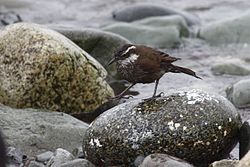
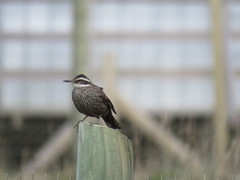

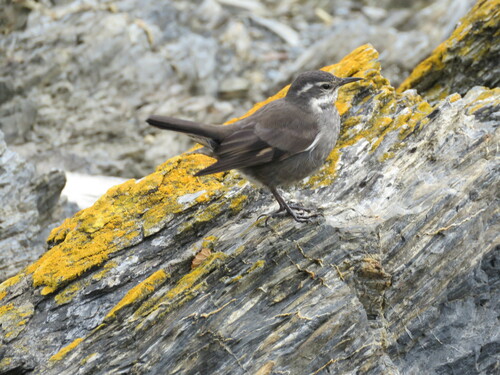
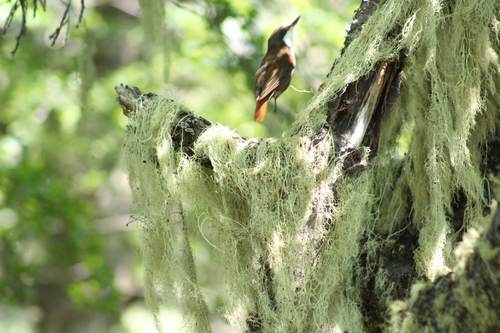
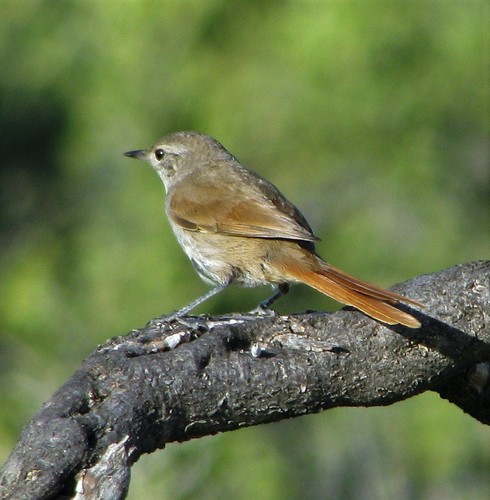
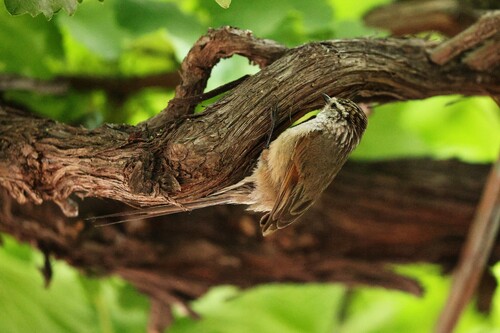
Dark-bellied Cinclodes

Dark-bellied Cinclodes

Cinclodes patagonicus

Silhouette: Edwin Price · PhyloPic

LCLeast ConcernNTVUENCR
Daily sighting probability ~50% · Likely
at Nahuel Huapi National Park

In 3 days ~90% in a week >90%

551 Verified sightings at Nahuel Huapi National Park From 2019 to 2026
1,309 In all 4 parks
March Best month
☀️ Diurnal When it's spotted

About the Dark-bellied Cinclodes

The dark-bellied cinclodes (Cinclodes patagonicus) is a species of bird in the Furnariinae subfamily of the ovenbird family Furnariidae. It is found in Argentina and Chile. The dark-bellied cinclodes was formally described in 1789 by the German naturalist Johann Friedrich Gmelin in his revised and expanded edition of Carl Linnaeus's Systema Naturae. He placed it with the wagtails in the genus Motacilla and coined the binomial name Motacilla patagonica. Gmelin based his description on the "Patagonian warbler" that had been described in 1783 by the English ornithologist John Latham in his book A General Synopsis of Birds. Latham had examined specimens in the Leverian Museum in London. The dark-bellied cinclodes is now one of 15 species placed in the genus Cinclodes that was introduced in 1840 by George Robert Gray.

Genetic data show that the dark-bellied cinclodes, Peruvian seaside cinclodes (C. taczanowskii), and the Chilean seaside cinclodes (C. nigrofumosus) are sister species. The dark... Wikipedia →

Sounds

Call1:27

Chile · 2022

© Cristian Pinto Fernandez · XC733280 · CC BY-NC-SA 4.0

Song0:52

Chile · 2018

© Peter Boesman · XC449876 · CC BY-NC-ND 4.0

Call0:04

Chile · 2019

© Cristian Pinto · XC488433 · CC BY-NC-SA 4.0

Global Distribution

Parks Where Found

# Park Country Daily sighting probability
1 Vicente Pérez Rosales National Park 🇨🇱 Chile
~50%
2 Nahuel Huapi National Park 🇦🇷 Argentina
~50%
3 Torres del Paine National Park 🇨🇱 Chile
~20%
4 Tierra del Fuego National Park 🇦🇷 Argentina
~10%

Cities Where Found

# City Country Daily sighting probability
1 Santiago 🇨🇱 Chile
<5%

Before you go

What are the chances of seeing a Dark-bellied Cinclodes in Nahuel Huapi National Park?

Likely

About 50% of wildlife watchers report a Dark-bellied Cinclodes sighting in Nahuel Huapi National Park on a given day, based on 551 verified sightings from GBIF citizen-science data from 2019 to 2026. It is the 6th most-seen of the 111 birds we can rate there. Over three days the chance rises to about 90%, and over a week to over 90%, if each day is a fresh chance.

When is the best time to see a Dark-bellied Cinclodes in Nahuel Huapi National Park?

March

In that month about 70% of wildlife watchers report a Dark-bellied Cinclodes in Nahuel Huapi National Park on a given day, against about 40% in July and August, the lowest months. That is one of Nahuel Huapi National Park's driest months, with about 90 mm of rain against 310 mm in June.

What time of day is best to see a Dark-bellied Cinclodes?

Between 3 and 6 pm

Across all the parks we cover, that three-hour window holds the most Dark-bellied Cinclodes sightings with a recorded time, and about 8 in 10 of them come between 6 am and 6 pm: it is a daytime animal.

Is Nahuel Huapi National Park the best place to see a Dark-bellied Cinclodes?

Among the best

Of the 4 parks where we can rate Dark-bellied Cinclodes sightings, Nahuel Huapi National Park ranks 2nd at about 50%, level with the leaders once rounded. The best odds are in Vicente Pérez Rosales National Park (Chile, about 50%).

Where does the Dark-bellied Cinclodes sighting chance come from?

GBIF citizen-science records

It is estimated from how often the Dark-bellied Cinclodes is recorded against all the birds logged in Nahuel Huapi National Park (551 verified sightings from 2019 to 2026), calibrated against known sighting rates. Figures are rounded to the nearest 10% because citizen-science data supports honest approximations, not decimals, and months with records from fewer than five people show "—". How it works.

← Back to Nahuel Huapi National Park