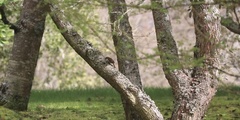
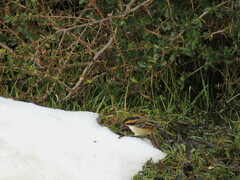
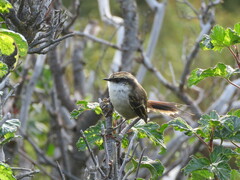
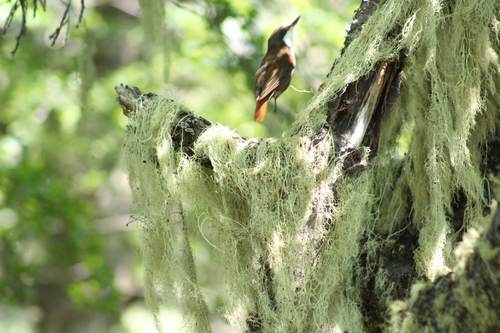
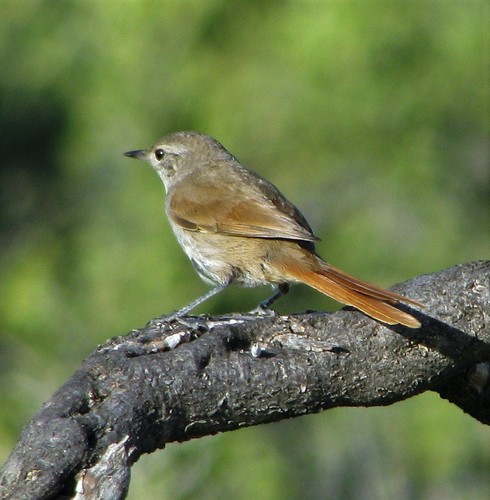
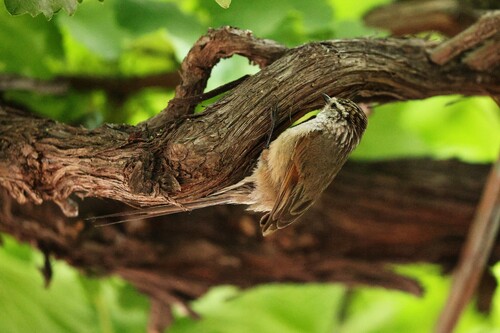
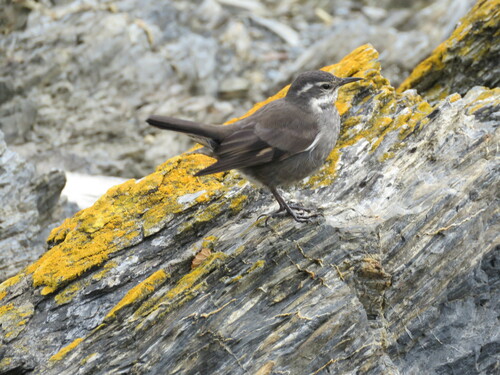
Thorn-tailed Rayadito

Thorn-tailed Rayadito

Aphrastura spinicauda

Silhouette: Edwin Price · PhyloPic

LCLeast ConcernNTVUENCR
Daily sighting probability ~40% · Likely
at Nahuel Huapi National Park

In 3 days ~80% in a week >90%

741 Verified sightings at Nahuel Huapi National Park From 2019 to 2026
3,303 In all 4 parks
May Best month
☀️ Diurnal When it's spotted

About the Thorn-tailed Rayadito

The thorn-tailed rayadito (Aphrastura spinicauda), is a species of bird in the family Furnariidae. It is found in temperate forests and subtropical dry shrubland south of 30°S. Some sources suggest it may formerly have occurred in the Falkland Islands. It remains the most common and best-known native bird in temperate forests of Zona Austral and Zona Sur in Chile, often occurring at densities of well over one individual per hectare.

The thorn-tailed rayadito was formally described in 1789 by the German naturalist Johann Friedrich Gmelin in his revised and expanded edition of Carl Linnaeus's Systema Naturae. He placed it with the wagtails in the genus Motacilla and coined the binomial name Motacilla spinicauda. Gmelin based his description on the "thorn-tailed warbler" that had been described and illustrated by the English ornithologist John Latham in his book A General Synopsis of Birds. The naturalist Joseph Banks had provided Latham with a water-colour drawing of the bird by Georg Forster who had accompanied James Cook on his second voyage to the Pacific Ocean. The picture was drawn in December 1774 at the Tierra del Fuego. This picture is held by the Natural History... Wikipedia →

Sounds

Song0:11

Chile · 2025

© Marc Anderson · XC1075480 · CC BY-NC-ND 4.0

Call0:44

Chile · 2023

© Scott Olmstead · XC872053 · CC BY-NC-SA 4.0

Alarm call0:26

Chile · 2020

© Dante Buzzetti · XC538664 · CC BY-NC-SA 4.0

Global Distribution

Parks Where Found

# Park Country Daily sighting probability
1 Tierra del Fuego National Park 🇦🇷 Argentina
~80%
2 Vicente Pérez Rosales National Park 🇨🇱 Chile
~70%
3 Nahuel Huapi National Park 🇦🇷 Argentina
~40%
4 Torres del Paine National Park 🇨🇱 Chile
~40%

Cities Where Found

# City Country Daily sighting probability
1 Santiago 🇨🇱 Chile
<5%

Before you go

What are the chances of seeing a Thorn-tailed Rayadito in Nahuel Huapi National Park?

Likely

About 40% of wildlife watchers report a Thorn-tailed Rayadito sighting in Nahuel Huapi National Park on a given day, based on 741 verified sightings from GBIF citizen-science data from 2019 to 2026. It is the 13th most-seen of the 111 birds we can rate there. Over three days the chance rises to about 80%, and over a week to over 90%, if each day is a fresh chance.

When is the best time to see a Thorn-tailed Rayadito in Nahuel Huapi National Park?

May

In that month about 70% of wildlife watchers report a Thorn-tailed Rayadito in Nahuel Huapi National Park on a given day, against about 30% in July to September, the lowest months.

What time of day is best to see a Thorn-tailed Rayadito?

Between 1 and 4 pm

Across all the parks we cover, that three-hour window holds the most Thorn-tailed Rayadito sightings with a recorded time, and about 9 in 10 of them come between 6 am and 6 pm: it is a daytime animal.

Which relatives of the Thorn-tailed Rayadito live in Nahuel Huapi National Park?

Same family: Furnariidae

The closest relatives of the Thorn-tailed Rayadito that you can see in Nahuel Huapi National Park (family Furnariidae, Ovenbirds and Woodcreepers) are Dark-bellied Cinclodes (about 50%), White-throated Treerunner (about 30%) and Sharp-billed Canastero (about 20%), with each one's daily chance of a sighting.

Where does the Thorn-tailed Rayadito sighting chance come from?

GBIF citizen-science records

It is estimated from how often the Thorn-tailed Rayadito is recorded against all the birds logged in Nahuel Huapi National Park (741 verified sightings from 2019 to 2026), calibrated against known sighting rates. Figures are rounded to the nearest 10% because citizen-science data supports honest approximations, not decimals, and months with records from fewer than five people show "—". How it works.

← Back to Nahuel Huapi National Park