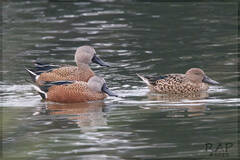
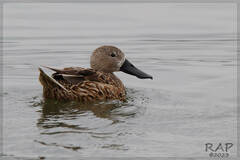
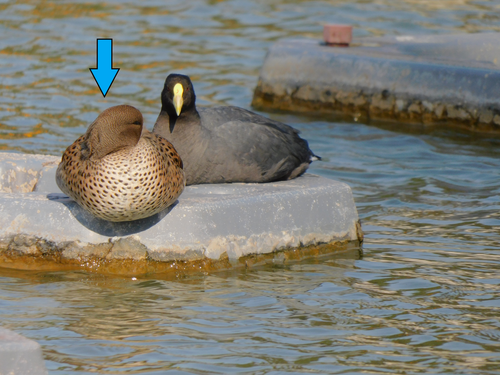
Red Shoveler

Red Shoveler

Spatula platalea

Silhouette: Sheatherius · PhyloPic

LCLeast ConcernNTVUENCR
Daily sighting probability <5% · Rare
at Nahuel Huapi National Park

In 3 days <5% in a week ~10%

10 Verified sightings at Nahuel Huapi National Park From 2019 to 2026
297 In all 3 parks
August Best month
☀️ Diurnal When it's spotted

About the Red Shoveler

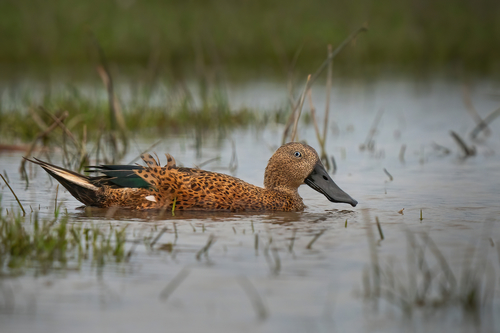
The red shoveler (Spatula platalea) is a species of dabbling duck native to southern South America. The species has a spatula-shaped bill, a green speculum, and light blue upper wing converts. Male shovelers vary in color from red to paler shades of red (and pink), while the females tend to have large, dark bills. Adults reach a size of about 45–56 centimetres (18–22 in), weigh about 523–608 grams (1.153–1.340 lb), and have a wingspan of about 66–73 centimetres (26–29 in).

The red shoveler breeds in the southern half of South America. It ranges from Tierra del Fuego northwards to Chile and most parts of Argentina, as well as to the Falkland Islands; there are small, isolated breeding populations in the southern regions of Peru, Bolivia, and Paraguay. They can also be found in the extreme southern regions of Brazil and Uruguay, in isolated coastal populations and also further inland. It inhabits shallow lakes and pools with dense reed beds, intertidal mangrove swamps and marshes. They can also be found in brackish waters, such as coastal lagoons, deltas and estuaries.

Red shovelers have a diet that includes herbs, grasses... Wikipedia →
Sounds

Call0:04

Argentina · 2020

© GABRIEL LEITE · XC521702 · CC BY-NC-SA 4.0

Song0:11

Chile · 1999

© Alvaro Jaramillo · XC60096 · CC BY-NC-ND 2.5

Song0:17

Chile · 2006

© Bernabe Lopez-Lanus · XC51957 · CC BY-NC-SA 3.0

Global Distribution

Parks Where Found

# Park Country Daily sighting probability
1 Torres del Paine National Park 🇨🇱 Chile
~20%
2 Tierra del Fuego National Park 🇦🇷 Argentina
<5%
3 Nahuel Huapi National Park 🇦🇷 Argentina
<5%

Cities Where Found

# City Country Daily sighting probability
1 Cochabamba 🇧🇴 Bolivia
~10%
2 Buenos Aires 🇦🇷 Argentina
<5%
3 São Paulo 🇧🇷 Brazil
<5%
4 Santiago 🇨🇱 Chile
<5%

Zoos & Centres Where Found

# Zoo / Centre Country
1 Disney's Animal Kingdom 🇺🇸 United States In captivity
2 San Diego Zoo 🇺🇸 United States In captivity
3 Leipzig Zoological Garden 🇩🇪 Germany In captivity
4 Zoo Miami 🇺🇸 United States In captivity
5 Nuremberg Zoo 🇩🇪 Germany In captivity
6 Tiergarten Am Tiergarten 28 in Nürnberg 🇩🇪 Germany In captivity
7 Slimbridge Wetland Centre 🇬🇧 United Kingdom In captivity
8 Temaikén 🇦🇷 Argentina In captivity
9 Zoologischer Garten Leipzig 🇩🇪 Germany In captivity
10 Houston Zoo 🇺🇸 United States In captivity
11 Cologne Zoological Garden 🇩🇪 Germany In captivity
12 Cleres Zoological Park 🇫🇷 France In captivity
13 Tracy Aviary 🇺🇸 United States In captivity
14 Zoológico de Concepción 🇨🇱 Chile In captivity
15 Tiergarten Am Tiergarten 12 in Nürnberg 🇩🇪 Germany In captivity
16 Tiergarten Am Tiergarten 14 in Nürnberg 🇩🇪 Germany In captivity
17 Tiergarten Am Tiergarten 6 in Nürnberg 🇩🇪 Germany In captivity
18 Cologne Zoo Aquarium 🇩🇪 Germany In captivity

Before you go

What are the chances of seeing a Red Shoveler in Nahuel Huapi National Park?

Rare

Under 5% of wildlife watchers report a Red Shoveler sighting in Nahuel Huapi National Park on a given day, based on 10 verified sightings from GBIF citizen-science data from 2019 to 2026. It is the 95th most-seen of the 111 birds we can rate there. Over three days the chance rises to under 5%, and over a week to about 10%, if each day is a fresh chance.

When is the best time to see a Red Shoveler in Nahuel Huapi National Park?

August

In that month about 10% of wildlife watchers report a Red Shoveler in Nahuel Huapi National Park on a given day, against under 5% in September to July, the lowest months. That is one of Nahuel Huapi National Park's wettest months, with about 250 mm of rain against 55 mm in February.

What time of day is best to see a Red Shoveler?

Between 8 and 11 am

Across all the parks we cover, that three-hour window holds the most Red Shoveler sightings with a recorded time, and about 9 in 10 of them come between 6 am and 6 pm: it is a daytime animal.

Is Nahuel Huapi National Park the best place to see a Red Shoveler?

3rd of 3

Of the 3 parks where we can rate Red Shoveler sightings, Nahuel Huapi National Park ranks 3rd at under 5%. The best odds are in Torres del Paine National Park (Chile, about 20%) and Tierra del Fuego National Park (Argentina, under 5%).

Which relatives of the Red Shoveler live in Nahuel Huapi National Park?

Same family: Anatidae

The closest relatives of the Red Shoveler that you can see in Nahuel Huapi National Park (family Anatidae, Ducks, Geese, and Swans) are Ashy-headed Goose (about 40%), Yellow-billed Pintail (about 30%) and Flying Steamer-Duck (about 30%), with each one's daily chance of a sighting.

Where does the Red Shoveler sighting chance come from?

GBIF citizen-science records

It is estimated from how often the Red Shoveler is recorded against all the birds logged in Nahuel Huapi National Park (10 verified sightings from 2019 to 2026), calibrated against known sighting rates. Figures are rounded to the nearest 10% because citizen-science data supports honest approximations, not decimals, and months with records from fewer than five people show "—". How it works.

← Back to Nahuel Huapi National Park