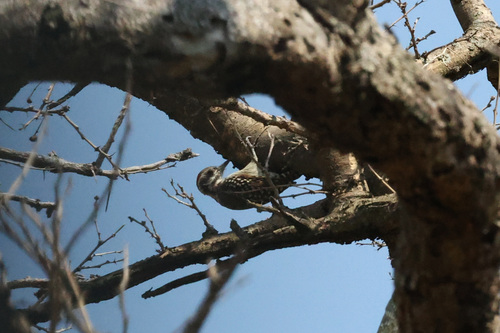
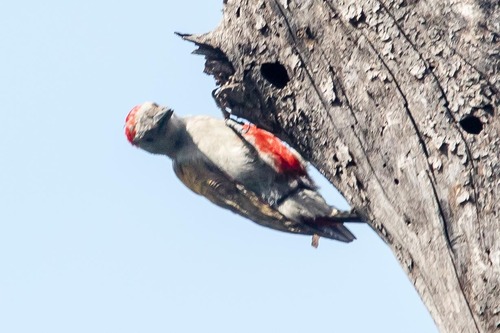
Brown-backed Woodpecker

Brown-backed Woodpecker

Dendropicos obsoletus

Silhouette: Pepe Reigada · PhyloPic

LCLeast ConcernNTVUENCR
Daily sighting probability <5% · Rare
at Ngorongoro Conservation Area

In 3 days ~10%

46 Verified sightings at Ngorongoro Conservation Area From 2019 to 2026
143 In all 4 parks
September Best month
☀️ Diurnal When it's spotted

About the Brown-backed Woodpecker

The brown-backed woodpecker (Dendropicos obsoletus) is a species of bird in the woodpecker family Picidae. It is found in a belt across the savannah region of sub-Saharan Africa from Senegal in the west to Ethiopia, Kenya and Tanzania in the east. It is generally uncommon, but has a very large range and the population appears to be steady, so the International Union for Conservation of Nature has rated its conservation status as being of "least concern".

The brown-backed woodpecker was described by the German naturalist Johann Georg Wagler in 1829 under the binomial name Picus obsoletus. He specified the type locality as Senegambia. The specific epithet is from the Latin obsoletus meaning "plain" or "ordinary". Before the introduction of molecular phylogenetics the relationship to other woodpeckers was uncertain. In 1948 the American ornithologist James Peter placed the brown-backed woodpecker in the genus Dendrocopos in his Check-List of Birds of the World, and in 2013 it was assigned to its own genus Ipophilius by Edward Dickinson and Leslie Christidis in the fourth edition of the Howard and Moore Complete of the Birds of the World. The species is now placed in the... Wikipedia →

Sounds

Drumming0:41

Gambia · 2020

© Joost van Bruggen · XC896706 · CC BY-NC-ND 4.0

Tapping0:18

Ethiopia · 2014

© Andrew Spencer · XC209958 · CC BY-NC-SA 4.0

Global Distribution

Parks Where Found

# Park Country Daily sighting probability
1 Nairobi National Park 🇰🇪 Kenya
<5%
2 Kidepo Valley National Park 🇺🇬 Uganda
<5%
3 Ngorongoro Conservation Area 🇹🇿 Tanzania
<5%
4 Murchison Falls National Park 🇺🇬 Uganda
<5%

Cities Where Found

# City Country Daily sighting probability
1 Nairobi 🇰🇪 Kenya
<5%

Before you go

What are the chances of seeing a Brown-backed Woodpecker in Ngorongoro Conservation Area?

Rare

Under 5% of wildlife watchers report a Brown-backed Woodpecker sighting in Ngorongoro Conservation Area on a given day, based on 46 verified sightings from GBIF citizen-science data from 2019 to 2026. It is the 367th most-seen of the 519 birds we can rate there. Over three days the chance rises to about 10%, if each day is a fresh chance.

When is the best time to see a Brown-backed Woodpecker in Ngorongoro Conservation Area?

Any time of year

In every month with enough records, under 5% of wildlife watchers report a Brown-backed Woodpecker in Ngorongoro Conservation Area on a given day, so our monthly data shows no clear season.

What time of day is best to see a Brown-backed Woodpecker?

Between 7 and 10 am

Across all the parks we cover, that three-hour window holds the most Brown-backed Woodpecker sightings with a recorded time, and about 8 in 10 of them come between 6 am and 6 pm: it is a daytime animal.

Is Ngorongoro Conservation Area the best place to see a Brown-backed Woodpecker?

Among the best

Of the 4 parks where we can rate Brown-backed Woodpecker sightings, Ngorongoro Conservation Area ranks 3rd at under 5%, level with the leaders once rounded. The best odds are in Nairobi National Park (Kenya, under 5%) and Kidepo Valley National Park (Uganda, under 5%).

Which relatives of the Brown-backed Woodpecker live in Ngorongoro Conservation Area?

Same genus: Dendropicos

The closest relatives of the Brown-backed Woodpecker that you can see in Ngorongoro Conservation Area (genus Dendropicos) are Cardinal Woodpecker (about 10%) and Eastern Grey Woodpecker (about 10%), with each one's daily chance of a sighting.

Where does the Brown-backed Woodpecker sighting chance come from?

GBIF citizen-science records

It is estimated from how often the Brown-backed Woodpecker is recorded against all the birds logged in Ngorongoro Conservation Area (46 verified sightings from 2019 to 2026), calibrated against known sighting rates. Figures are rounded to the nearest 10% because citizen-science data supports honest approximations, not decimals, and months with records from fewer than five people show "—". How it works.

← Back to Ngorongoro Conservation Area