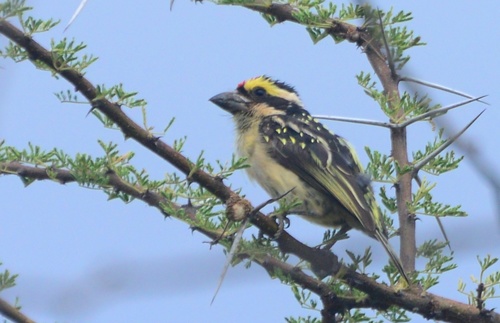
D'Arnaud's Barbet

D'Arnaud's Barbet

Trachyphonus darnaudii

Silhouette: PhyloPic

LCLeast ConcernNTVUENCR
Daily sighting probability ~20% · Possible
at Ngorongoro Conservation Area

In 3 days ~50% in a week ~80%

488 Verified sightings at Ngorongoro Conservation Area From 2019 to 2026
5,103 In all 15 parks
April Best month
☀️ Diurnal When it's spotted

About the D'Arnaud's Barbet

D'Arnaud's barbet (Trachyphonus darnaudii) is a species of bird in the family Lybiidae that is found in East Africa. Barbets and toucans are a group of birds with a worldwide tropical distribution. The barbets get their name from the bristles which fringe their heavy bills. Three geographical races (darnaudii, böhmi, emini) have been recorded. The usambiro barbet was previously regarded as a subspecies, but the 2021 taxonomic update to the IOC World Bird List upgraded this to full species status with the taxonomic name Trachyphonus usambiro.

D'Arnaud's barbet was formally described in 1847 as Micropogon darnaudii by the French naturalists Florent Prévost and Marc Athanase Parfait Œillet des Murs. The species was named in honour of the French explorer and engineer Joseph Pons d'Arnaud. The type locality is the Kordofan region of central Sudan. D'Arnaud's barbet is now one of four species placed in the genus Trachyphonus that was introduced 1821 by the Italian naturalist Camillo Ranzani.

Four subspecies are recognised: T. d... Wikipedia →

Sounds

Duet0:35

Tanzania · 2026

© isaac kilusu · XC1178615 · CC BY-NC-SA 4.0

Song0:32

Kenya · 2023

© Brendan Sloan · XC795074 · CC BY-NC-ND 4.0

Alarm call0:05

Kenya · 2016

© James Bradley · XC345087 · CC BY-NC-SA 4.0

Global Distribution

Parks Where Found

# Park Country Daily sighting probability
1 Mkomazi National Park 🇹🇿 Tanzania
~60%
2 Tsavo West National Park 🇰🇪 Kenya
~50%
3 Kidepo Valley National Park 🇺🇬 Uganda
~50%
4 Serengeti National Park 🇹🇿 Tanzania
~50%
5 Ruaha National Park 🇹🇿 Tanzania
~40%
6 Tarangire National Park 🇹🇿 Tanzania
~40%
7 Tsavo East National Park 🇰🇪 Kenya
~30%
8 Samburu National Reserve 🇰🇪 Kenya
~30%
9 Ngorongoro Conservation Area 🇹🇿 Tanzania
~20%
10 Masai Mara National Reserve 🇰🇪 Kenya
~20%
11 Amboseli National Park 🇰🇪 Kenya
~20%
12 Meru National Park 🇰🇪 Kenya
~10%
13 Lake Manyara National Park 🇹🇿 Tanzania
~10%
14 Nairobi National Park 🇰🇪 Kenya
<5%
15 Lake Nakuru National Park 🇰🇪 Kenya
<5%

Cities Where Found

# City Country Daily sighting probability
1 Dar es-Salaam 🇹🇿 Tanzania
~10%

Before you go

What are the chances of seeing a D'Arnaud's Barbet in Ngorongoro Conservation Area?

Possible

About 20% of wildlife watchers report a D'Arnaud's Barbet sighting in Ngorongoro Conservation Area on a given day, based on 488 verified sightings from GBIF citizen-science data from 2019 to 2026. It is the 84th most-seen of the 519 birds we can rate there. Over three days the chance rises to about 50%, and over a week to about 80%, if each day is a fresh chance.

When is the best time to see a D'Arnaud's Barbet in Ngorongoro Conservation Area?

April

In that month about 40% of wildlife watchers report a D'Arnaud's Barbet in Ngorongoro Conservation Area on a given day, against about 10% in January and May–October, the lowest months. That is one of Ngorongoro Conservation Area's wettest months, with about 190 mm of rain against almost none in July.

What time of day is best to see a D'Arnaud's Barbet?

Between 9 am and noon

Across all the parks we cover, that three-hour window holds the most D'Arnaud's Barbet sightings with a recorded time, and about 8 in 10 of them come between 6 am and 6 pm: it is a daytime animal.

Where does the D'Arnaud's Barbet sighting chance come from?

GBIF citizen-science records

It is estimated from how often the D'Arnaud's Barbet is recorded against all the birds logged in Ngorongoro Conservation Area (488 verified sightings from 2019 to 2026), calibrated against known sighting rates. Figures are rounded to the nearest 10% because citizen-science data supports honest approximations, not decimals, and months with records from fewer than five people show "—". How it works.

← Back to Ngorongoro Conservation Area