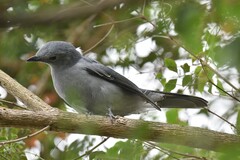
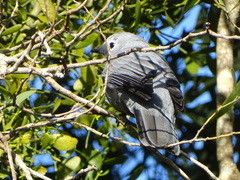

Grey Cuckoo-Shrike

Grey Cuckoo-Shrike

Coracina caesia

Silhouette: Sheatherius · PhyloPic

Daily sighting probability <5% · Rare
at Ngorongoro Conservation Area

In 3 days ~10% in a week ~20%

57 Verified sightings at Ngorongoro Conservation Area From 2019 to 2026
925 In all 7 parks
October Best month
☀️ Diurnal When it's spotted

About the Grey Cuckoo-Shrike

The grey cuckooshrike (Ceblepyris caesius) is a species of bird in the cuckooshrike family Campephagidae. It is a medium-sized forest bird, with grey to blue-grey plumage and large black eyes. There are two subspecies that occur in forest patches of southern and central Africa respectively.

The grey cuckooshrike belongs to the family Campephagidae of the old world songbirds. There are almost 90 species within Campephagidae that occur in Africa, Asia and Australasia. Ceblepyris caesia is often considered to be part of a superspecies with the white-breasted cuckooshrike (Ceblepyris pectoralis); which looks somewhat similar apart from the striking white underparts compared to C. caesia's grey underparts. The grey cuckooshrike is also found at higher elevation than its white-breasted counterpart. A 2010 genetic analysis confirmed the two species as each other's closest relatives, with their common ancestor diverging from the ancestor of Grauer's cuckooshrike.

"Grey cuckooshrike" has been designated the official name by the International Ornithologists' Union (IOC). The species is also commonly referred to as the mountain grey cuckooshrike and the African grey cuckooshrike... Wikipedia →

Sounds

Recording0:10

South Africa · 2023

© Sally Adam · iNaturalist · CC BY-NC 4.0

Recording0:29

Equatorial Guinea · 2024

© KD Dijkstra · Observation.org, Nature data from around the World · CC BY-NC 4.0

Global Distribution

Parks Where Found

# Park Country Daily sighting probability
1 Bwindi Impenetrable National Park 🇺🇬 Uganda
~20%
2 Nyungwe National Park 🇷🇼 Rwanda
~20%
3 Garden Route National Park 🇿🇦 South Africa
~10%
4 Gorongosa National Park 🇲🇿 Mozambique
~10%
5 Aberdare National Park 🇰🇪 Kenya
<5%
6 Ngorongoro Conservation Area 🇹🇿 Tanzania
<5%
7 Kruger National Park 🇿🇦 South Africa
<5%

Before you go

What are the chances of seeing a Grey Cuckoo-Shrike in Ngorongoro Conservation Area?

Rare

Under 5% of wildlife watchers report a Grey Cuckoo-Shrike sighting in Ngorongoro Conservation Area on a given day, based on 57 verified sightings from GBIF citizen-science data from 2019 to 2026. It is the 326th most-seen of the 519 birds we can rate there. Over three days the chance rises to about 10%, and over a week to about 20%, if each day is a fresh chance.

When is the best time to see a Grey Cuckoo-Shrike in Ngorongoro Conservation Area?

October and November

In those months about 10% of wildlife watchers report a Grey Cuckoo-Shrike in Ngorongoro Conservation Area on a given day, against under 5% in December to September, the lowest months. Those are among Ngorongoro Conservation Area's wettest months, with about 110 mm of rain a month against almost none in July.

What time of day is best to see a Grey Cuckoo-Shrike?

Between 7 and 10 am

Across all the parks we cover, that three-hour window holds the most Grey Cuckoo-Shrike sightings with a recorded time, and about 9 in 10 of them come between 6 am and 6 pm: it is a daytime animal.

Where does the Grey Cuckoo-Shrike sighting chance come from?

GBIF citizen-science records

It is estimated from how often the Grey Cuckoo-Shrike is recorded against all the birds logged in Ngorongoro Conservation Area (57 verified sightings from 2019 to 2026), calibrated against known sighting rates. Figures are rounded to the nearest 10% because citizen-science data supports honest approximations, not decimals, and months with records from fewer than five people show "—". How it works.

← Back to Ngorongoro Conservation Area