Mocking Cliff Chat

Mocking Cliff Chat

Thamnolaea cinnamomeiventris

Silhouette: Martin Bulla, based on François Desbordes' illustration · PhyloPic

LCLeast ConcernNTVUENCR
Daily sighting probability <5% · Rare
at Ngorongoro Conservation Area

In 3 days <5%

13 Verified sightings at Ngorongoro Conservation Area From 2019 to 2026
1,290 In all 14 parks
August Best month
☀️ Diurnal When it's spotted

About the Mocking Cliff Chat

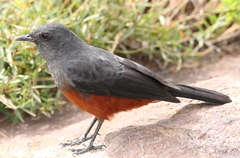
The mocking cliff chat, mocking chat or cliff chat, (Thamnolaea cinnamomeiventris) is a species of chat in the family Muscicapidae which occurs in rocky habitats in much of eastern Sub-Saharan Africa. It is the only species placed in the genus Thamnolaea.

The mocking cliff chat was formally described and illustrated in 1836 by the French ornithologist Frédéric de Lafresnaye based on a specimen that had been sent to France from the Cape of Good Hope in South Africa. Lafresnaye placed the species with the thrushes in the genus Turdus and coined the binomial name Turdus cinnamomeiventris. The specific epithet combines Modern Latin cinnamomeus meaning "cinnamon-coloured" with Latin venter, ventris meaning "belly". The type locality has been designated as Cape Province. The mocking cliff chat is now the only species placed in the genus Thamnolaea that was introduced in 1851 by the German ornithologist Jean Cabanis. The genus name combines the Ancient Greek θαμνος/thamnos meaning "bush" with λαιος/laios meaning "thrush".

Nine subspecies are recognised: Wikipedia →

Sounds

Call0:30

Zimbabwe · 2024

© Dries Van de Loock · XC963278 · CC BY-NC-ND 4.0

Song1:04

South Africa · 2023

© Marc Anderson · XC876561 · CC BY-NC-ND 4.0

Imitation0:16

South Africa · 2023

© Lynette Rudman · XC776874 · CC BY-NC-SA 4.0

Global Distribution

Parks Where Found

# Park Country Daily sighting probability
1 Hluhluwe-Imfolozi Park 🇿🇦 South Africa
~30%
2 uMkhuze Game Reserve 🇿🇦 South Africa
~30%
3 Kidepo Valley National Park 🇺🇬 Uganda
~20%
4 Gonarezhou National Park 🇿🇼 Zimbabwe
~10%
5 Pilanesberg National Park 🇿🇦 South Africa
~10%
6 Ruaha National Park 🇹🇿 Tanzania
~10%
7 Kruger National Park 🇿🇦 South Africa
~10%
8 Serengeti National Park 🇹🇿 Tanzania
<5%
9 Lake Nakuru National Park 🇰🇪 Kenya
<5%
10 Tarangire National Park 🇹🇿 Tanzania
<5%
11 Masai Mara National Reserve 🇰🇪 Kenya
<5%
12 Kafue National Park 🇿🇲 Zambia
<5%
13 Ngorongoro Conservation Area 🇹🇿 Tanzania
<5%
14 Nairobi National Park 🇰🇪 Kenya
<5%

Before you go

What are the chances of seeing a Mocking Cliff Chat in Ngorongoro Conservation Area?

Rare

Under 5% of wildlife watchers report a Mocking Cliff Chat sighting in Ngorongoro Conservation Area on a given day, based on 13 verified sightings from GBIF citizen-science data from 2019 to 2026. It is the 445th most-seen of the 519 birds we can rate there. Over three days the chance rises to under 5%, if each day is a fresh chance.

When is the best time to see a Mocking Cliff Chat in Ngorongoro Conservation Area?

Any time of year

In every month with enough records, under 5% of wildlife watchers report a Mocking Cliff Chat in Ngorongoro Conservation Area on a given day, so our monthly data shows no clear season.

What time of day is best to see a Mocking Cliff Chat?

Between 6 and 9 am

Across all the parks we cover, that three-hour window holds the most Mocking Cliff Chat sightings with a recorded time, and nearly all of them come between 6 am and 6 pm: it is a daytime animal.

Is Ngorongoro Conservation Area the best place to see a Mocking Cliff Chat?

13th of 14

Of the 14 parks where we can rate Mocking Cliff Chat sightings, Ngorongoro Conservation Area ranks 13th at under 5%. The best odds are in Hluhluwe-Imfolozi Park (South Africa, about 30%), uMkhuze Game Reserve (South Africa, about 30%) and Kidepo Valley National Park (Uganda, about 20%).

Which relatives of the Mocking Cliff Chat live in Ngorongoro Conservation Area?

Same family: Muscicapidae

The closest relatives of the Mocking Cliff Chat that you can see in Ngorongoro Conservation Area (family Muscicapidae, Old World Flycatchers, Robins, and Chats) are Capped Wheatear (about 30%), Northern Anteater-Chat (about 30%) and White-eyed Slaty Flycatcher (about 30%), with each one's daily chance of a sighting.

Where does the Mocking Cliff Chat sighting chance come from?

GBIF citizen-science records

It is estimated from how often the Mocking Cliff Chat is recorded against all the birds logged in Ngorongoro Conservation Area (13 verified sightings from 2019 to 2026), calibrated against known sighting rates. Figures are rounded to the nearest 10% because citizen-science data supports honest approximations, not decimals, and months with records from fewer than five people show "—". How it works.

← Back to Ngorongoro Conservation Area


