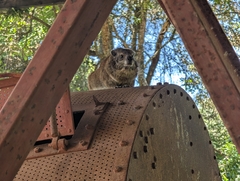
Southern Tree Hyrax

Southern Tree Hyrax

Dendrohyrax arboreus

Silhouette: Steven Traver · PhyloPic

LCLeast ConcernNTVUENCR
Daily sighting probability ~10% · With luck
at Ngorongoro Conservation Area

In 3 days ~30% in a week ~60%

9 Verified sightings at Ngorongoro Conservation Area From 2019 to 2026
57 In all 4 parks
July Best month
☀️🌙 Day & Night When it's spotted

About the Southern Tree Hyrax

The southern tree hyrax (Dendrohyrax arboreus), also known as the southern tree dassie, is a species of mammal in the family Procaviidae. The southern tree hyrax is mainly found in the south central eastern side of Africa.

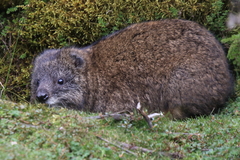
The southern tree hyrax has a guinea pig-like appearance. It has long, soft, grey-brown fur that covers the body, while the underside is paler. Hairs are lighter near their tips and the ears have a fringe of white hair. They weigh about 2.27 kg (5.0 lb) on average, and have an average length of 52 cm (20 in).

It is found in Angola, Zambia, Democratic Republic of the Congo, Kenya, Uganda, Rwanda, Burundi, Tanzania, Malawi, Mozambique, and South Africa. Its natural habitats are temperate forests, subtropical or tropical dry forests, subtropical or tropical moist lowland forests, subtropical or tropical moist montane forests, moist savanna, and rocky areas. It may be found at elevations up to 4,500 m (14,800 ft).

The tree hyrax lives in trees and is mostly nocturnal, as opposed to the rock hyrax which lives among rocks and is mainly diurnal. It occurs singly, in pairs or in small groups, favouring hollow... Wikipedia →

Sounds

Call1:01

Zambia · 2023

© Marc Anderson · XC1070940 · CC BY-NC-ND 4.0

Call0:20

Central African Republic · 2025

© Antoine Ede, Dzanga-Sangha protected Areas · XC1050403 · CC BY-NC-SA 4.0

Recording0:22

Kenya · 2017

© Yvonne A. de Jong · iNaturalist · CC BY-NC-SA 4.0

Global Distribution

Parks Where Found

# Park Country Daily sighting probability
1 Volcanoes National Park 🇷🇼 Rwanda
~40%
2 Nairobi National Park 🇰🇪 Kenya
~20%
3 Masai Mara National Reserve 🇰🇪 Kenya
~20%
4 Ngorongoro Conservation Area 🇹🇿 Tanzania
~10%

Zoos & Centres Where Found

# Zoo / Centre Country
1 Prague Zoo 🇨🇿 Czechia In captivity
2 Ostrava Zoo 🇨🇿 Czechia In captivity
3 Stone Zoo 🇺🇸 United States In captivity
4 Rákosův pavilon 🇨🇿 Czechia In captivity
5 Velemlokárium 🇨🇿 Czechia In captivity

Before you go

What are the chances of seeing a Southern Tree Hyrax in Ngorongoro Conservation Area?

With luck

About 10% of wildlife watchers report a Southern Tree Hyrax sighting in Ngorongoro Conservation Area on a given day, based on 9 verified sightings from GBIF citizen-science data from 2019 to 2026. It is the 32nd most-seen of the 37 mammals we can rate there. Over three days the chance rises to about 30%, and over a week to about 60%, if each day is a fresh chance.

When is the best time to see a Southern Tree Hyrax in Ngorongoro Conservation Area?

July

In that month about 30% of wildlife watchers report a Southern Tree Hyrax in Ngorongoro Conservation Area on a given day, against under 5% in January, April, June and August–October, the lowest months. That is one of Ngorongoro Conservation Area's driest months, with almost no rain against 190 mm in April.

What time of day is best to see a Southern Tree Hyrax?

Between 11 am and 2 pm

Across all the parks we cover, that three-hour window holds the most Southern Tree Hyrax sightings with a recorded time, and about 7 in 10 of them come between 6 am and 6 pm: it is seen both by day and at night.

Is Ngorongoro Conservation Area the best place to see a Southern Tree Hyrax?

4th of 4

Of the 4 parks where we can rate Southern Tree Hyrax sightings, Ngorongoro Conservation Area ranks 4th at about 10%. The best odds are in Volcanoes National Park (Rwanda, about 40%), Nairobi National Park (Kenya, about 20%) and Masai Mara National Reserve (Kenya, about 20%).

Where does the Southern Tree Hyrax sighting chance come from?

GBIF citizen-science records

It is estimated from how often the Southern Tree Hyrax is recorded against all the mammals logged in Ngorongoro Conservation Area (9 verified sightings from 2019 to 2026), calibrated against known sighting rates. Figures are rounded to the nearest 10% because citizen-science data supports honest approximations, not decimals, and months with records from fewer than five people show "—". How it works.

← Back to Ngorongoro Conservation Area