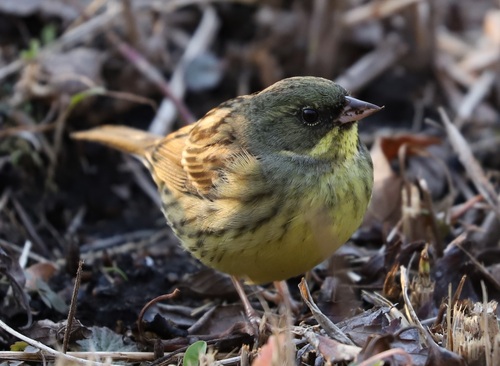
Meadow Bunting

Meadow Bunting

Emberiza cioides

Silhouette: L. Shyamal · PhyloPic

LCLeast ConcernNTVUENCR
Daily sighting probability ~30% · Possible
at Nikko National Park

In 3 days ~60% in a week ~90%

144 Verified sightings at Nikko National Park From 2019 to 2026
144 In 1 park
February Best month
🌙 Nocturnal When it's spotted

About the Meadow Bunting

The meadow bunting or Siberian meadow bunting (Emberiza cioides) is a passerine bird of eastern Asia which belongs to the genus Emberiza in the bunting family Emberizidae. The meadow bunting is 15 to 16.5 cm long. The male is mostly rufous-brown with dark streaks on the back. The boldly-patterned head is brown with white eyebrows, moustachial stripe and throat and grey sides to the neck. The outer tail-feathers are white and the legs are pinkish-brown. Females are similar but are duller and paler with a less well-defined head pattern.

The song is a short, hurried phrase given from a prominent perch. The call is a series of up to four sharp notes. It breeds in southern Siberia, northern and eastern China, eastern Kazakhstan, Kyrgyzstan, Mongolia, Korea and Japan. It is fairly non-migratory but northern birds move south as far as southern China and Taiwan. There are several records from Europe but many of these are considered to be escapes from captivity rather than genuine vagrants. It occurs in dry, open habitats such as scrub, farmland, grassland and open woodland.

The nest is built low in bushes or on the ground. Three to five eggs are laid and are incubated for... Wikipedia →

Sounds

Song0:21

South Korea · 2026

© Se-Jun Choi · XC1152378 · CC BY-NC-ND 4.0

Call0:56

Mongolia · 2026

© Ding Li Yong · XC1148032 · CC BY-NC-ND 4.0

Song1:01

China · 2026

© Peter Boesman · XC1147450 · CC BY-NC-ND 4.0

Global Distribution

Parks Where Found

# Park Country Daily sighting probability
1 Nikko National Park 🇯🇵 Japan
~30%

More parks will be added in future updates.

Cities Where Found

# City Country Daily sighting probability
1 Sendai 🇯🇵 Japan
~50%
2 Nagoya 🇯🇵 Japan
~30%
3 Tokyo 🇯🇵 Japan
~10%
4 Osaka 🇯🇵 Japan
~10%
5 Kitakyushu 🇯🇵 Japan
~10%
6 Hiroshima 🇯🇵 Japan
~10%
7 Fukuoka 🇯🇵 Japan
<5%
8 Sapporo 🇯🇵 Japan
<5%
9 Beijing 🇨🇳 China
<5%
10 Seoul 🇰🇷 South Korea
<5%

Zoos & Centres Where Found

# Zoo / Centre Country
1 Inokashira Park Zoo 🇯🇵 Japan In captivity

Before you go

What are the chances of seeing a Meadow Bunting in Nikko National Park?

Possible

About 30% of wildlife watchers report a Meadow Bunting sighting in Nikko National Park on a given day, based on 144 verified sightings from GBIF citizen-science data from 2019 to 2026. It is the 28th most-seen of the 102 birds we can rate there. Over three days the chance rises to about 60%, and over a week to about 90%, if each day is a fresh chance.

When is the best time to see a Meadow Bunting in Nikko National Park?

February and April–May

In those months about 40% of wildlife watchers report a Meadow Bunting in Nikko National Park on a given day, against about 10% in January, March, June and October–November, the lowest months.

What time of day is best to see a Meadow Bunting?

Between 10 pm and 1 am

Across all the parks we cover, that three-hour window holds the most Meadow Bunting sightings with a recorded time, and about 8 in 10 of them come between 6 pm and 6 am: it is mostly seen at night.

Where else can you see a Meadow Bunting?

Only Nikko National Park, in our data

Nikko National Park is the only park on Wallace's Line with enough records to rate Meadow Bunting sightings: about 30% of wildlife watchers there report one on a given day.

Which relatives of the Meadow Bunting live in Nikko National Park?

Same genus: Emberiza

The closest relatives of the Meadow Bunting that you can see in Nikko National Park (genus Emberiza, Old World Buntings) are Masked Bunting (about 40%) and Chestnut-eared Bunting (about 20%), with each one's daily chance of a sighting.

Where does the Meadow Bunting sighting chance come from?

GBIF citizen-science records

It is estimated from how often the Meadow Bunting is recorded against all the birds logged in Nikko National Park (144 verified sightings from 2019 to 2026), calibrated against known sighting rates. Figures are rounded to the nearest 10% because citizen-science data supports honest approximations, not decimals, and months with records from fewer than five people show "—". How it works.

← Back to Nikko National Park