Australian Bluespotted Maskray

Australian Bluespotted Maskray

Neotrygon australiae

Silhouette: M Kolmann · PhyloPic

Daily sighting probability ~30% · Possible
at Ningaloo Marine Park

In 3 days ~70% in a week ~90%

17 Verified sightings at Ningaloo Marine Park From 2019 to 2026
40 In all 2 parks
June Best month
☀️ Diurnal When it's spotted

About the Australian Bluespotted Maskray

Neotrygon australiae, the Australian bluespotted maskray, is a type of whiptail stingray found mainly in Australia, Indonesia, and Papua New Guinea. This species is often caught by local trawlers and might be retained for local delicacy in Indonesia and Papua New Guinea.

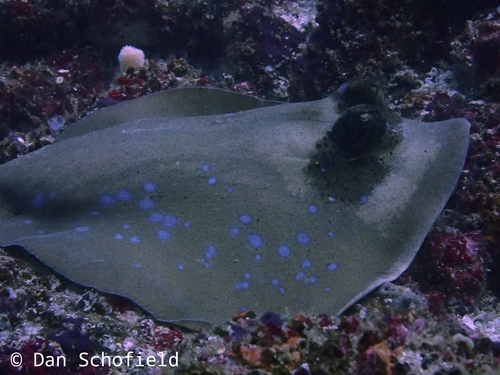
This species can be distinguished from its closest congener (Neotrygon kuhlii) through several characteristics, namely much broader disc, narrowly angular pectoral apices, rounded or weakly angular fleshy snout, entirely dark ventral tail fold, very long tail with black-white bars on the rear, reddish brown to greenish body color, and covered with large blue spots and small peppery dark spots. The maximum size for the female specimens is 45.2 cm disc width (DW).

This species distribution range encompasses Northern Territory, Western Australia, and Queensland in Australia;Lesser Sunda Islands and southern Papua in Indonesia; Timor-Leste; and Papua New Guinea. It inhabits the inshore habitats and ranges from the surface to a depth of around 90 m. It is also caught, either as target or bycatch, by local fisheries and will likely be used for human consumption in the regions... Wikipedia →
Global Distribution

Parks Where Found

# Park Country Daily sighting probability
1 Komodo National Park 🇮🇩 Indonesia
~40%
2 Ningaloo Marine Park 🇦🇺 Australia
~30%

Before you go

What are the chances of seeing an Australian Bluespotted Maskray in Ningaloo Marine Park?

Possible

About 30% of wildlife watchers report an Australian Bluespotted Maskray sighting in Ningaloo Marine Park on a given day, based on 17 verified sightings from GBIF citizen-science data from 2019 to 2026. It is the 13th most-seen of the 24 sharks and rays we can rate there. Over three days the chance rises to about 70%, and over a week to about 90%, if each day is a fresh chance.

When is the best time to see an Australian Bluespotted Maskray in Ningaloo Marine Park?

June

In that month about 60% of wildlife watchers report an Australian Bluespotted Maskray in Ningaloo Marine Park on a given day, against under 5% in April and July, the lowest months. That is one of Ningaloo Marine Park's wettest months, with about 50 mm of rain against almost none in October.

What time of day is best to see an Australian Bluespotted Maskray?

Between 9 am and noon

Across all the parks we cover, that three-hour window holds the most Australian Bluespotted Maskray sightings with a recorded time, and about 8 in 10 of them come between 6 am and 6 pm: it is a daytime animal.

Is Ningaloo Marine Park the best place to see an Australian Bluespotted Maskray?

2nd of 2

Of the 2 parks where we can rate Australian Bluespotted Maskray sightings, Ningaloo Marine Park ranks 2nd at about 30%. The best odds are in Komodo National Park (Indonesia, about 40%).

Which relatives of the Australian Bluespotted Maskray live in Ningaloo Marine Park?

Same genus: Neotrygon

The closest relatives of the Australian Bluespotted Maskray that you can see in Ningaloo Marine Park (genus Neotrygon, Maskrays) are Ningaloo Maskray (about 30%) and Painted Maskray (about 20%), with each one's daily chance of a sighting.

Where does the Australian Bluespotted Maskray sighting chance come from?

GBIF citizen-science records

It is estimated from how often the Australian Bluespotted Maskray is recorded against all the sharks and rays logged in Ningaloo Marine Park (17 verified sightings from 2019 to 2026), calibrated against known sighting rates. Figures are rounded to the nearest 10% because citizen-science data supports honest approximations, not decimals, and months with records from fewer than five people show "—". How it works.

← Back to Ningaloo Marine Park