Ningaloo Maskray

Ningaloo Maskray

Neotrygon ningalooensis

Silhouette: M Kolmann · PhyloPic

Daily sighting probability ~30% · Possible
at Ningaloo Marine Park

In 3 days ~60% in a week ~90%

12 Verified sightings at Ningaloo Marine Park From 2019 to 2026
12 In 1 park
November Best month
🌅 Crepuscular When it's spotted

About the Ningaloo Maskray

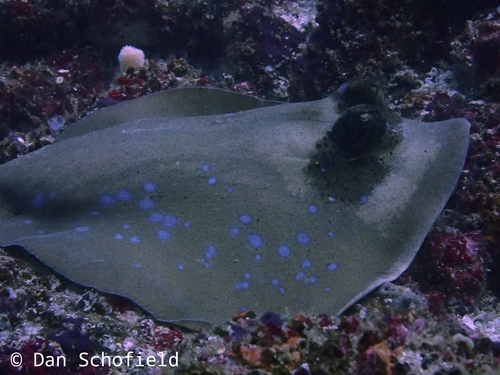
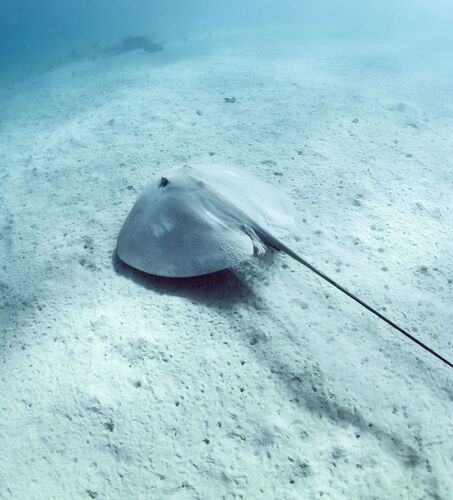
The Ningaloo maskray (Neotrygon ningalooensis) is a species of stingray in the family Dasyatidae, found along the northwestern coast of Australia. Measuring up to 30 cm (12 in) across, it has a diamond-shaped pectoral fin disc with a blunt snout and rounded outer corners. Its tail is whip-like with both upper and lower fin folds. This species has a distinctive dorsal color pattern consisting of numerous small, sharp-edged deep orange spots and slightly larger, fuzzy-edged pale blue spots on a yellowish brown background.

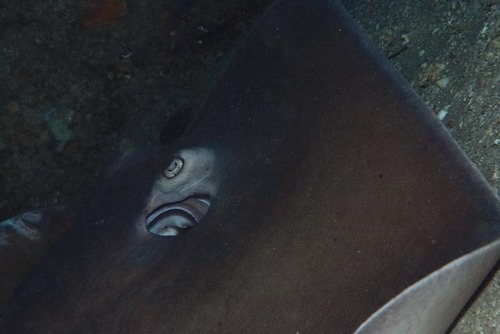
Inhabiting inshore waters less than 5 m (16 ft) deep, the bottom-dwelling Ningaloo maskray has highly specific habitat preferences. It is found on reddish sand near reefs, upon which its coloration grants it excellent camouflage. It is able to bury itself deeper than other maskrays thanks to its protruding eyes. The International Union for Conservation of Nature (IUCN) has listed this species as Data Deficient due to lack of information. It is not vulnerable to fisheries but may be impacted by habitat degradation.

The first known sighting of the Ningaloo maskray was during a study of Ningaloo Marine Park's sharks and rays (hence its common... Wikipedia →

Global Distribution

Parks Where Found

# Park Country Daily sighting probability
1 Ningaloo Marine Park 🇦🇺 Australia
~30%

More parks will be added in future updates.

Before you go

What are the chances of seeing a Ningaloo Maskray in Ningaloo Marine Park?

Possible

About 30% of wildlife watchers report a Ningaloo Maskray sighting in Ningaloo Marine Park on a given day, based on 12 verified sightings from GBIF citizen-science data from 2019 to 2026. It is the 18th most-seen of the 24 sharks and rays we can rate there. Over three days the chance rises to about 60%, and over a week to about 90%, if each day is a fresh chance.

When is the best time to see a Ningaloo Maskray in Ningaloo Marine Park?

November

In that month about 50% of wildlife watchers report a Ningaloo Maskray in Ningaloo Marine Park on a given day, against under 5% in March and April, the lowest months. That is one of Ningaloo Marine Park's driest months, with almost no rain against 50 mm in June.

What time of day is best to see a Ningaloo Maskray?

Between 3 and 6 pm

Across all the parks we cover, that three-hour window holds the most Ningaloo Maskray sightings with a recorded time, and about 7 in 10 of them come between 6 am and 6 pm: it is most active around dawn and dusk.

Where else can you see a Ningaloo Maskray?

Only Ningaloo Marine Park, in our data

Ningaloo Marine Park is the only park on Wallace's Line with enough records to rate Ningaloo Maskray sightings: about 30% of wildlife watchers there report one on a given day.

Which relatives of the Ningaloo Maskray live in Ningaloo Marine Park?

Same genus: Neotrygon

The closest relatives of the Ningaloo Maskray that you can see in Ningaloo Marine Park (genus Neotrygon, Maskrays) are Australian Bluespotted Maskray (about 30%) and Painted Maskray (about 20%), with each one's daily chance of a sighting.

Where does the Ningaloo Maskray sighting chance come from?

GBIF citizen-science records

It is estimated from how often the Ningaloo Maskray is recorded against all the sharks and rays logged in Ningaloo Marine Park (12 verified sightings from 2019 to 2026), calibrated against known sighting rates. Figures are rounded to the nearest 10% because citizen-science data supports honest approximations, not decimals, and months with records from fewer than five people show "—". How it works.

← Back to Ningaloo Marine Park