Thorny Ray

Thorny Ray

Urogymnus asperrimus

Silhouette: M Kolmann · PhyloPic

Daily sighting probability ~30% · Possible
at Ningaloo Marine Park

In 3 days ~60% in a week ~90%

13 Verified sightings at Ningaloo Marine Park From 2019 to 2026
13 In 1 park
August Best month
☀️ Diurnal When it's spotted

About the Thorny Ray

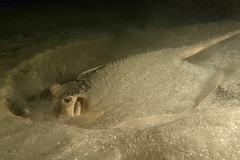
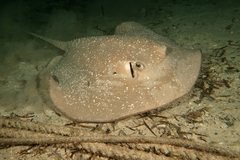
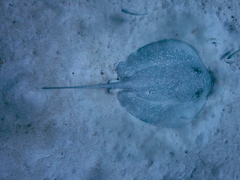
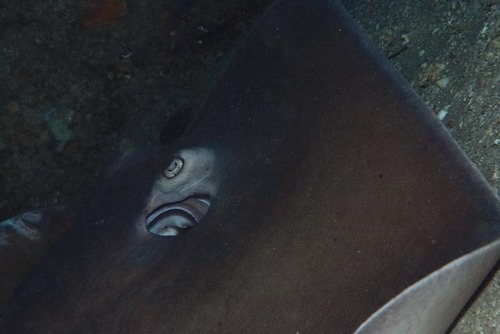
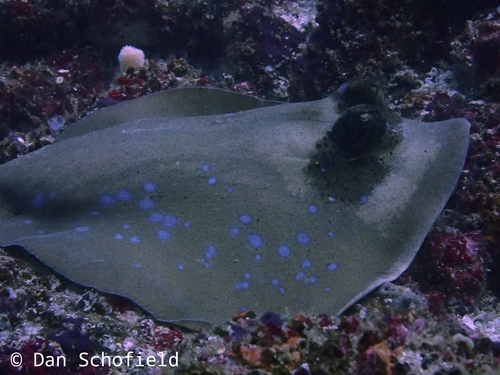
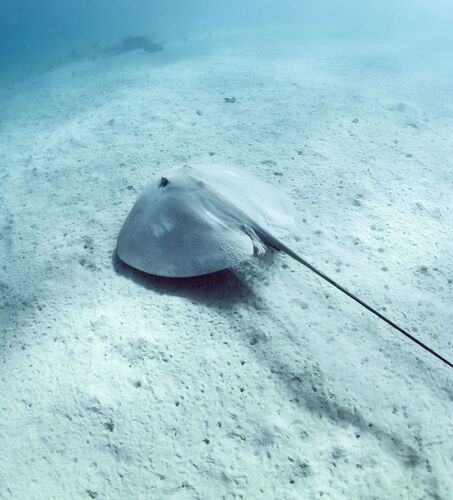
The porcupine ray (Urogymnus asperrimus) is a rare species of stingray in the family Dasyatidae. This bottom-dweller is found throughout the tropical Indo-Pacific, as well as off West Africa. It favors sand, coral rubble, and seagrass habitats in inshore waters to a depth of 30 m (100 ft). A large and heavy-bodied species reaching 1.2–1.5 m (3.9–4.9 ft) in width, the porcupine ray has a nearly circular, plain-colored pectoral fin disc and a thin tail without any fin folds. Uniquely within its family, it lacks a venomous stinging spine. However, an adult ray can still defend itself ably with the many large, sharp thorns found over its disc and tail.

The diet of the porcupine ray consists mainly of benthic invertebrates and bony fishes, which it digs up from the sea floor. It is aplacental viviparous, in which the developing embryos are nourished by histotroph ("uterine milk") produced by the mother. The porcupine ray has long been valued for its rough and durable skin, which was made into a shagreen leather once used for various utilitarian and ornamental purposes, such as to cover sword hilts and shields. It is caught incidentally by coastal fisheries. Because it must be handled carefully due to its thorns, its commercial significance is limited. Unregulated fishing has led to this species declining in many parts of its range, thus it has been listed as Endangered by the International Union for Conservation of Nature. Wikipedia →

Global Distribution

Parks Where Found

# Park Country Daily sighting probability
1 Ningaloo Marine Park 🇦🇺 Australia
~30%

More parks will be added in future updates.

Zoos & Centres Where Found

# Zoo / Centre Country
1 Cairns Aquarium 🇦🇺 Australia In captivity

Before you go

What are the chances of seeing a Thorny Ray in Ningaloo Marine Park?

Possible

About 30% of wildlife watchers report a Thorny Ray sighting in Ningaloo Marine Park on a given day, based on 13 verified sightings from GBIF citizen-science data from 2019 to 2026. It is the 14th most-seen of the 24 sharks and rays we can rate there. Over three days the chance rises to about 60%, and over a week to about 90%, if each day is a fresh chance.

When is the best time to see a Thorny Ray in Ningaloo Marine Park?

August

In that month about 50% of wildlife watchers report a Thorny Ray in Ningaloo Marine Park on a given day, against under 5% in September to November, the lowest months. That is one of Ningaloo Marine Park's driest months, with about 10 mm of rain against 50 mm in June.

What time of day is best to see a Thorny Ray?

Between 10 am and 1 pm

Across all the parks we cover, that three-hour window holds the most Thorny Ray sightings with a recorded time, and about 8 in 10 of them come between 6 am and 6 pm: it is a daytime animal.

Where else can you see a Thorny Ray?

Only Ningaloo Marine Park, in our data

Ningaloo Marine Park is the only park on Wallace's Line with enough records to rate Thorny Ray sightings: about 30% of wildlife watchers there report one on a given day.

Which relatives of the Thorny Ray live in Ningaloo Marine Park?

Same family: Dasyatidae

The closest relatives of the Thorny Ray that you can see in Ningaloo Marine Park (family Dasyatidae, Whiptail Stingrays) are Reef ray (about 70%), Broad Cowtail Stingray (about 50%) and Dragon stingray (about 30%), with each one's daily chance of a sighting.

Where does the Thorny Ray sighting chance come from?

GBIF citizen-science records

It is estimated from how often the Thorny Ray is recorded against all the sharks and rays logged in Ningaloo Marine Park (13 verified sightings from 2019 to 2026), calibrated against known sighting rates. Figures are rounded to the nearest 10% because citizen-science data supports honest approximations, not decimals, and months with records from fewer than five people show "—". How it works.

← Back to Ningaloo Marine Park