Australian Yellow White-eye

Australian Yellow White-eye

Zosterops luteus

Silhouette: Ferran Sayol · PhyloPic

LCLeast ConcernNTVUENCR Endemic
Daily sighting probability ~30% · Possible
at Ningaloo Marine Park

In 3 days ~60% in a week ~90%

96 Verified sightings at Ningaloo Marine Park From 2019 to 2026
197 In all 3 parks
June Best month
☀️ Diurnal When it's spotted

About the Australian Yellow White-eye

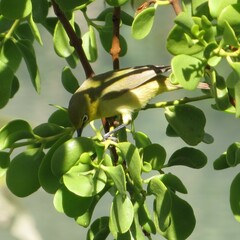
The canary white-eye or yellow white-eye (Zosterops luteus) is a species of white-eye endemic to northern Australia in subtropical or tropical mangrove forests. Its common name reflects the circle of white feathers around its eye.

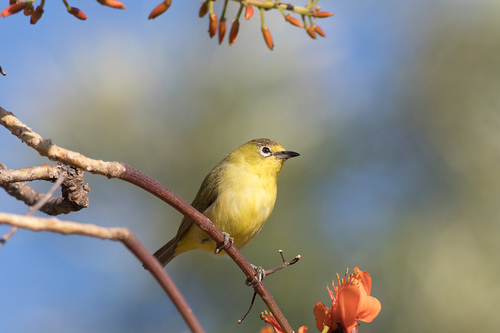
Zosterops luteus is a small white-eye with a bright olive back and yellow underparts and lores. It has a characteristic ring of silver-white feathers around its eyes, with a dark loral stripe. It is a nectar feeder with a short, sharp beak and a brush-tipped tongue similar to the honeyeaters.

The bird is 100–110 mm long, with a wingspan of 52–59 mm, a bill of 13-16mm and weighs between 6.5 and 11.0 grams. The canary white-eye or yellow white-eye is a member of the family Zosteropidae, known as white-eyes, or silver-eyes. Their distribution includes Africa, south and east Asia, Australia, and many islands in the Indian and west Pacific Oceans.

The lectotype for this species is ANSP 18264, an adult male collected at Port Essington in the Northern Territory and held in the Academy of Natural Sciences of Drexel University, Philadelphia. There is also a paralectotype ANSP 18265, another adult male collected from... Wikipedia →
Sounds

Song0:48

Australia · 2025

© Peter Boesman · XC1067065 · CC BY-NC-ND 4.0

Call0:08

Australia · 2022

© Marc Anderson · XC816285 · CC BY-NC-ND 4.0

Uncertain0:28

Australia · 2022

© Drew Davison · XC720400 · CC BY-NC-ND 4.0

Global Distribution

Parks Where Found

# Park Country Daily sighting probability
1 Cape Range 🇦🇺 Australia
~30%
2 Ningaloo Marine Park 🇦🇺 Australia
~30%
3 Kakadu National Park 🇦🇺 Australia
<5%

Before you go

What are the chances of seeing an Australian Yellow White-eye in Ningaloo Marine Park?

Possible

About 30% of wildlife watchers report an Australian Yellow White-eye sighting in Ningaloo Marine Park on a given day, based on 96 verified sightings from GBIF citizen-science data from 2019 to 2026. It is the 20th most-seen of the 102 birds we can rate there. Over three days the chance rises to about 60%, and over a week to about 90%, if each day is a fresh chance.

When is the best time to see an Australian Yellow White-eye in Ningaloo Marine Park?

June and August

In those months about 40% of wildlife watchers report an Australian Yellow White-eye in Ningaloo Marine Park on a given day, against about 10% in May, the lowest month. Those are among Ningaloo Marine Park's wettest months, with about 30 mm of rain a month against almost none in October.

What time of day is best to see an Australian Yellow White-eye?

Between 7 and 10 am

Across all the parks we cover, that three-hour window holds the most Australian Yellow White-eye sightings with a recorded time, and about 9 in 10 of them come between 6 am and 6 pm: it is a daytime animal.

Is Ningaloo Marine Park the best place to see an Australian Yellow White-eye?

Among the best

Of the 3 parks where we can rate Australian Yellow White-eye sightings, Ningaloo Marine Park ranks 2nd at about 30%, level with the leaders once rounded. The best odds are in Cape Range (Australia, about 30%).

Which relatives of the Australian Yellow White-eye live in Ningaloo Marine Park?

Same order: Passeriformes

The closest relatives of the Australian Yellow White-eye that you can see in Ningaloo Marine Park (order Passeriformes, Perching Birds) are Singing Honeyeater (about 70%), Pied Butcherbird (about 60%) and Welcome Swallow (about 50%), with each one's daily chance of a sighting.

Where does the Australian Yellow White-eye sighting chance come from?

GBIF citizen-science records

It is estimated from how often the Australian Yellow White-eye is recorded against all the birds logged in Ningaloo Marine Park (96 verified sightings from 2019 to 2026), calibrated against known sighting rates. Figures are rounded to the nearest 10% because citizen-science data supports honest approximations, not decimals, and months with records from fewer than five people show "—". How it works.

← Back to Ningaloo Marine Park