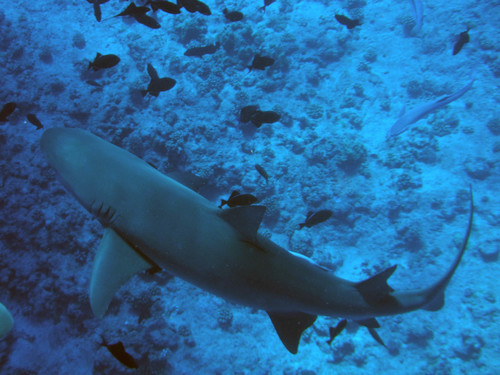
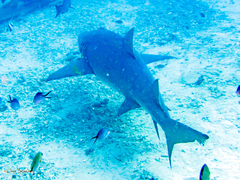
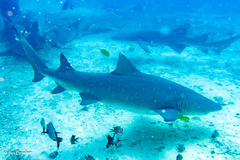

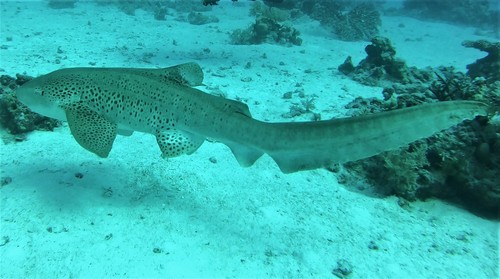
Sicklefin Lemon Shark

Sicklefin Lemon Shark

Negaprion acutidens

Silhouette: Margot Michaud · PhyloPic

Daily sighting probability ~30% · Possible
at Ningaloo Marine Park

In 3 days ~70% in a week ~90%

20 Verified sightings at Ningaloo Marine Park From 2019 to 2026
20 In 1 park
September Best month
☀️ Diurnal When it's spotted

About the Sicklefin Lemon Shark

The sicklefin lemon shark (Negaprion acutidens) or sharptooth lemon shark is a species of requiem shark belonging to the family Carcharhinidae, widely distributed in the tropical waters of the Indo-Pacific. It is closely related to the better-known lemon shark (N. brevirostris) of the Americas; the two species are almost identical in appearance, both being stout-bodied sharks with broad heads, two dorsal fins of nearly equal size, and a plain yellow-tinged coloration. As its common name suggests, the sicklefin lemon shark differs from its American counterpart in having more falcate (sickle-shaped) fins. This large species grows up to 3.8 m (12 ft) long. It generally inhabits water less than 92 m (302 ft) deep in a variety of habitats, from mangrove estuaries to coral reefs.

A slow-moving predator feeding mainly on bony fishes, the sicklefin lemon shark seldom travels long distances and many individuals can be found year-round at certain locations. Like other members of its family, this species is viviparous, with females giving birth to no more than 13 pups every other year, following a gestation period of 10–11 months. Although they are potentially dangerous to humans and known to respond vigorously to any provocation, under normal circumstances, sicklefin lemon sharks are cautious and tend to retreat if approached. The IUCN has assessed this species as Endangered; its low reproductive productivity and rate of movement limits the capacity of depleted stocks to recover. Off India and Southeast Asia, this species has been severely depleted or extirpated by unregulated exploitation for its meat, fins, and liver oil. Wikipedia →

Global Distribution

Parks Where Found

# Park Country Daily sighting probability
1 Ningaloo Marine Park 🇦🇺 Australia
~30%

More parks will be added in future updates.

Zoos & Centres Where Found

# Zoo / Centre Country
1 Tianjin Zoo 🇨🇳 China In captivity
2 Ocean Park Aquarium 🇦🇺 Australia In captivity
3 Aquarium de Vannes 🇫🇷 France In captivity

Before you go

What are the chances of seeing a Sicklefin Lemon Shark in Ningaloo Marine Park?

Possible

About 30% of wildlife watchers report a Sicklefin Lemon Shark sighting in Ningaloo Marine Park on a given day, based on 20 verified sightings from GBIF citizen-science data from 2019 to 2026. It is the 9th most-seen of the 24 sharks and rays we can rate there. Over three days the chance rises to about 70%, and over a week to about 90%, if each day is a fresh chance.

When is the best time to see a Sicklefin Lemon Shark in Ningaloo Marine Park?

March, May and September

In those months about 50% of wildlife watchers report a Sicklefin Lemon Shark in Ningaloo Marine Park on a given day, against under 5% in August, the lowest month. Those are among Ningaloo Marine Park's wettest months, with about 25 mm of rain a month against almost none in October.

What time of day is best to see a Sicklefin Lemon Shark?

Between 9 am and noon

Across all the parks we cover, that three-hour window holds the most Sicklefin Lemon Shark sightings with a recorded time, and about 8 in 10 of them come between 6 am and 6 pm: it is a daytime animal.

Where else can you see a Sicklefin Lemon Shark?

Only Ningaloo Marine Park, in our data

Ningaloo Marine Park is the only park on Wallace's Line with enough records to rate Sicklefin Lemon Shark sightings: about 30% of wildlife watchers there report one on a given day.

Which relatives of the Sicklefin Lemon Shark live in Ningaloo Marine Park?

Same family: Carcharhinidae

The closest relatives of the Sicklefin Lemon Shark that you can see in Ningaloo Marine Park (family Carcharhinidae, Requiem Sharks) are Whitetip Reef Shark (about 60%), Blacktip Reef Shark (about 40%) and Gray Reef Shark (about 30%), with each one's daily chance of a sighting.

Where does the Sicklefin Lemon Shark sighting chance come from?

GBIF citizen-science records

It is estimated from how often the Sicklefin Lemon Shark is recorded against all the sharks and rays logged in Ningaloo Marine Park (20 verified sightings from 2019 to 2026), calibrated against known sighting rates. Figures are rounded to the nearest 10% because citizen-science data supports honest approximations, not decimals, and months with records from fewer than five people show "—". How it works.

← Back to Ningaloo Marine Park