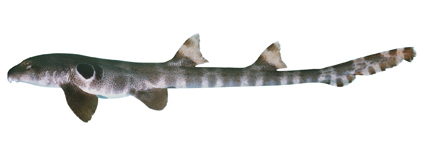
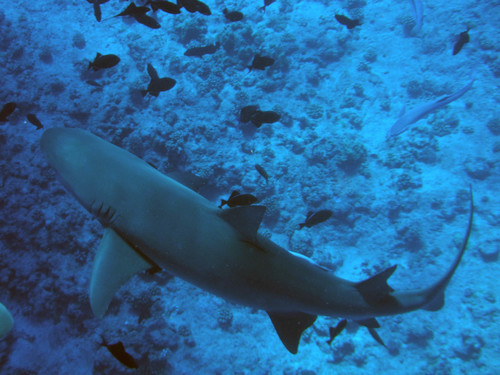
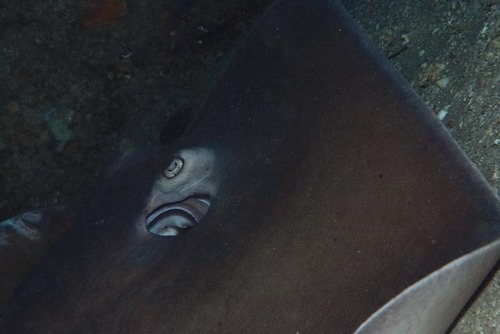
Tasselled Wobbegong

Tasselled Wobbegong

Eucrossorhinus dasypogon

Silhouette: Lankester Edwin Ray (vectorized by T. Michael Keesey) · PhyloPic

Daily sighting probability ~40% · Likely
at Ningaloo Marine Park

In 3 days ~70% in a week >90%

25 Verified sightings at Ningaloo Marine Park From 2019 to 2026
298 In all 2 parks
October Best month
☀️ Diurnal When it's spotted

About the Tasselled Wobbegong

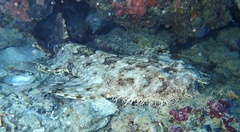
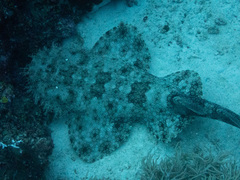
The tasselled wobbegong (Eucrossorhinus dasypogon) is a species of carpet shark in the family Orectolobidae and the only extant member of the genus Eucrossorhinus. It inhabits shallow coral reefs off northern Australia, New Guinea, and adjacent islands. Reaching 1.8 m (5.9 ft) in length, this species has a broad and flattened body and head. Its most distinctive trait is a fringe of branching dermal flaps around its head, which extends onto its chin. The fringe, along with its complex color pattern of small blotches and reticulations, enable it to camouflage itself against the reef environment.

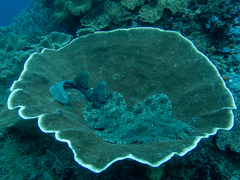
During the day, the solitary tasselled wobbegong can generally be found lying inside caves or under ledges with its tail curled. Individual sharks tend to remain within a local area and have favored resting spots. While resting, it opportunistically ambushes nearby fish and invertebrates, and also lures in prey by waving its tail to mimic the appearance of a small fish. At night, it emerges and actively forages for food. This species is aplacental viviparous, though little is known of its life history. The tasselled wobbegong has been reported to bite and kill humans unprovoked, although such has only been reported once in 1940. The International Union for Conservation of Nature (IUCN) listed this species as Near Threatened in 2003, as outside of Australia it is threatened by fisheries and habitat degradation. As of 2015, its IUCN status is Least Concern. Wikipedia →

Global Distribution

Parks Where Found

# Park Country Daily sighting probability
1 Raja Ampat 🇮🇩 Indonesia
~90%
2 Ningaloo Marine Park 🇦🇺 Australia
~40%

Zoos & Centres Where Found

# Zoo / Centre Country
1 The Maryland Zoo 🇺🇸 United States In captivity
2 L'Oceanogràfic 🇪🇸 Spain In captivity
3 Ripley's Aquarium of the Smokies 🇺🇸 United States In captivity
4 Seaquarium du Grau-du-Roi 🇫🇷 France In captivity

Before you go

What are the chances of seeing a Tasselled Wobbegong in Ningaloo Marine Park?

Likely

About 40% of wildlife watchers report a Tasselled Wobbegong sighting in Ningaloo Marine Park on a given day, based on 25 verified sightings from GBIF citizen-science data from 2019 to 2026. It is the 8th most-seen of the 24 sharks and rays we can rate there. Over three days the chance rises to about 70%, and over a week to over 90%, if each day is a fresh chance.

When is the best time to see a Tasselled Wobbegong in Ningaloo Marine Park?

October

In that month about 70% of wildlife watchers report a Tasselled Wobbegong in Ningaloo Marine Park on a given day, against under 5% in August, the lowest month. That is one of Ningaloo Marine Park's driest months, with almost no rain against 50 mm in June.

What time of day is best to see a Tasselled Wobbegong?

Between 9 am and noon

Across all the parks we cover, that three-hour window holds the most Tasselled Wobbegong sightings with a recorded time, and about 8 in 10 of them come between 6 am and 6 pm: it is a daytime animal.

Is Ningaloo Marine Park the best place to see a Tasselled Wobbegong?

2nd of 2

Of the 2 parks where we can rate Tasselled Wobbegong sightings, Ningaloo Marine Park ranks 2nd at about 40%. The best odds are in Raja Ampat (Indonesia, about 90%).

Where does the Tasselled Wobbegong sighting chance come from?

GBIF citizen-science records

It is estimated from how often the Tasselled Wobbegong is recorded against all the sharks and rays logged in Ningaloo Marine Park (25 verified sightings from 2019 to 2026), calibrated against known sighting rates. Figures are rounded to the nearest 10% because citizen-science data supports honest approximations, not decimals, and months with records from fewer than five people show "—". How it works.

← Back to Ningaloo Marine Park