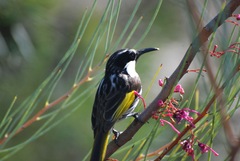
White-cheeked Honeyeater

White-cheeked Honeyeater

Phylidonyris niger

Silhouette: Rachael Joakim · PhyloPic

LCLeast ConcernNTVUENCR Endemic
Daily sighting probability ~20% · Possible
at Noosa National Park

In 3 days ~40% in a week ~70%

84 Verified sightings at Noosa National Park From 2019 to 2026
364 In all 5 parks
September Best month
☀️ Diurnal When it's spotted

About the White-cheeked Honeyeater

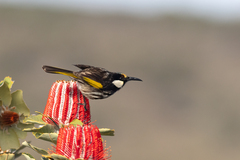
The white-cheeked honeyeater (Phylidonyris niger) is a species of honeyeater that inhabits the east coast and the south-west corner of Australia. It has a large white patch on its cheek, brown eyes, and a yellow panel on its wing.

The white-cheeked honeyeater was formally described by the German naturalist Johann Matthäus Bechstein in 1811. He placed it with the tree creepers in the genus Certhia and coined the binomial name Certhia nigra. His account was based on "L'Héorotaire noir" that had been described and illustrated in 1802 by the French ornithologist Louis Pierre Vieillot. Bechstein specified the type locality as "Neuholland", now Sydney, New South Wales. The white-cheeked honeyeater is now one of three species placed in the genus Phylidonyris that was introduced in 1830 by René Lesson. The generic name Phylidonyris combines the term Phylédon or Philédon, used by the French naturalist Georges Cuvier in 1817 for the friarbirds (now placed in the genus Philemon), with Cinnyris (Cuvier, 1816) for the sunbirds; the specific epithet derives from Latin niger 'black'.

Two subspecies are recognised: Phylidonyris niger niger in eastern Australia; and P. n. gouldii (Schlegel... Wikipedia →

Sounds

Call0:29

Australia · 2023

© Romuald Mikusek · XC1169806 · CC BY-NC-SA 4.0

Song0:10

Australia · 2026

© Marc Anderson · XC1086190 · CC BY-NC-ND 4.0

Call0:14

Australia · 2025

© Peter Boesman · XC1066835 · CC BY-NC-ND 4.0

Global Distribution

Parks Where Found

# Park Country Daily sighting probability
1 Booderee National Park 🇦🇺 Australia
~20%
2 Noosa National Park 🇦🇺 Australia
~20%
3 Blue Mountains National Park 🇦🇺 Australia
<5%
4 Royal National Park 🇦🇺 Australia
<5%
5 Lamington National Park 🇦🇺 Australia
<5%

Cities Where Found

# City Country Daily sighting probability
1 Perth 🇦🇺 Australia
~10%
2 Sydney 🇦🇺 Australia
<5%

Zoos & Centres Where Found

# Zoo / Centre Country
1 Adelaide Zoo 🇦🇺 Australia In captivity
2 Featherdale Sydney Wildlife Park 🇦🇺 Australia In captivity

Before you go

What are the chances of seeing a White-cheeked Honeyeater in Noosa National Park?

Possible

About 20% of wildlife watchers report a White-cheeked Honeyeater sighting in Noosa National Park on a given day, based on 84 verified sightings from GBIF citizen-science data from 2019 to 2026. It is the 40th most-seen of the 128 birds we can rate there. Over three days the chance rises to about 40%, and over a week to about 70%, if each day is a fresh chance.

When is the best time to see a White-cheeked Honeyeater in Noosa National Park?

February–March and September

In those months about 30% of wildlife watchers report a White-cheeked Honeyeater in Noosa National Park on a given day, against about 10% in April, August, October and December–January, the lowest months.

What time of day is best to see a White-cheeked Honeyeater?

Between 11 am and 2 pm

Across all the parks we cover, that three-hour window holds the most White-cheeked Honeyeater sightings with a recorded time, and about 9 in 10 of them come between 6 am and 6 pm: it is a daytime animal.

Is Noosa National Park the best place to see a White-cheeked Honeyeater?

Among the best

Of the 5 parks where we can rate White-cheeked Honeyeater sightings, Noosa National Park ranks 2nd at about 20%, level with the leaders once rounded. The best odds are in Booderee National Park (Australia, about 20%).

Which relatives of the White-cheeked Honeyeater live in Noosa National Park?

Same family: Meliphagidae

The closest relatives of the White-cheeked Honeyeater that you can see in Noosa National Park (family Meliphagidae, Honeyeaters) are Noisy Miner (about 60%), Noisy Friarbird (about 60%) and Lewin's Honeyeater (about 50%), with each one's daily chance of a sighting.

Where does the White-cheeked Honeyeater sighting chance come from?

GBIF citizen-science records

It is estimated from how often the White-cheeked Honeyeater is recorded against all the birds logged in Noosa National Park (84 verified sightings from 2019 to 2026), calibrated against known sighting rates. Figures are rounded to the nearest 10% because citizen-science data supports honest approximations, not decimals, and months with records from fewer than five people show "—". How it works.

← Back to Noosa National Park