
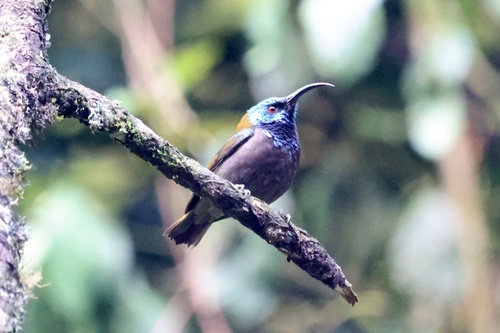
Stuhlmann's Sunbird

Stuhlmann's Sunbird

Cinnyris stuhlmanni

Silhouette: Sheatherius · PhyloPic

LCLeast ConcernNTVUENCR
Daily sighting probability ~20% · Possible
at Nyungwe National Park

In 3 days ~50% in a week ~80%

279 Verified sightings at Nyungwe National Park From 2019 to 2026
579 In all 4 parks
January Best month
☀️ Diurnal When it's spotted

About the Stuhlmann's Sunbird

The Rwenzori double-collared sunbird (Cinnyris stuhlmanni), also called Stuhlmann's sunbird or the Rwanda double-collared sunbird, is a species of bird in the family Nectariniidae. It is found in the Ruwenzori range of mountains in south central Africa. Its natural habitat is subtropical or tropical dry forests. It is threatened by habitat loss. It is sometimes considered to be a subspecies of the greater double-collared sunbird (Cinnyris afer). Some authors consider this bird to be part of a species complex with Cinnyris afer, where it joins Ludwig's double-collared sunbird (Cinnyris ludovicensis) and Prigogine's double-collared sunbird (Cinnyris prigoginei). As with other closely related species, each inhabiting different locations, there are subtle similarities and differences between the local populations, and their taxonomic treatment depends on the views of the taxonomist.

The sunbird is a large-sized species. The adult male has a glossy, metallic green head, throat upper breast and back with no bronzy tinge. The upper-tail coverts are metallic blue and the tail black glossed with blue. The throat and upper breast are metallic green, the lower breast scarlet... Wikipedia →

Sounds

Call0:50

Burundi · 2026

© Bram Piot · XC1082353 · CC BY-NC-SA 4.0

Song0:04

Uganda · 2015

© Martin St-Michel · XC287848 · CC BY-NC-SA 4.0

Global Distribution

Parks Where Found

# Park Country Daily sighting probability
1 Volcanoes National Park 🇷🇼 Rwanda
~30%
2 Virunga National Park 🇨🇩 Democratic Republic of the Congo
~20%
3 Nyungwe National Park 🇷🇼 Rwanda
~20%
4 Bwindi Impenetrable National Park 🇺🇬 Uganda
<5%

Before you go

What are the chances of seeing a Stuhlmann's Sunbird in Nyungwe National Park?

Possible

About 20% of wildlife watchers report a Stuhlmann's Sunbird sighting in Nyungwe National Park on a given day, based on 279 verified sightings from GBIF citizen-science data from 2019 to 2026. It is the 62nd most-seen of the 252 birds we can rate there. Over three days the chance rises to about 50%, and over a week to about 80%, if each day is a fresh chance.

When is the best time to see a Stuhlmann's Sunbird in Nyungwe National Park?

January–February and July

In those months about 30% of wildlife watchers report a Stuhlmann's Sunbird in Nyungwe National Park on a given day, against about 10% in March–May and August, the lowest months.

What time of day is best to see a Stuhlmann's Sunbird?

Between 8 and 11 am

Across all the parks we cover, that three-hour window holds the most Stuhlmann's Sunbird sightings with a recorded time, and about 9 in 10 of them come between 6 am and 6 pm: it is a daytime animal.

Is Nyungwe National Park the best place to see a Stuhlmann's Sunbird?

3rd of 4

Of the 4 parks where we can rate Stuhlmann's Sunbird sightings, Nyungwe National Park ranks 3rd at about 20%. The best odds are in Volcanoes National Park (Rwanda, about 30%) and Virunga National Park (Democratic Republic of the Congo, about 20%).

Which relatives of the Stuhlmann's Sunbird live in Nyungwe National Park?

Same genus: Cinnyris

The closest relatives of the Stuhlmann's Sunbird that you can see in Nyungwe National Park (genus Cinnyris, Cinnyris Sunbirds) are Regal Sunbird (about 60%), Variable Sunbird (about 50%) and Northern Double-collared Sunbird (about 30%), with each one's daily chance of a sighting.

Where does the Stuhlmann's Sunbird sighting chance come from?

GBIF citizen-science records

It is estimated from how often the Stuhlmann's Sunbird is recorded against all the birds logged in Nyungwe National Park (279 verified sightings from 2019 to 2026), calibrated against known sighting rates. Figures are rounded to the nearest 10% because citizen-science data supports honest approximations, not decimals, and months with records from fewer than five people show "—". How it works.

← Back to Nyungwe National Park