Aardvark

Aardvark

Orycteropus afer

Silhouette: Pearson Scott Foresman · PhyloPic

LCLeast ConcernNTVUENCR
Daily sighting probability ~20% · Possible
at Odzala-Kokoua National Park

In 3 days ~40% in a week ~70%

5 Verified sightings at Odzala-Kokoua National Park From 2019 to 2026
5 In 1 park
September Best month
☀️🌙 Day & Night When it's spotted

About the Aardvark

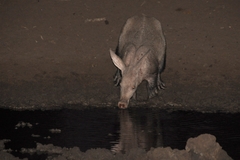
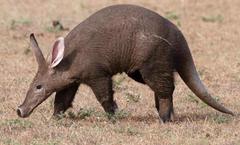
The aardvark (Orycteropus afer) is a medium-sized, burrowing, nocturnal mammal native to Africa. The aardvark is the only living member of the genus Orycteropus, the family Orycteropodidae and the order Tubulidentata. The aardvark is an afrotherian, a clade that also includes elephants, manatees, and hyraxes.

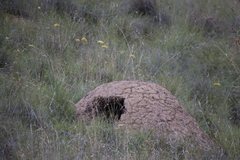
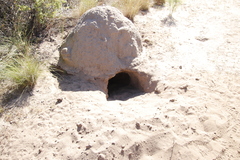
It is found over much of the southern two-thirds of the African continent, avoiding areas that are mainly rocky. A nocturnal feeder, the aardvark subsists on ants and termites (myrmecophagy) by using its sharp claws and powerful legs to dig the insects out of their hills, and its long snout to sniff out food. It digs a burrow in which to live and rear its young.

The aardvark is sometimes colloquially called the "African ant bear", "anteater" (not to be confused with the South American anteaters), or the "Cape anteater". The name aardvark is Afrikaans (pronounced [ˈɑːrtfark]) and comes from earlier Afrikaans erdvark. It means 'earth pig' or 'ground pig' (aarde: 'earth', vark: 'pig, young pig'), because of its burrowing habits.

The name Orycteropus means 'burrowing foot', and the name afer refers to Africa. The name of the aardvark's order... Wikipedia →

Global Distribution

Parks Where Found

# Park Country Daily sighting probability
1 Odzala-Kokoua National Park 🇨🇬 Republic of the Congo
~20%

More parks will be added in future updates.

Zoos & Centres Where Found

# Zoo / Centre Country
1 Prague Zoo 🇨🇿 Czechia In captivity
2 Cincinnati Zoo and Botanical Garden 🇺🇸 United States In captivity
3 Zoo Pilsen 🇨🇿 Czechia In captivity
4 Olomouc Zoo 🇨🇿 Czechia In captivity
5 Zoo de Doué 🇫🇷 France In captivity
6 Columbus Zoo and Aquarium 🇺🇸 United States In captivity
7 Bronx Zoo 🇺🇸 United States In captivity
8 Kansas City Zoo 🇺🇸 United States In captivity
9 Omaha’s Henry Doorly Zoo and Aquarium 🇺🇸 United States In captivity
10 Chester Zoo 🇬🇧 United Kingdom In captivity
11 Detroit Zoo 🇺🇸 United States In captivity
12 Colchester Zoo 🇬🇧 United Kingdom In captivity
13 Berlin Zoological Garden 🇩🇪 Germany In captivity
14 Wrocław Zoological Garden 🇵🇱 Poland In captivity
15 Memphis Zoo 🇺🇸 United States In captivity
16 Cologne Zoological Garden 🇩🇪 Germany In captivity
17 Philadelphia Zoo 🇺🇸 United States In captivity
18 Honolulu Zoo 🇺🇸 United States In captivity
19 London Zoo 🇬🇧 United Kingdom In captivity
20 Зоопарк ХІІ Місяців 🇺🇦 Ukraine In captivity
21 Faunia 🇪🇸 Spain In captivity
22 Minsk Zoo 🇧🇾 Belarus In captivity
23 Lincoln Park Zoo 🇺🇸 United States In captivity
24 Turtle Back Zoo 🇺🇸 United States In captivity
25 Valencia Bioparc 🇪🇸 Spain In captivity
26 Zoologischer Garten Halle 🇩🇪 Germany In captivity
27 Henry Vilas Zoo 🇺🇸 United States In captivity
28 Sacramento Zoo 🇺🇸 United States In captivity
29 Papiliorama 🇨🇭 Switzerland In captivity
30 Africarium 🇵🇱 Poland In captivity
31 Aquarium Berlin 🇩🇪 Germany In captivity
32 Sobela Ocean Aquarium 🇺🇸 United States In captivity
33 Rákosův pavilon 🇨🇿 Czechia In captivity
34 Velemlokárium 🇨🇿 Czechia In captivity
35 Cologne Zoo Aquarium 🇩🇪 Germany In captivity
36 terrarium ogrodu zoologicznego we Wrocławiu 🇵🇱 Poland In captivity
37 Дэльфінарый 🇧🇾 Belarus In captivity

Closest Relatives at Odzala-Kokoua National Park

No species of the same family or order lives in Odzala-Kokoua National Park, so these are its closest relatives here: other mammals.

Before you go

What are the chances of seeing an Aardvark in Odzala-Kokoua National Park?

Possible

About 20% of wildlife watchers report an Aardvark sighting in Odzala-Kokoua National Park on a given day, based on 5 verified sightings from GBIF citizen-science data from 2019 to 2026. It is the 28th most-seen of the 32 mammals we can rate there. Over three days the chance rises to about 40%, and over a week to about 70%, if each day is a fresh chance.

When is the best time to see an Aardvark in Odzala-Kokoua National Park?

September

In that month about 40% of wildlife watchers report an Aardvark in Odzala-Kokoua National Park on a given day, against under 5% in February–April, June–August, October and December, the lowest months. That is one of Odzala-Kokoua National Park's wettest months, with about 190 mm of rain against 50 mm in January.

What time of day is best to see an Aardvark?

Between 10 pm and 1 am

Across all the parks we cover, that three-hour window holds the most Aardvark sightings with a recorded time, and about half of them come between 6 am and 6 pm: it is seen both by day and at night.

Where else can you see an Aardvark?

Only Odzala-Kokoua National Park, in our data

Odzala-Kokoua National Park is the only park on Wallace's Line with enough records to rate Aardvark sightings: about 20% of wildlife watchers there report one on a given day.

Where does the Aardvark sighting chance come from?

GBIF citizen-science records

It is estimated from how often the Aardvark is recorded against all the mammals logged in Odzala-Kokoua National Park (5 verified sightings from 2019 to 2026), calibrated against known sighting rates. Figures are rounded to the nearest 10% because citizen-science data supports honest approximations, not decimals, and months with records from fewer than five people show "—". How it works.

← Back to Odzala-Kokoua National Park