Cascades Frog

Cascades Frog

Rana cascadae

Silhouette: Sharp Photography, sharpphotography.co.uk · PhyloPic

LCLeast ConcernNTVUENCR Endemic
Daily sighting probability ~20% · Possible
at Olympic National Park

In 3 days ~50% in a week ~80%

149 Verified sightings at Olympic National Park From 2019 to 2026
149 In 1 park
August Best month
☀️ Diurnal When it's spotted

About the Cascades Frog

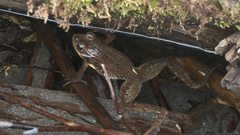
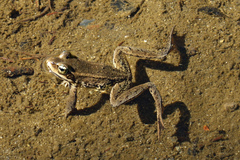
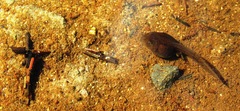
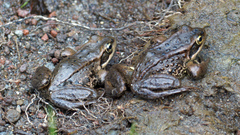
The Cascades frog (Rana cascadae) is a species of frog in the family Ranidae found in the Pacific Northwest, mainly in the Cascade Range and Olympic Mountains. The Cascades frog has moist, grainy skin, a light olive to brown to color on its back, a yellow jaw stripe on its throat, and bright yellow to orange coloration on its groin and rear legs. The cascades frog also has varying amounts of dorsal spots on its back, with colors that darken from lighter gray to black with age. The colors on the frog's back are also used to attract mates. The shape of the frog's head is most commonly an oval with the mouth coming out to a slight specific point. Female Cascade frogs are typically larger than males, averaging 60–75 mm (2.4–3.0 in), compared to males that average 50–60 mm (2.0–2.4 in) in length.

The advertisement call of the R. cascadae is a faint series of low, grating, clucking noises. Calls are produced at night and during the day from above and under the water. The Cascades frog's sister species is the Northern red-legged frog, as confirmed by mitochondrial DNA analysis. Genetic research shows that Californian Cascade frog... Wikipedia →

Global Distribution

Parks Where Found

# Park Country Daily sighting probability
1 Olympic National Park 🇺🇸 United States
~20%

More parks will be added in future updates.

Before you go

What are the chances of seeing a Cascades Frog in Olympic National Park?

Possible

About 20% of wildlife watchers report a Cascades Frog sighting in Olympic National Park on a given day, based on 149 verified sightings from GBIF citizen-science data from 2019 to 2026. It is the 3rd most-seen of the 13 amphibians we can rate there. Over three days the chance rises to about 50%, and over a week to about 80%, if each day is a fresh chance.

When is the best time to see a Cascades Frog in Olympic National Park?

July to September

In those months about 30% of wildlife watchers report a Cascades Frog in Olympic National Park on a given day, against under 5% in March–April, October and December–January, the lowest months. Those are among Olympic National Park's driest months, with about 70 mm of rain a month against 370 mm in November.

What time of day is best to see a Cascades Frog?

Between 11 am and 2 pm

Across all the parks we cover, that three-hour window holds the most Cascades Frog sightings with a recorded time, and about 9 in 10 of them come between 6 am and 6 pm: it is a daytime animal.

Where else can you see a Cascades Frog?

Only Olympic National Park, in our data

Olympic National Park is the only park on Wallace's Line with enough records to rate Cascades Frog sightings: about 20% of wildlife watchers there report one on a given day.

Where does the Cascades Frog sighting chance come from?

GBIF citizen-science records

It is estimated from how often the Cascades Frog is recorded against all the amphibians logged in Olympic National Park (149 verified sightings from 2019 to 2026), calibrated against known sighting rates. Figures are rounded to the nearest 10% because citizen-science data supports honest approximations, not decimals, and months with records from fewer than five people show "—". How it works.

← Back to Olympic National Park