Long-toed Salamander

Long-toed Salamander

Ambystoma macrodactylum

Silhouette: Matt Reinbold (modified by T. Michael Keesey) · PhyloPic

LCLeast ConcernNTVUENCR
Daily sighting probability ~10% · With luck
at Olympic National Park

In 3 days ~20% in a week ~30%

10 Verified sightings at Olympic National Park From 2019 to 2026
35 In all 4 parks
August Best month
☀️ Diurnal When it's spotted

About the Long-toed Salamander

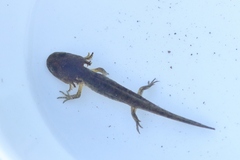
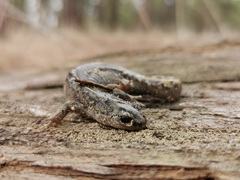
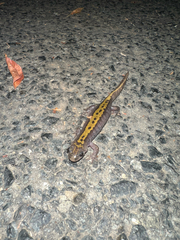
The long-toed salamander (Ambystoma macrodactylum) is a mole salamander in the family Ambystomatidae. This species, typically 4.1–8.9 cm (1.6–3.5 in) long when mature, is characterized by its mottled black, brown, and yellow pigmentation, and its long outer fourth toe on the hind limbs. Analysis of fossil records, genetics, and biogeography suggest A. macrodactylum and A. laterale are descended from a common ancestor that gained access to the western Cordillera with the loss of the mid-continental seaway toward the Paleocene.

The distribution of the long-toed salamander is primarily in the Pacific Northwest, with an altitudinal range of up to 2,800 m (9,200 ft). It lives in a variety of habitats, including temperate rainforests, coniferous forests, montane riparian zones, sagebrush plains, red fir forests, semiarid sagebrush, cheatgrass plains, and alpine meadows along the rocky shores of mountain lakes. It lives in slow-moving streams, ponds, and lakes during its aquatic breeding phase. The long-toed salamander hibernates during the cold winter months, surviving on energy reserves stored in the skin and tail.

The five subspecies have different genetic and ecological histories, phenotypically expressed in a range of color and skin patterns. Although the long-toed salamander is classified as a species of Least Concern by the IUCN, many forms of land development threaten and negatively affect the salamander's habitat. Wikipedia →

Global Distribution

Parks Where Found

# Park Country Daily sighting probability
1 Jasper National Park 🇨🇦 Canada
~10%
2 Glacier National Park 🇺🇸 United States
~10%
3 Banff National Park 🇨🇦 Canada
~10%
4 Olympic National Park 🇺🇸 United States
~10%

Cities Where Found

# City Country Daily sighting probability
1 Seattle 🇺🇸 United States
~10%
2 Portland 🇺🇸 United States
~10%
3 Vancouver 🇨🇦 Canada
<5%

Before you go

What are the chances of seeing a Long-toed Salamander in Olympic National Park?

With luck

About 10% of wildlife watchers report a Long-toed Salamander sighting in Olympic National Park on a given day, based on 10 verified sightings from GBIF citizen-science data from 2019 to 2026. It is the 12th most-seen of the 13 amphibians we can rate there. Over three days the chance rises to about 20%, and over a week to about 30%, if each day is a fresh chance.

When is the best time to see a Long-toed Salamander in Olympic National Park?

March and August–September

In those months about 10% of wildlife watchers report a Long-toed Salamander in Olympic National Park on a given day, against under 5% in April–July and October–February, the lowest months.

What time of day is best to see a Long-toed Salamander?

Between noon and 3 pm

Across all the parks we cover, that three-hour window holds the most Long-toed Salamander sightings with a recorded time, and about 8 in 10 of them come between 6 am and 6 pm: it is a daytime animal.

Is Olympic National Park the best place to see a Long-toed Salamander?

Among the best

Of the 4 parks where we can rate Long-toed Salamander sightings, Olympic National Park ranks 4th at about 10%, level with the leaders once rounded. The best odds are in Jasper National Park (Canada, about 10%), Glacier National Park (United States, about 10%) and Banff National Park (Canada, about 10%).

Where does the Long-toed Salamander sighting chance come from?

GBIF citizen-science records

It is estimated from how often the Long-toed Salamander is recorded against all the amphibians logged in Olympic National Park (10 verified sightings from 2019 to 2026), calibrated against known sighting rates. Figures are rounded to the nearest 10% because citizen-science data supports honest approximations, not decimals, and months with records from fewer than five people show "—". How it works.

← Back to Olympic National Park